

Arab–Israel War - History
Books & Reference In-app purchases Contains ads
Arab Israeli War
- Downloads
- 1+
- on Google Play
- Price
- Free
- In-app purchases
- Updated
- Nov 22
- 2023 · v1.0
Screenshots



About Arab–Israel War - History
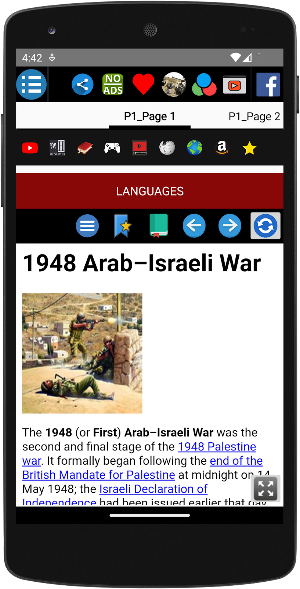
The Arab–Israeli conflict is the intercommunal phenomenon involving political tension, military conflicts, and other disputes between various Arab countries and Israel, which escalated during the 20th century, but had mostly faded out by the early 21st century. The roots of the Arab–Israeli conflict have been attributed to the support by Arab League member countries for the Palestinians, a fellow League member, in the ongoing Israeli–Palestinian conflict; this in turn has been attributed to the simultaneous rise of Zionism and Arab nationalism towards the end of the 19th century, though the two national movements had not clashed until the 1920s.
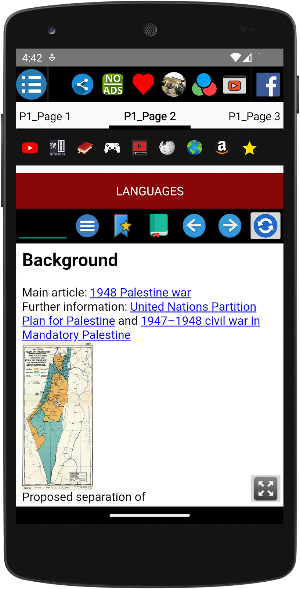
Part of the Palestine–Israel conflict arose from the conflicting claims by these movements to the land that formed the British Mandatory Palestine, which was regarded by the Jewish people as their ancestral homeland, while at the same time it was regarded by the Pan-Arab movement as historically and currently belonging to the Arab Palestinians, and in the Pan-Islamic context, as Muslim lands. The sectarian conflict within the British Mandate territory between Palestinian Jews and Arabs escalated into a full-scale Palestinian civil war in 1947. Taking the side of the Palestinian Arabs, especially following the Israeli Declaration of Independence, the neighbouring Arab countries invaded the by-then former Mandate territory in May 1948, commencing the First Arab–Israeli War. Large-scale hostilities mostly ended with ceasefire agreements after the 1973 Yom Kippur War. Peace agreements were signed between Israel and Egypt in 1979, resulting in Israeli withdrawal from the Sinai Peninsula and the abolition of the military governance system in the West Bank and Gaza Strip, in favor of Israeli Civil Administration and consequent unilateral annexation of the Golan Heights and East Jerusalem.
The nature of the conflict has shifted over the years from the large-scale, regional Arab–Israeli conflict to a more local Israeli–Palestinian conflict, which peaked during the 1982 Lebanon War when Israel intervened in the Lebanese Civil War to oust the Palestinian Liberation Organization from Lebanon. By 1983, Israel reached normalization with Christian-dominated Lebanese government, but the agreement was annulled the next year with Muslim and Druze militias' takeover of Beirut. With the decline of the 1987–1993 First Palestinian Intifada, the interim Oslo Accords led to the creation of the Palestinian National Authority in 1994, within the context of the Israeli–Palestinian peace process. The same year, Israel and Jordan reached a peace accord. In 2002, the Arab League offered recognition of Israel by Arab countries as part of the resolution of the Palestine–Israel conflict in the Arab Peace Initiative. The initiative, which has been reconfirmed since, calls for normalizing relations between the Arab League and Israel, in exchange for a full withdrawal by Israel from the occupied territories (including East Jerusalem) and a "just settlement" of the Palestinian refugee problem based on UN Resolution 194. In the 1990s and early 2000s, a cease-fire had been largely maintained between Israel and Baathist Syria, while limited warfare continued in Lebanon vs Iranian proxy militias. Despite the peace agreements with Egypt and Jordan, the interim peace accords with the Palestinian Authority and the generally existing cease-fire, until the mid-2010s the Arab League and Israel had remained at odds with each other over many issues. Among Arab belligerents in the conflict, Iraq and Syria are the only states who have reached no formal peace accord or treaty with Israel, both however turning to support Iran.
Developments in the course of the Syrian Civil War reshuffled the situation near Israel's northern border, putting the Syrian Arab Republic, Hezbollah and the Syrian opposition at odds with each other and complicating their relations with Israel, upon the emerging warfare with Iran.
Alternatives to Arab–Israel War - History
Looking for apps like Arab–Israel War - History? Here are 6 similar Android apps on Google Play. All of them are free to download.
-
Satanism - History
-
History of Liberia
-
Jewish history
-
Retro Classic Games 500 in 1
-
History of Ancient Egypt
-
Israel - Palestine War History
| App | Rating | Price | Installs | Last updated | Compare |
|---|---|---|---|---|---|
| Arab–Israel War - History | – | Free | 1+ | Nov 22, 2023 | |
| Satanism - History | – | Free | 500+ | Oct 28, 2023 | Compare |
| History of Liberia | – | Free | 100+ | Oct 29, 2023 | Compare |
| Jewish history | – | Free | 50+ | Oct 28, 2023 | Compare |
| Retro Classic Games 500 in 1 | – | Free | 100+ | Oct 28, 2023 | Compare |
| History of Ancient Egypt | – | Free | 100+ | Oct 28, 2023 | Compare |
| Israel - Palestine War History | – | Free | 100+ | Nov 25, 2023 | Compare |
Similar apps on Google Play
- Satanism - History
- History of Liberia
- Jewish history
- Retro Classic Games 500 in 1
- History of Ancient Egypt
- Israel - Palestine War History
- Adolf Hitler - Biography
- Oromo History - Seenaa Oromoo
- History of DR Congo
- Black People History
- History of Afghanistan
- HIV/AIDS
- History of Ethiopia/የኢትዮጵያ ታሪክ
- HIV/AIDS Info
- Gulf War - History
- Arab–Israel War - History
- History of Zimbabwe
- History of Zambia
- History of Yemen
- The Art of War by Sun Tzu
- Diabetes
- As a Man Thinketh -James Allen
- History of Vietnam
- History of Venezuela
- History of Vatican City
- History of Vanuatu
- History of Uzbekistan
- History of US Virgin Islands
- History of Uruguay
- History of the United Kingdom
- History of Gaza
- History of the UAE
- History of Uganda
- History of Tuvalu
- Turks Caicos Islands - History
- History of Turkmenistan
- History of Turkey
- History of Tunisia
- History of Trinidad and Tobago
- History of Tonga
- History of Togo
- History of Thailand
- History of Tanzania
- History of Tajikistan
- History of Taiwan
- History of Syria
- History of Switzerland
- History of Sweden
- History of Suriname
- History of Sudan
- History of Sri Lanka
- History of Spain
- History of South Sudan
- History of South Korea
- History of Solomon Islands
- History of Slovenia
- History of Slovakia
- History of Sierra Leone
- History of Seychelles
- History of Serbia
- History of Senegal
- History of Saudi Arabia
- History of San Marino
- History of Saint Lucia
- Saint Kitts and Nevis History
- Rwanda History -Amateka Rwanda
- History of Russia
- History of Romania
- History of Qatar
- History of Puerto Rico
- History of Portugal
- History of Poland
- History of the Philippine
- History of Papua New Guinea
- History of Panama
- History of Palestine
- History of Palau
- History of Pakistan
- History of Oman
- History of Norway
- Northern Mariana IslandHistory
- Northern Cyprus - History
- History of North Macedonia
- History of North Korea
- History of Norfolk Island
- History of Niue
- History of Nigeria
- History of Niger
- History of Nicaragua
- History of New Zealand
- New Caledonia - History
- History of the Netherlands
- History of Nepal
- History of Nauru
- History of Namibia
- History of Myanmar
- History of Mozambique
- History of Morocco
- Montserrat - History
- History of Montenegro
- History of Mongolia
- History of Monaco
- History of Moldova
- History F States of Micronesia
- History of Mexico
- History of Mauritius
- History of Mauritania
- History of Marshall Islands
- History of Malta
- History of Mali
- History of the Maldives
- History of Malaysia
- History of Malawi
- History of Madagascar
- History of Macau
- History of Luxembourg
- History of Lithuania
- History of Liechtenstein
- History of Earth
- History of Libya
- History of Lesotho
- History of Lebanon
- History of Latvia
- History of Laos
- History of Kyrgyzstan
- History of Kuwait
- History of Kosovo
- History of Kiribati
- History of Kenya
- History of Kazakhstan
- History of Jordan
- History of Jersey
- History of Japan
- History of Jamaica
- History of Italy
- History of Israel
- History of the Isle of Man
- History of Ireland
- Cricket - History
- History of Iran
- History of Indonesia
- History of India
- History of Iceland
- History of Hungary
- History of Hong Kong - 香港史
- History of Honduras
- History of Haiti - Istwa Ayiti
- History of Guyana
- History of Guinea-Bissau
- History of Guinea