

Democracy - History
Books & Reference In-app purchases Contains ads
Democracy
- Downloads
- 10+
- on Google Play
- Price
- Free
- In-app purchases
- Updated
- Feb 21
- 2024 · v1.0
Screenshots




About Democracy - History
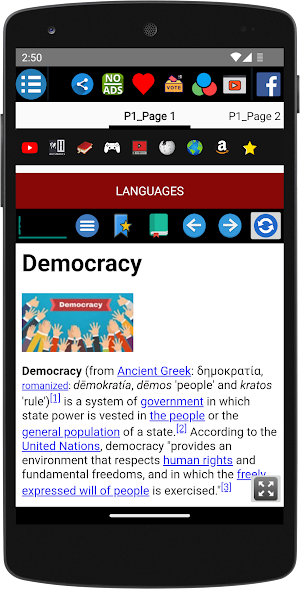
Democracy (from Ancient Greek: δημοκρατία, romanized: dēmokratía, dēmos 'people' and kratos 'rule') is a system of government in which state power is vested in the people or the general population of a state. According to the United Nations, democracy "provides an environment that respects human rights and fundamental freedoms, and in which the freely expressed will of people is exercised."
In a direct democracy, the people have the direct authority to deliberate and decide legislation. In a representative democracy, the people choose governing officials through elections to do so. Who is considered part of "the people" and how authority is shared among or delegated by the people has changed over time and at different rates in different countries. Features of democracy oftentimes include freedom of assembly, association, personal property, freedom of religion and speech, citizenship, consent of the governed, voting rights, freedom from unwarranted governmental deprivation of the right to life and liberty, and minority rights.
The notion of democracy has evolved over time considerably. Throughout history, one can find evidence of direct democracy, in which communities make decisions through popular assembly. Today, the dominant form of democracy is representative democracy, where citizens elect government officials to govern on their behalf such as in a parliamentary or presidential democracy.
Most democracies apply in most cases majority rule, but in some cases plurality rule, supermajority rule (e.g. constitution) or consensus rule (e.g. Switzerland) are applied. They serve the crucial purpose of inclusiveness and broader legitimacy on sensitive issues—counterbalancing majoritarianism—and therefore mostly take precedence on a constitutional level. In the common variant of liberal democracy, the powers of the majority are exercised within the framework of a representative democracy, but the constitution and a supreme court limit the majority and protect the minority—usually through securing the enjoyment by all of certain individual rights, e.g. freedom of speech or freedom of association.
The term appeared in the 5th century BC in Greek city-states, notably Classical Athens, to mean "rule of the people", in contrast to aristocracy (ἀριστοκρατία, aristokratía), meaning "rule of an elite". Western democracy, as distinct from that which existed in antiquity, is generally considered to have originated in city-states such as those in Classical Athens and the Roman Republic, where various schemes and degrees of enfranchisement of the free male population were observed before the form disappeared in the West at the beginning of late antiquity. In virtually all democratic governments throughout ancient and modern history, democratic citizenship was initially restricted to an elite class, which was later extended to all adult citizens. In most modern democracies, this was achieved through the suffrage movements of the 19th and 20th centuries.
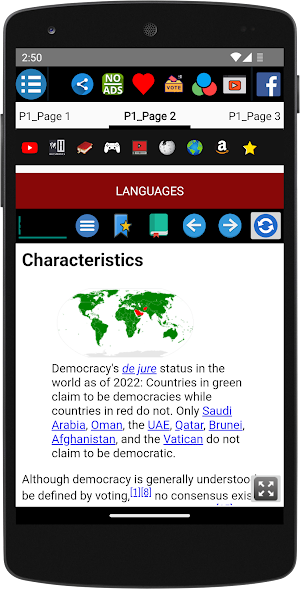
Democracy contrasts with forms of government where power is either held by an individual, as in autocratic systems like absolute monarchy, or where power is held by a small number of individuals, as in an oligarchy—oppositions inherited from ancient Greek philosophy. Karl Popper defined democracy in contrast to dictatorship or tyranny, focusing on opportunities for the people to control their leaders and to oust them without the need for a revolution. World public opinion strongly favors democratic systems of government. According to the V-Dem Democracy indices and The Economist Democracy Index, less than half the world's population lives in a democracy as of 2022. Democratic backsliding with a rise in hybrid regimes has exceeded democratization since the early to mid 2010s.
Alternatives to Democracy - History
Looking for apps like Democracy - History? Here are 6 similar Android apps on Google Play. The highest rated is History of Ancient Egypt (4.0/5), and all 6 are free to download.
-
History of Afghanistan
-
واتس عمر اب الازرق
-
Retro Classic Games 500 in 1 3.3
-
History of Liberia
-
Satanism - History 2.8
-
History of Ancient Egypt 4.0
| App | Rating | Price | Installs | Last updated | Compare |
|---|---|---|---|---|---|
| Democracy - History | – | Free | 10+ | Feb 21, 2024 | |
| History of Afghanistan | – | Free | 100+ | Oct 28, 2023 | Compare |
| واتس عمر اب الازرق | – | Free | 50+ | Dec 31, 2023 | Compare |
| Retro Classic Games 500 in 1 | 3.3 / 5 | Free | 100+ | Oct 28, 2023 | Compare |
| History of Liberia | – | Free | 100+ | Oct 29, 2023 | Compare |
| Satanism - History | 2.8 / 5 | Free | 500+ | Oct 28, 2023 | Compare |
| History of Ancient Egypt | 4.0 / 5 | Free | 100+ | Oct 28, 2023 | Compare |
Similar apps on Google Play
- History of Afghanistan
- واتس عمر اب الازرق
- Retro Classic Games 500 in 1
- History of Liberia
- Satanism - History
- History of Ancient Egypt
- History of the USA
- Israel - Palestine War History
- Jewish history
- Adolf Hitler - Biography
- شات التاج الذهبي
- History of Africa
- Black People History
- HIV/AIDS Info
- History of Sudan
- History of DR Congo
- World War I - History
- History of Cuba
- History of Burkina Faso
- Oromo History - Seenaa Oromoo
- History of Ethiopia/የኢትዮጵያ ታሪክ
- History of Mozambique
- World History
- Russia - Ukraine War - History
- Bible - History
- Ancient Rome History
- History of Ancient Israel
- Ancient History
- Devil - History
- Democracy - History
- Communism - History
- Capitalism - History
- Lionel Messi - Biography
- History of religion
- D-Day History
- History of Ancient Greece
- Gulf War - History
- Arab–Israel War - History
- History of Zimbabwe
- History of Zambia
- History of Yemen
- The Art of War by Sun Tzu
- Diabetes
- HIV/AIDS
- As a Man Thinketh -James Allen
- History of Vietnam
- History of Venezuela
- History of Vatican City
- History of Vanuatu
- History of Uzbekistan
- History of US Virgin Islands
- History of Uruguay
- History of the United Kingdom
- History of Gaza
- History of the UAE
- History of Uganda
- History of Tuvalu
- Turks Caicos Islands - History
- History of Turkmenistan
- History of Turkey
- History of Tunisia
- History of Trinidad and Tobago
- History of Tonga
- History of Togo
- History of Thailand
- History of Tanzania
- History of Tajikistan
- History of Taiwan
- History of Syria
- History of Switzerland
- History of Sweden
- History of Suriname
- History of Sri Lanka
- History of Spain
- History of South Sudan
- History of South Korea
- History of Solomon Islands
- History of Slovenia
- History of Slovakia
- History of Sierra Leone
- History of Seychelles
- History of Serbia
- History of Senegal
- History of Saudi Arabia
- History of San Marino
- History of Saint Lucia
- Saint Kitts and Nevis History
- Rwanda History -Amateka Rwanda
- History of Russia
- History of Romania
- History of Qatar
- History of Puerto Rico
- History of Portugal
- History of Poland
- History of the Philippine
- History of Papua New Guinea
- History of Panama
- History of Palestine
- History of Palau
- History of Pakistan
- History of Oman
- History of Norway
- Northern Mariana IslandHistory
- Northern Cyprus - History
- History of North Macedonia
- History of North Korea
- History of Norfolk Island
- History of Niue
- History of Nigeria
- History of Niger
- History of Nicaragua
- History of New Zealand
- New Caledonia - History
- History of the Netherlands
- History of Nepal
- History of Nauru
- History of Namibia
- History of Myanmar
- History of Morocco
- Montserrat - History
- History of Montenegro
- History of Mongolia
- History of Monaco
- History of Moldova
- History F States of Micronesia
- History of Mexico
- History of Mauritius
- History of Mauritania
- History of Marshall Islands
- History of Malta
- History of Mali
- History of the Maldives
- History of Malaysia
- History of Malawi
- History of Madagascar
- History of Macau
- History of Luxembourg
- History of Lithuania
- History of Liechtenstein
- History of Earth
- History of Libya
- History of Lesotho
- History of Lebanon
- History of Latvia
- History of Laos
- History of Kyrgyzstan
- History of Kuwait
- History of Kosovo
- History of Kiribati
- History of Kenya