

Surah Mujadila (سورة المجــــا
Education Contains ads
Surat Mujadilah "She Who Disputes, The Pleading Woman" is 58th surah of Qur'an
- Downloads
- 100+
- on Google Play
- Price
- Free
- No in-app purchases
- Updated
- Oct 21
- 2021 · v1.0
Screenshots
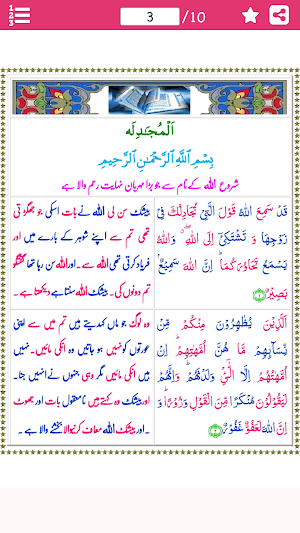



About Surah Mujadila (سورة المجــــا
Surah al-Mujadilah (Arabic: سورة المجادلة, "She Who Disputes, The Pleading Woman") is the 58th chapter (sūrah) of the Qur'an with 22 verses (ayat). Revealed in Medina, the chapter first addresses the legality of pre-Islamic method of divorce called zihar. The name "she who disputes" refers to the woman who petitioned Muhammad about the unjustness of this method, and the chapter's first verses outlaws it and prescribes how to deal with past cases of zihar. The chapter also discusses public assemblies and prescribes manners associated with it. The chapter ends by contrasting what it calls "the confederates of God" and "the confederates of Satan" and promising rewards for the former.
Revelation history:
According to the Islamic tradition, the chapter was revealed during the Medinan period of Muhammad's prophethood, therefore, a Medinan sura. A minority opinion says that only the first ten verses were from the Medinan period, and the rest were from the Meccan period. Another minority opinion says that verse 9 was from the Meccan period, and the rest Medinan.
Both traditional and modern scholars of the Quran date the revelation of the chapter to between 4 AH to 7 AH (roughly 625–628 CE), likely after the Battle of the Trench. The Muslim community was in Medina under the leadership of Muhammad, under threat from the Quraysh tribe in Mecca and from the intrigues of "the hypocrites" (munafiqun, those who were outwardly Muslim but secretly opposed the Muslims) and the Jewish tribes in Medina. The Constitution of Medina acts as a constitution for this community, and the Quran—regarded as divine revelations by the Muslims—provided the law, and Muhammad acts as the final authority in interpreting the law and adjudicating disputes among the members of the community.
"She who disputes"
The first section (verses 1 to 6) was revealed in response to a juridical petition by a Muslim woman named Khaula bint Tha'laba, whom the chapter name refers to. Her husband, a Muslim man named Aws ibn al-Samit, divorced her using the pre-Islamic Arabian custom of zihar. According to the custom, when a husband invoked the declaration "You are to me as my mother's back", the husband would be free to remarry and released from his obligation towards his wife, while the wife could not remarry. This practice was not isolated and many new converts to Islam used it in Medina.
Khaula considered this practice unfair to woman and petitioned Muhammad, as ruler and judge in Medina, to revoke the divorce, using moral and legal arguments. Muhammad initially declined to rule in her favor, citing the existing social custom and the lack of Quranic revelation to the contrary. According to the Islamic tradition, Khaula prayed to God about her predicament, and then God revealed the first six verses of Al-Mujadila to Muhammad, stating that her prayer was heard, overruling Muhammad and effectively outlawing the practice of zihar.
The chapter is named Al-Mujadila, "she who disputes", in reference to Khawla bint Tha'laba whose petition was the occasion of revelation for some of the chapter's verses. It is alternatively called Al-Mujadalah, a related word meaning "the dialogue", referring to the use of discourse and the dialectical method that is an important theme in the chapter.
i) If a person recites surah al Hadid and surah al Mujadilah in his obligatory salats (salah / namaz / solat / salat / salaah / salaat) regularly Allah would not punish him so long as he lives in this world; neither he nor his family would face any trouble or worry, nor he would be afflicted with a detestable disease.
ii) Whoso recites this surah would get deliverance on the day of judgement.
iii) If any valuabel article or document is kept or buried in safe place recite this sura.
User reviews

MP3 player surah. Almugadila
Alternatives to Surah Mujadila (سورة المجــــا
Looking for apps like Surah Mujadila (سورة المجــــا? Here are 6 similar Android apps on Google Play. All of them are free to download.
-
40 Hadith An-Nawawi - الأربعون
-
دعائے قنوت - نمازِ وتر
-
Noorani Qaida in Pashto (پښتو)
-
فالنامہ
-
الدعاء ويليه العلاج بالرقى
-
Umrah Ki Adaigi Ka Asan Tarika
| App | Rating | Price | Installs | Last updated | Compare |
|---|---|---|---|---|---|
| Surah Mujadila (سورة المجــــا | – | Free | 100+ | Oct 21, 2021 | |
| 40 Hadith An-Nawawi - الأربعون | – | Free | 1,000+ | Dec 3, 2021 | Compare |
| دعائے قنوت - نمازِ وتر | – | Free | 100+ | Jan 4, 2022 | Compare |
| Noorani Qaida in Pashto (پښتو) | – | Free | 100+ | Jul 16, 2022 | Compare |
| فالنامہ | – | Free | 50+ | Jan 31, 2022 | Compare |
| الدعاء ويليه العلاج بالرقى | – | Free | 10+ | Oct 30, 2022 | Compare |
| Umrah Ki Adaigi Ka Asan Tarika | – | Free | 100+ | Mar 23, 2022 | Compare |
Similar apps on Google Play
- 40 Hadith An-Nawawi - الأربعون
- دعائے قنوت - نمازِ وتر
- Noorani Qaida in Pashto (پښتو)
- فالنامہ
- الدعاء ويليه العلاج بالرقى
- Umrah Ki Adaigi Ka Asan Tarika
- Hazrat Imam Hussain 100 Qissay
- Dua e Hajat Urdu دعائے حاجات
- دعائے گنج العرش بمع اردو ترجمہ
- Hajj o Umrah - حج و عمرہ
- Maut ka Manzar - موت کا منظر
- Learn Computer in 7 Days URDU
- Sugar Ka Ilaj - شوگر کا علاج
- Learn Photoshop in URDU
- Interview Tips - انٹرویو ٹپس
- Learn InPage in URDU - اِن پیج
- Allama Iqbal & Falsafa e Hayat
- Ghussay Ka Ilaj - غصے کا علاج
- Zaitoon Se Ilaj زیتون سے علاج
- Beauty Tips in Urdu -بیوٹی ٹپس
- Cholesterol Se Nijaat
- Urdu Muhavare aur Kahanyian
- Remove Pimples Acne in 1 Week
- Qasida Al-Burda Poem of Mantle
- Qaseed Burda Shareef with URDU
- Job Search Tips in URDU ملازمت
- Exam & Paper Solving Tips URDU
- Talaq Khula Aur Iddat K Masail
- Masjid Ke Adaab - مسجد کے آداب
- 6 Fundamentals of Islam in Eng
- Khatam e Nabuwat Course Urdu
- Tafsir Ibne Abbas Part-1 Urdu
- Benefits of Ya Qahhar -يا قهار
- General Knowledge in Urdu -CSS
- Qurbani ke Masail مسائل قربانی
- Rehmat Da Khazana پنجابی نعتاں
- Sassi Punnu - Urdu Love Story
- Laila Majnu - Urdu Love Story
- Tareekh Ibn Kaseer Part-2 URDU
- Tareekh Ibn Kaseer Part-1 URDU
- Saltanat e Usmania in Urdu
- Hazrat Imam Hassan 100 Waqiat
- Nafal Namaz نفل نماز ki Barkat
- Adhan with English Translation
- Maa Ka Muqam - ماں کا مقام
- Jawani Ki Barbadi+Roohani Ilaj
- Sahih Namaz e Nabavi نماز نبوی
- Rahnuma e Tableeghi Safar 6 No
- Hazrat Usman r.a Ke 100 Qissay
- Ghusal Ke Masail -غسل کے مسائل
- Musafir Ki Namaz مسافر کی نماز
- Surah Al Mudassir Urdu Tafsir
- Surah Muzammil Urdu Tafsir
- Surah Mulk Urdu Terjuma Tafsir
- Surah Rahman Terjuma o Tafsir
- Surah Yaseen -Terjuma o Tafsir
- Janat Mein Le Janay Walay Amal
- Aaqa Ka Mahina || آقا کا مہینہ
- Darood Sharif Ke Fazail - درود
- Khilafat o Malookiat - Maududi
- Karbala کربلا Ka Khooni Manzar
- Mutah - Fiqa Jafria Ke Mutabiq
- Shajra e Nasab - شجرہِ نسب
- Tohfa e Shadi - تحفۂ شادی
- Madani Qaida Bangla - Tajweed
- Madani Qaida Hindi - Tajweed
- Story of Hazrat Ayub in Urdu
- Biography of Hazrat Yunus Urdu
- Hazrat Ibrahim (R.A) Ka Qissa
- Hazrat Ayesha ra Ke 100 Qissay
- Hazrat Nuh (نوح) A.S Ka Qissa
- Kalonji Se Ilaj کلونجی سے علاج
- Hazrat Lut (لوط) A.S Ka Qissa
- Hazrat Fatima r.a Ke 100 Qisay
- 17 Wazaif Se Zindagi Asaan
- Surat Mulk Se Mushkilat Ka Hal
- Surat Inam Se Mushkilat Ka Hal
- Surah Quraish Ke Karishmat
- Surat Baqarah Se Mushkilat Hal
- Surat Kausar کوثر Ke Karishmat
- Surat Kafiroon - Mushkilat Hal
- Surat Fateha+Ikhlas -Karishmat
- Ism e Azam Se Mushkilat Ka Hal
- 4 Qul Se Mushkilat Ka Hal Urdu
- Bismillah Se Mushkilat Ka Hal
- Hakeem Luqman Ki 50 Naseehaten
- Lazzat e Zikr - لذتِ ذکر
- Badnazri بد نظری K 14 Nuqsanat
- Dua Qubool Na Hone Ki Wajuhat
- Nad e Ali se Mushkilat Ka Hal
- Miswak K Faiday مسواک کے فضائل
- Hakeemi Nuskhe - حکیمی نسخے
- Pyare Rasoolﷺ Ki Peshangoyian
- Gharelu Ilaj -Desi Totkay Urdu
- Subah o Sham Ke Azkar - Dua'in
- Maloomat e Quran - Islami Quiz
- Hazrat Khizar (A.S) Ka Qissa
- Faizan e Jumma - فیضانِ جمعہ
- Pyare Nabi(PBUH) ki Sunnatain
- Biography of Hazrat Suleman AS
- Hazrat Yousuf Ka Qissa in Urdu
- Bal e Jibreel by Allama Iqbal
- Namaz e Taraweeh - 20 Rakat
- Shehad se Har Bemari Ka Ilaj
- Aulad Ke Liye Duain (دعائیں)
- Namaz e Janaza Ka Tarika Urdu
- Qaza Namaz Ka Tarika -قضا نماز
- Aurton Ki Namaz عورتوں کی نماز
- Hifazat Ki Duain حفاظتی دعائیں
- Itikaf اعتکاف Ke Amal o Wazaif
- Ibadat e Ramzan-ul-Mubarak
- Laylatul Qadr شب قدر کی عبادات
- A Dua a Day - Ramadan Calendar
- Zakat (زکوٰۃ) Ke Haqdar Kon?
- Namaz of Females and Mistakes
- Sajda Sahw Ke Masail سجدہ سہو
- Salatul Tasbih - صلوٰۃ التسبیح
- Wuzu Aur Science وضو اور سائنس
- Namaz Main Luqma Kay Masail
- Namaz e Witr (وتر) + tahajjud
- Bachon Ki Namaz - بچوں کی نماز
- Namaz e Hanafi Ka Sahih Tariqa
- Gunahon Ka Ilaj گناہوں کا علاج
- Faizan e Tajveed - فیضان تجوید
- 40 Ahadees Terjuma + Tashreeh
- Hadees Ki Duain
- Islami Wazaif -650 Masnoon Dua
- Ahkam e Parda - Quran o Sunnat
- Anmol Moti - Aqwal e Zareen
- Kahaniyon Ki Duniya - کہانیاں
- Astrology in Urdu - علمِ نجوم
- Horoscope and Stars in Urdu
- 40 Astaghfar - چہل استغفار
- Darood e Ibrahimi درود ابراہیم
- Hazrat Awais Qarni (R.A)
- Sood Kia Hai? (سود کیا ہے؟)
- Waldain Ke Huqooq
- Pull Siraat پُل صراط کی دہشت
- Hirz e Azam -جادو ٹونے کا علاج
- Islam Kya Hai - اسلام کیا ہے
- Haqooq Ul Zojain
- Tajdeed e Iman and Nikah
- Jadu Tona Ka Ilaj
- Hikmat Aur Danayi Ki Baatein
- Dua Qunoot Bangla Translation
- Aafat e Nazar Aur Un Ka Ilaj
- میت کے غسل کا اسلامی طریقہ
- Dua e Qunoot Word for Word
- Ameer Taimoor in Urdu
- Yousaf Bin Tashfeen in Urdu