Opashka: Queue Wait Times
See broad queue wait ranges and closing chances from two-tap crowd signals.
About Opashka: Queue Wait Times
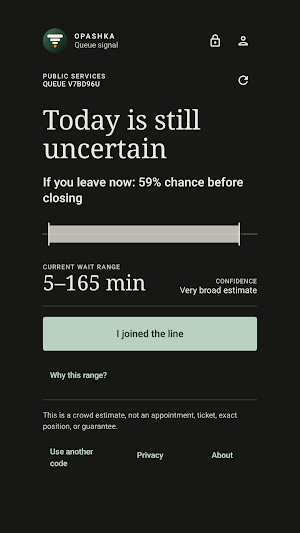
Opashka helps you decide whether to travel to an uncertain physical queue. Open a seven-character queue signal to see a broad wait interval, the chance of being served before closing, and a lighter hour for tomorrow when enough reports exist.
It is designed for essential in-person lines that have no operator app, ticket machine, or published wait data. People standing in the same line contribute two structured actions: "I joined the line" and "I was served." The result is one shared estimate without names, comments, ratings, photos, or public profiles.
KEY FEATURES
- Read a current wait range instead of a fragile exact time
- See the chance of being served before the line closes
- Check a potentially lighter hour for tomorrow when history supports it
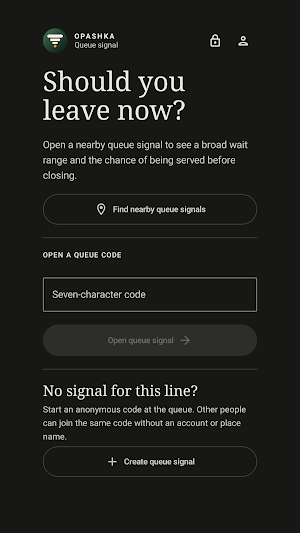
- Open a queue with a short code or discover nearby signals
- Start a neutral queue signal without entering a place or staff name
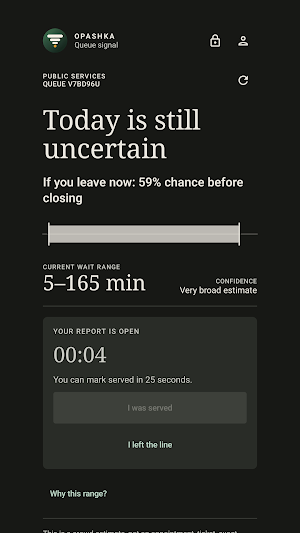
- Add a joined report with one tap and a served report with one more tap
- Record leaving the line without treating it as a completed service
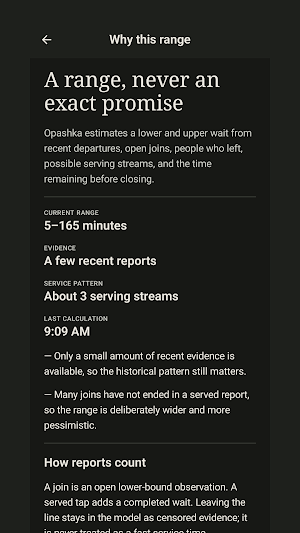
- Read the reasons behind a broad, sparse, or recently changed estimate
- View the last saved estimate when the live service cannot be reached
- Keep pending reports in a bounded on-device outbox until the connection returns
- Use layouts built for phones and tablets with scalable text and labeled controls
HOW THE SIGNAL WORKS
A join begins an open observation. A served tap adds a completed wait. If someone leaves, that wait remains censored evidence rather than becoming a falsely short service time. Recent reports help infer the current departure pace, possible serving streams, and changes such as a counter opening or closing.
Reports from one installation have bounded influence. A sudden pace change discounts older observations. With only a few reports, category history provides a deliberately broad starting interval and the screen explains why confidence is limited.
WHY OPASHKA SHOWS A RANGE
Physical lines can change quickly, and not everyone reports the outcome. A single exact number would hide that uncertainty. Opashka instead shows lower and upper wait bounds, a plain-language confidence label, and an uncertainty band that grows wider when the evidence is sparse or heavily censored.
LOCATION AND DATA
Approximate location is requested only while using nearby discovery, creating a signal, joining, or marking served. The app converts the fix into a broad area cell. Exact coordinates are not sent to the queue service or written to its database.
The device creates a P-256 signing key in Android Keystore. Signed requests help limit replay and repeated influence without an account. Public reads return combined queue estimates only; individual reports are never displayed.
You can delete this installation's raw reports and local data from the Privacy screen. The app also explains retention periods, service providers, and the optional feedback flow before you choose to use them.
WHEN THE CONNECTION IS WEAK
A saved estimate remains visible with its age clearly labeled. A joined, served, or left-line action can wait locally for a constrained retry. The app never labels saved data as live, and duplicate retries use the same request identity.
IMPORTANT LIMITS
Opashka is a crowd estimate, not an appointment, ticket, exact place in line, or service promise. It does not identify an institution or its staff. Use the displayed range as one input when deciding whether and when to travel.
SUPPORT
Questions or feedback: [email protected]
Similar Apps

RawiLoom: Hadith Study
Trace narrator chains, compare hadith versions, and join live study circles.
Pwyso: Livestock Weight
Estimate livestock weight ranges from synchronized photos on two nearby phones.

Punutis: Herd Kinship
Weave cattle memories into an ancestry braid before choosing a pairing.

Punctra: Transit Reliability
Compare live departure odds and protect trips with evidence-backed alerts.

Opashka: Queue Wait Times
See broad queue wait ranges and closing chances from two-tap crowd signals.

Muyara: Live Class Sessions
Run live classroom checks where every student can answer and ask for help.
