

Ohm's Law Calculator
Education Contains ads
Calculate voltage, current, and resistance with Ohm's Law Calculator
- Downloads
- 551+
- on Google Play
- Price
- Free
- No in-app purchases
- Updated
- Jul 18
- 2025 · v1.0.3
Screenshots
About Ohm's Law Calculator
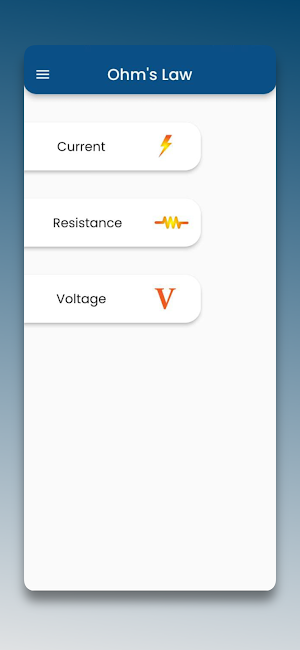
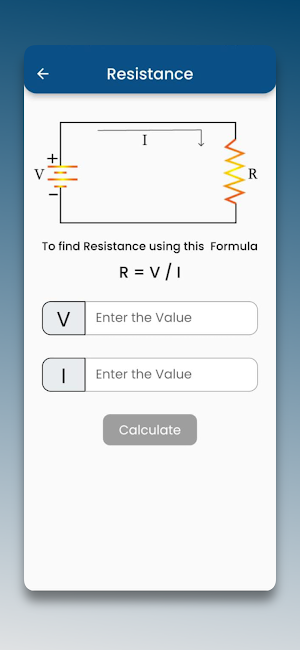
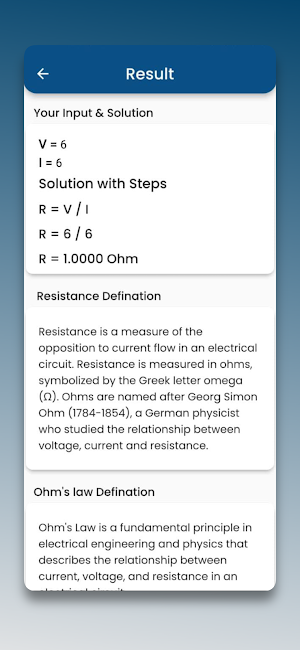
Ohm's Law Calculator is a simple and easy-to-use tool that helps you calculate voltage, current, and resistance according to Ohm's Law.
The Ohm's Law Calculator performs calculations based on Ohm's Law, which states that the current flowing through a conductor is directly proportional to the voltage applied across it and inversely proportional to its resistance. Simply input any two values (voltage, current, or resistance), and the app will instantly compute the missing value, making complex calculations a breeze.
Why use Ohm's Law Calculator?
Ideal for students, engineers, and hobbyists
Helps you understand the relationship between voltage, current, and resistance
Precise and accurate calculations
Free to download and use
Frequently Asked Questions (FAQ) about Ohm's Law
What is Ohm's Law?
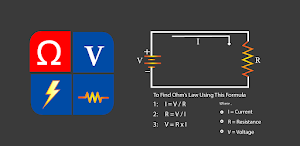
Ohm's Law is a basic law of electricity that states that the voltage across a conductor is directly proportional to the current flowing through it, provided all physical conditions and temperatures remain constant. Mathematically, this current-voltage relationship is written as,
V = IR
where V is the voltage across the conductor, I is the current flowing through it, and R is the resistance of the conductor.
What is the unit of resistance?
The unit of resistance is the ohm (Ω). One ohm is defined as the resistance of a conductor that allows one ampere of current to flow when one volt of potential difference is applied across it.
What are the limitations of Ohm's Law?
Ohm's Law is a basic law of electricity, but it does have some limitations. For example, Ohm's Law does not apply to non-linear devices, such as transistors and diodes. Additionally, Ohm's Law does not take into account the effects of temperature on resistance.
What are some applications of Ohm's Law?
Ohm's Law can be used to calculate the voltage, current, or resistance in an electrical circuit. It can also be used to design and troubleshoot electrical circuits.
What are some common mistakes people make when using Ohm's Law?
Some common mistakes people make when using Ohm's Law include:
Forgetting to consider the effects of temperature on resistance
Using Ohm's Law to calculate the voltage, current, or resistance in a non-linear device
Not understanding the limitations of Ohm's Law
How can I learn more about Ohm's Law?
There are many resources available to learn more about Ohm's Law. You can find books, articles, and websites that explain Ohm's Law in detail. You can also find online calculators that can help you calculate the voltage, current, or resistance in an electrical circuit.
User reviews

Best application for Ohm's Law. i can easily calculate Ohm's law using current, voltage & resistance.

Nice app

Ohms law calculator is powerful and reliable tool that simplifies ohm's Law calculations. It's user friendly interfaces ,accurate calculations,versatility,and ongoing support from the developers make it essential applications for everyone involved in electrical engineering or electronics. Whether you're a student,pr...

As a student of mathematics and physics I can say that this app an excellent tool for calculating relationship between Current, Voltage, Resistance and power in simple Resistive Circuits....

Ohm's Law Calculator Best application for calculating 0hm law with voltage current and resistance with diagram representation❤

This app is very intresting and helpful app i like it you all are must try it ...due to this app we solve our mathematical questions✨
Alternatives to Ohm's Law Calculator
Looking for apps like Ohm's Law Calculator? Here are 6 similar Android apps on Google Play. All of them are free to download.
-
Integral calculator with steps
-
Double Integral Calculator
-
Random Generator
-
TDEE Calculator
-
Image To Text
-
Number System Converter
| App | Rating | Price | Installs | Last updated | Compare |
|---|---|---|---|---|---|
| Ohm's Law Calculator | – | Free | 500+ | Jul 18, 2025 | |
| Integral calculator with steps | – | Free | 10,000+ | Jul 16, 2025 | Compare |
| Double Integral Calculator | – | Free | 5,000+ | Oct 8, 2025 | Compare |
| Random Generator | – | Free | 1,000+ | Jul 17, 2025 | Compare |
| TDEE Calculator | – | Free | 500+ | Aug 30, 2026 | Compare |
| Image To Text | – | Free | 100+ | – | Compare |
| Number System Converter | – | Free | 100+ | Jul 20, 2025 | Compare |
Similar apps on Google Play
- Integral calculator with steps
- Double Integral Calculator
- Random Generator
- TDEE Calculator
- Image To Text
- Number System Converter
- Word Counter
- Triple Integral Calculator
- Series Parallel Calculator
- Proportion Calculator
- Ohm's Law Calculator
- Rounding Calculator
- Factorial Calculator
- Arc Length Calculator
- Grams to Moles Calculator
- Pythagorean Theorem Calculator
- Slope Calculator
- Chemical Equation Balancer App
- Blood Type Calculator
- Factor Calculator
- Z Score Calculator
- Limit Calculator with Steps
- Derivative Calculator Solver