
Proportion Calculator
Education Contains ads
Calculate proportions quickly and easily with our Proportion Calculator.
- Downloads
- 423+
- on Google Play
- Price
- Free
- No in-app purchases
- Updated
- Jul 16
- 2025 · v1.0.2
Screenshots

About Proportion Calculator
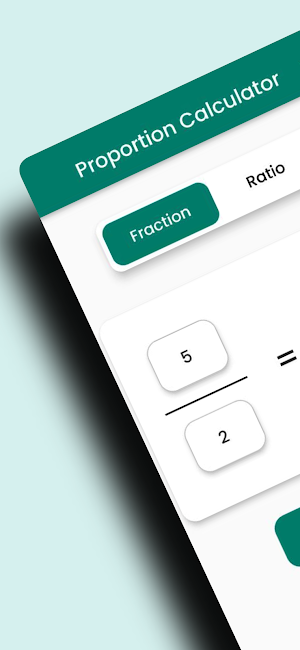
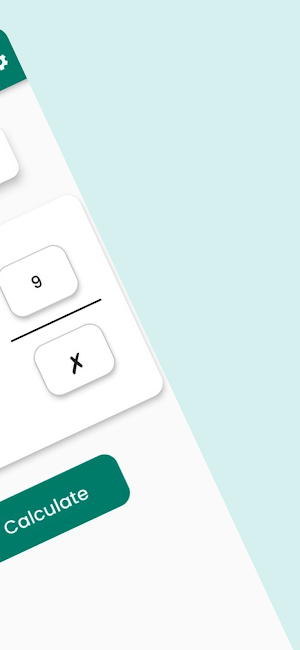
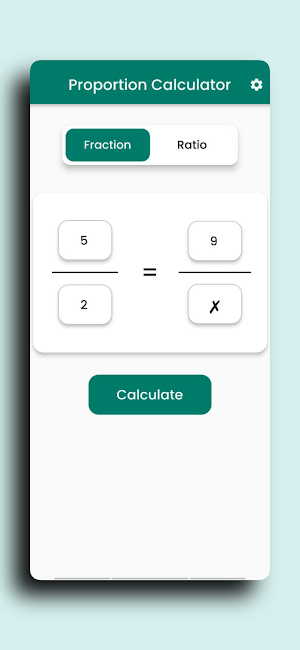
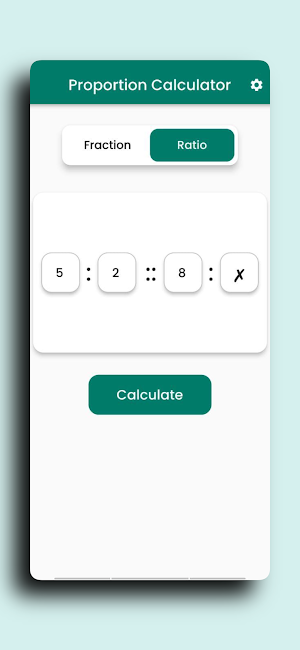
Proportion Calculator helps users to find the value of X in a proportion of two ratios. It does so by providing labeled steps that explain the process in detail. This helps users to understand proportions more deeply.
Here are some key properties of proportions:
Symmetry Property
If two proportions, a:b = c:d and c:d = a:b, are given, then the first and fourth terms (a and d) are called extremes, while the second and third terms (b and c) are called means. The symmetry property states that the interchange of extremes and means does not change the proportion's validity.
Product Property
The product property states that if two proportions, a:b = c:d and c:d = e:f, are given, then the product of the extremes (a and d) is equal to the product of the means (b and c). Mathematically, ad = bc and cd = ef.
Reciprocal Property
The reciprocal property states that if a:b = c:d, then its reciprocal proportion is b:a = d:c. This property allows for the interchange of numerator and denominator without affecting the proportionality.
Addition and Subtraction Properties: Proportions can be added or subtracted. If a:b = c:d and e:f = g:h, then their sums or differences are also in proportion. For example, a:b + e:f = c:d + g:h and a:b - e:f = c:d - g:h.
Cross-Multiplication Property
The cross-multiplication property is commonly used to solve proportion problems. If a:b = c:d, then the product of the means (b and c) is equal to the product of the extremes (a and d). Mathematically, ad = bc.
These properties allow for the manipulation and simplification of proportions, making them useful in various mathematical calculations and problem-solving scenarios.
Frequently Asked Questions (FAQ) about Proportion
Q: What is a proportion?
A: A proportion is a statement that two ratios or fractions are equal.
Q: How do I solve a proportion?
A: To solve a proportion, you can use cross multiplication or scaling. Cross multiplication involves multiplying the extremes and means of the proportion to find the unknown value. Scaling involves multiplying or dividing all terms of the proportion to maintain its equality.
Q: Can proportions be used in real-life situations?
A: Yes, proportions are widely used in real-life situations. They are used in scaling recipes, calculating discounts, determining similar shapes in geometry, analyzing financial ratios, and many other applications.
Q: What if the terms in a proportion have different units?
A: Proportions can still be used even if the terms have different units. In such cases, you may need to convert the units to ensure compatibility before solving the proportion.
Q: Are proportions reversible?
A: Yes, proportions are reversible. Swapping the terms of a proportion maintains its equality. This means you can interchange the known and unknown values and still obtain a valid proportion.
Q: Can proportions have more than two terms?
A: Yes, proportions can have multiple terms. However, the fundamental principle of equality between the ratios or fractions remains the same.
Q: Are there any shortcuts to solve proportions?
A: One shortcut to solve proportions is to reduce the fractions involved to their simplest form before performing calculations. This can simplify the process and make it easier to solve proportions.
Q: How can I apply proportions in real-world scenarios?
A: Proportions can be applied in various real-world scenarios, such as calculating the equivalent value of currency exchange rates, determining the proper mixing ratios in cooking or mixing chemicals, and analyzing data relationships in scientific experiments or surveys.
User reviews

This is best app

Proportion can also be used to solve problems in both types fraction and ratio. With so many proportion calculator applications available onthe store but this one is best🙂
Alternatives to Proportion Calculator
Looking for apps like Proportion Calculator? Here are 6 similar Android apps on Google Play. All of them are free to download.
-
Double Integral Calculator
-
Random Generator
-
TDEE Calculator
-
Image To Text
-
Number System Converter
-
Word Counter
| App | Rating | Price | Installs | Last updated | Compare |
|---|---|---|---|---|---|
| Proportion Calculator | – | Free | 100+ | Jul 16, 2025 | |
| Double Integral Calculator | – | Free | 5,000+ | Oct 8, 2025 | Compare |
| Random Generator | – | Free | 1,000+ | Jul 17, 2025 | Compare |
| TDEE Calculator | – | Free | 500+ | Aug 30, 2026 | Compare |
| Image To Text | – | Free | 100+ | – | Compare |
| Number System Converter | – | Free | 100+ | Jul 20, 2025 | Compare |
| Word Counter | – | Free | 100+ | Jul 19, 2025 | Compare |
Similar apps on Google Play
- Double Integral Calculator
- Random Generator
- TDEE Calculator
- Image To Text
- Number System Converter
- Word Counter
- Triple Integral Calculator
- Series Parallel Calculator
- Proportion Calculator
- Ohm's Law Calculator
- Rounding Calculator
- Factorial Calculator
- Arc Length Calculator
- Grams to Moles Calculator
- Pythagorean Theorem Calculator
- Slope Calculator
- Chemical Equation Balancer App
- Blood Type Calculator
- Factor Calculator
- Z Score Calculator
- Limit Calculator with Steps
- Derivative Calculator Solver
- Integral calculator with steps