

STATES MIDI
Ted Fransson Music iPad
STATES MIDI is a paid Music app for iPad by Ted Fransson. Rated 5.0/5 from 2 ratings. Requires iOS 17.0. Updated November 14, 2026.
- Rating
- 5.0
- 2 ratings
- Price
- 7.99 USD
- on the App Store
- Size
- 8 MB
- Age 4+
- Updated
- Nov 14
- 2026 · v1.1.0
Screenshots
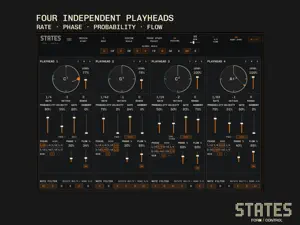

About STATES MIDI
STATES is a four-playhead MIDI sequencer that lets you work with notes, rhythm and time without having to program every event individually. Each playhead can have its own rate, note selection, phase, flow, probability, harmony, register and dynamics, while sharing a common root, scale and transport. The four playheads can work independently or interact with one another, creating anything from simple repeating patterns to more complex musical structures that change over time. NOTE FILTER determines which notes each playhead can use, while ROTATE changes where it begins within that selection. PHASE changes when notes occur within a rhythmic cycle. Select multiple phase positions and use DIR + or − to control the direction of movement between them. FLOW works over longer phrases of up to four bars, introducing changes that unfold beyond a single measure. HARMONY connects the playheads, allowing their note choices to influence one another. Keyboard Mode lets you change the available notes from an external MIDI keyboard while the sequencer is running. Most controls can be automated from your AUv3 host, allowing changes in rate, probability, level, phase, flow, note selection and other parameters to become part of the composition. STATES can be used with a single instrument or up to four separate instruments, with MIDI outputs 1–4 allowing you to route and combine the playheads however you like. KEY FUNCTIONS * Four independent playheads * Independent RATE, NOTE FILTER, PHASE, FLOW and HARMONY per playhead * Rotatable NOTE FILTERS * Selectable PHASE positions and phase pools * FLOW across 1–4 bar phrases * Per-playhead PROBABILITY * Independent OCTAVE and RANGE * VELOCITY and GATE control * Independent LEVEL, MUTE and SOLO * Keyboard Mode for external MIDI control * Global ROOT and SCALE system * Multiple included scales and CUSTOM scale * Configurable time signatures * Host sync and internal clock * Extensive AUv3 host automation * Copy and paste between playheads * Nine appearance profiles STATES does not produce sound on its own. Load it as an AUv3 MIDI processor in a compatible host and route its MIDI output to your instruments.
What’s new
Version 1.1.0 · Updated November 14, 2026
STATES 1.1.0 introduces a new appearance, expanded rhythmic possibilities and improvements to musical control. • Added STUDIO / GRAPHITE, a new dark appearance profile with refined contrast and individual playhead panels. GRAPHITE is now the default appearance for new instances. • Appearance is now independent of presets. Switching presets or loading INIT no longer changes your selected colour profile. • Updated the app icon and visual identity. • Added five TRIPLET RATE values, fully integrated with PHASE, FLOW and AUv3 automation. • Improved NOTE FILTER alignment across all four playheads. • Corrected ROTATE octave mapping for more accurate pitch placement. • Improved slider precision for finer parameter adjustments and more reliable values. • Refined the HOST and pulse indicators in GRAPHITE. • Updated the built-in reference guide.
App privacy
The developer, Ted Fransson, reported these privacy practices to Apple.
Data Not Collected
The developer does not collect any data from this app.
Alternatives to STATES MIDI
Looking for apps like STATES MIDI? Here are 6 similar apps on the App Store. The highest rated is WaveStack Modulate - LFO (5.0/5), and 1 of the 6 are free to download.
-
 WaveStack Modulate - LFO
5.0
-
 Sinusoidal Run Rhythm
-
 STPZMX Synth
5.0
-
 SM-1: Semi-modular synth
5.0
-
 Atavism: Cinematic Pad Effect
5.0
-
 FreezeKeys
5.0
| App | Rating | Price | Last updated | Compare |
|---|---|---|---|---|
| STATES MIDI | 5.0 / 5 (2 ratings) | 7.99 USD | November 14, 2026 | |
| WaveStack Modulate - LFO | 5.0 / 5 (2) | Free | Nov 10, 2026 | Compare |
| Sinusoidal Run Rhythm | – | 14.99 USD | Nov 4, 2026 | Compare |
| STPZMX Synth | 5.0 / 5 (1) | 9.99 USD | Nov 19, 2026 | Compare |
| SM-1: Semi-modular synth | 5.0 / 5 (1) | 9.99 USD | Nov 19, 2026 | Compare |
| Atavism: Cinematic Pad Effect | 5.0 / 5 (1) | 4.99 USD | Nov 3, 2026 | Compare |
| FreezeKeys | 5.0 / 5 (1) | 2.99 USD | Nov 13, 2026 | Compare |
Compare STATES MIDI with the top alternatives: ratings, updates, ASO score and keyword gaps →