

Agenda Simulator
Nikola Sretenovic Education iPhoneiPadiPod touchMac
Agenda Simulator is a free Education app for iPhone and iPad by Nikola Sretenovic. Requires iOS 17.0. Updated August 26, 2026.
- Price
- Free
- on the App Store
- Size
- 2 MB
- Age 4+
- Updated
- Aug 26
- 2026 · v1.1
Screenshots



About Agenda Simulator
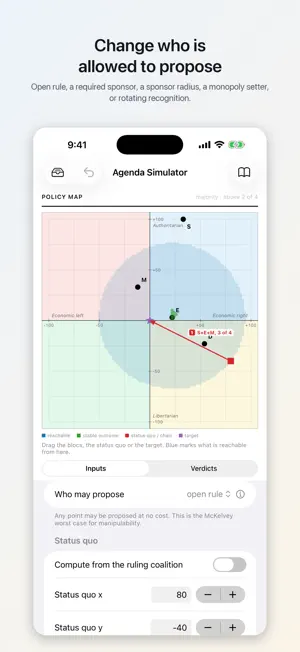
Agenda Simulator turns spatial voting theory into something you can see and touch. Place the blocs on a policy map, say what the voting rule is, pick a target, and the app tells you whether an agenda setter can get there from today's policy, in how many votes, and which coalition carries each one. It is a teaching tool. Every verdict comes with the reasoning, the numbers behind it, and an honest statement of what the model does not know. WHAT IT ANSWERS - Can a majority be walked from today's policy to a given position? - What is the exact sequence of proposals that does it? - Which coalition carries each vote, and by what margin? - Is there a core, a position nothing can beat? Then chaining is dead. - Who really holds power? Banzhaf shares show that weight and power come apart. - How fragile is the rule? The Nakamura number says whether chaos is possible. WHAT YOU CONTROL - Up to 8 blocs, each with a position and a voting weight - Simple majority or two-thirds supermajority - Who is allowed to propose: anyone, within a radius of a sponsor, a monopoly setter in the Romer-Rosenthal sense, or blocs recognised in rotation - The status quo, typed, dragged, or computed from the coalition in government - The target you are aiming at, used by the open and sponsor modes. The monopoly setter and rotating recognition ignore it and follow the proposers' own interests - Policy feedback, in the open and sponsor modes: let each enacted agenda pull opinion toward it, then watch a plan that worked on paper stop working, because the blocs that were going to carry the next vote have already been pulled toward what you just enacted. In the default scenario it breaks at the second vote. The monopoly setter and rotating recognition run a mechanism forward instead of walking a plan to a target, so there is nothing there for drift to break WHAT IS IN LEARN A glossary of every term on screen, an explanation of how to read the map and the verdict, the reason unreachable does not mean impossible, four ready-made examples including the 5-voter McKelvey construction, and a plain statement of what the model leaves out. BUILT ON THE ACTUAL THEORY McKelvey's chaos theorem, Plott's symmetry conditions, the Romer-Rosenthal setter, Baron-Ferejohn recognition, the Nakamura number, Banzhaf power, the core and the yolk. The engine is checked against a reference implementation point by point. APPLE INTELLIGENCE On a supported device, describe a situation in words and the app suggests the two disagreements that best separate the positions, then names the axes for you. It also suggests where a bloc or a policy sits, calibrated against what you have already placed. Suggestions are starting points you can drag. AGENDA SIMULATOR PRO The app is free to use and to teach with. Every built-in example, every voting rule, every proposal-rights mode and the whole Learn section are free, with no limits and no ads. Pro adds saving your own scenarios and the Apple Intelligence assistants: 1 week free, then 19.99 a month, 39.99 for 6 months, or 59.99 a year. If you cancel, scenarios you have already saved stay on your device and stay readable. PRIVACY No account, no analytics, nothing collected. The only network the app uses is Apple's, to handle the subscription. Scenarios are saved on your device, and Apple Intelligence runs on-device. HONEST LIMITS Voters are sincere and myopic, the setter has perfect knowledge, votes are costless, and the policy space is two dimensions. Reachable verdicts are exact. Unreachable and core verdicts are statements about a 101 by 101 grid, and the app says so wherever it matters. Terms of Use: https://www.apple.com/legal/internet-services/itunes/dev/stdeula/ Privacy Policy: https://handfulapps.com/apps/agenda-simulator/privacy.html
What’s new
Version 1.1 · Updated August 26, 2026
The verdict panel is easier to read. The steps of a plan are now a table, so the agenda, the coalition carrying it and the support line up down their own columns instead of running on in a sentence. The count of agendas that beat your status quo is now shown as a figure with a scale, rather than buried in a paragraph. It is the number that explains why a chain is as short as it is, so it is worth being able to find. The power table is ruled, and its bars no longer use the same blue that means "reachable" on the map. One colour was doing two jobs. Nothing rounds any more: sections are separated by drawn rules instead of whitespace, and headings read as headings. Longer Learn articles no longer run the full width of an iPad or a Mac window.
App privacy
The developer, Nikola Sretenovic, reported these privacy practices to Apple.
Data Not Collected
The developer does not collect any data from this app.
Alternatives to Agenda Simulator
Looking for apps like Agenda Simulator? Here are 6 similar apps on the App Store. The highest rated is Lutheran Catechism (5.0/5), and all 6 are free to download.
-
 SAT Math : Data Analysis Lite
3.8
-
 Polax: Political Compass
4.8
-
 iformula
4.0
-
 Political Science Terms
-
 Stats tester mini
-
 Lutheran Catechism
5.0
| App | Rating | Price | Last updated | Compare |
|---|---|---|---|---|
| Agenda Simulator | – | Free | August 26, 2026 | |
| SAT Math : Data Analysis Lite | 3.8 / 5 (5) | Free | Apr 30, 2024 | Compare |
| Polax: Political Compass | 4.8 / 5 (4) | Free | Mar 12, 2026 | Compare |
| iformula | 4.0 / 5 (1) | Free | Jun 2, 2025 | Compare |
| Political Science Terms | – | Free | Mar 26, 2025 | Compare |
| Stats tester mini | – | Free | Jul 29, 2026 | Compare |
| Lutheran Catechism | 5.0 / 5 (12) | Free | Jul 24, 2026 | Compare |
Compare Agenda Simulator with the top alternatives: ratings, updates, ASO score and keyword gaps →