

KanjiAI
Samir Patel Education iPhoneiPadiPod touch
KanjiAI is a free Education app for iPhone and iPad by Samir Patel. Rated 3.0/5 from 1 ratings. Requires iOS 26.2. Updated March 24, 2026.
- Rating
- 3.0
- 1 ratings
- Price
- Free
- on the App Store
- Size
- 107 MB
- Age 4+
- Updated
- Mar 24
- 2026 · v1.5 (1)
Screenshots

About KanjiAI
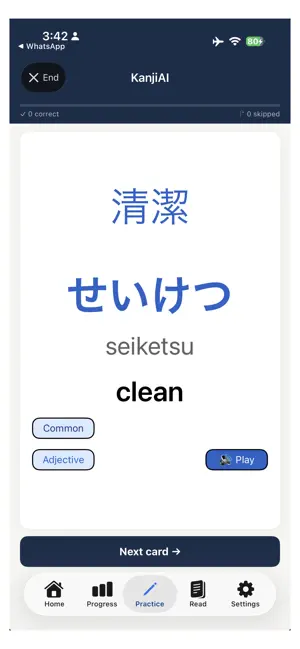
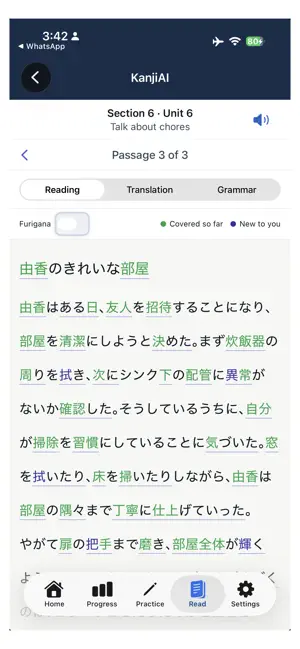
KanjiAI: Kanji & Japanese Reading Master kanji. Read real Japanese. Build toward JLPT N4 to N1 — all from one free app. A flashcard loop that actually works Set your lesson range, choose your parts of speech, and study the exact vocabulary you've been taught. Type the reading in kana or romaji, hear natural audio on every card, and mark words you've truly mastered so they fade into the background. Go deeper with the Top 10,000 Words When you're ready to push further, turn on the Top 10K toggle to add high-frequency vocabulary up to approximately JLPT N1 — but only words that use kanji you already know. No surprises, just natural expansion. Tap any kanji. Go deeper. Every kanji on every card is a link. Tap it to open its full detail page — see how it breaks down into components, explore its on and kun readings, find the phonetic component that explains why it sounds the way it does, and read the mnemonic that makes it stick. Navigate recursively through every component. Read real Japanese — at your level Every unit has three AI-generated reading passages built from vocabulary you already know. A focused unit passage, a daily life scene, and a short narrative. Each passage includes: Furigana toggle — show or hide readings Colour-coded kanji so you instantly see what you know vs. what's new Tap any word or kanji for its meaning Grammar cards explaining the patterns used, with real sentence examples Read-aloud with word-by-word highlighting Everything is pre-generated and fully offline — no API key, no internet required. A clear path to JLPT KanjiAI is structured around the JLPT progression from N4 to N1. As you advance through your lessons, you're building toward real exam readiness — not just memorising isolated characters, but understanding how grammar and vocabulary work together in context. Fully offline. Free. Forever. No account. No subscription. No internet connection required. Your progress stays on your device. Everything in the app — every flashcard, every reading passage, every kanji detail — works completely offline. A companion app for Japanese learners studying with Duolingo. Not affiliated with Duolingo, Inc.
What’s new
Version 1.5 (1) · Updated March 24, 2026
Version 1.5 • Furigana / Romaji toggle — A new dual-pill control in the Reading view lets you switch between furigana (kanji readings), romaji (full romanization of every word), or plain Japanese — tap either label to turn it on, tap again to turn it off. • Adjustable passage font size — Choose from four sizes (Small, Medium, Large, XL) in Settings → Reading. The setting applies only to reading passages so the rest of the app stays consistent. • Clearer passage layout — The passage title is now displayed larger than the body text with a divider, making it easier to tell where the title ends and the reading begins. Bug fixes and performance improvements.
App privacy
The developer, Samir Patel, reported these privacy practices to Apple.
Data Not Collected
The developer does not collect any data from this app.
Alternatives to KanjiAI
Looking for apps like KanjiAI? Here are 6 similar apps on the App Store. The highest rated is Kanji no Ma (5.0/5), and all 6 are free to download.


| App | Rating | Price | Last updated | Compare |
|---|---|---|---|---|
| KanjiAI | 3.0 / 5 (1 rating) | Free | March 24, 2026 | |
| Kotoba Snap | – | Free | Aug 16, 2026 | Compare |
| Kanji no Ma | 5.0 / 5 (2) | Free | Jul 2, 2026 | Compare |
| Demigod C2 Japanese | 5.0 / 5 (1) | Free | Sep 15, 2026 | Compare |
| Shirimono | – | Free | Jun 24, 2026 | Compare |
| NihonGO Dominos | 5.0 / 5 (2) | Free | Aug 27, 2026 | Compare |
| Kototap | 5.0 / 5 (1) | Free | Oct 12, 2026 | Compare |
Compare KanjiAI with the top alternatives: ratings, updates, ASO score and keyword gaps →