

Umbra Wallet
Umbraprivacy Ltd. Finance iPhoneiPadiPod touch
Umbra Wallet is a free Finance app for iPhone and iPad by Umbraprivacy Ltd. Rated 5.0/5 from 6 ratings. Requires iOS 15.1. Updated June 10, 2026.
- Rating
- 5.0
- 6 ratings
- Price
- Free
- on the App Store
- Size
- 282 MB
- Age 17+
- Updated
- Jun 10
- 2026 · v3.1.0
Screenshots

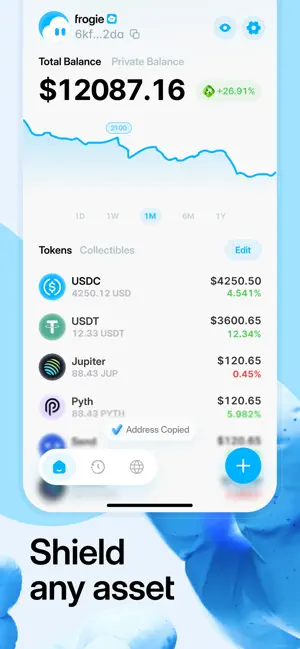


About Umbra Wallet
Umbra Wallet - Private by Default The most private way to use Solana. Umbra shields your balances, transfers, and on-chain activity from prying eyes — without sacrificing speed, simplicity, or access to DeFi. Every transaction on Solana is public. Your wallet balance, transfer history, DeFi positions — visible to anyone who knows your address. Umbra changes that. Built from the ground up with zero-knowledge cryptography, Umbra gives you control over what you share and what stays hidden. SHIELDED TRANSFERS Send and receive SOL, SPL & Token22 tokens without exposing your transaction to the public ledger. Sender address, recipient address, and transfer amount stay confidential. You get the speed of Solana with the privacy of cash. PRIVATE MODE Shield your entire wallet from on-chain observers. When activated, your balances and activity are routed through Umbra's privacy layer, making it significantly harder for third parties to track your holdings or profile your financial behavior. Toggle it on when you need discretion. Toggle it off when you don't. DISTRESS MODE A first-of-its-kind safety feature. Set up a secondary wallet view that displays a limited, decoy balance. If you're ever coerced into revealing your wallet — through a physical threat, social engineering, or any situation where you feel unsafe — Distress Mode gives you a believable exit without exposing your real funds. Personal safety should never be an afterthought. GASLESS TRANSFERS Send tokens without needing SOL to cover fees. Transfer USDC, USDT, and other SPL tokens the moment you receive them — no friction, no fumbling with fee tokens. DEFI ACCESS Swap, earn yield, and manage your portfolio from within the wallet. Umbra connects to leading Solana DeFi protocols so you can trade without hopping between apps or exposing activity across multiple frontends. SELF-CUSTODIAL Your keys never leave your device. Umbra does not store, transmit, or have access to your private keys or seed phrase. All sensitive operations happen locally on your phone. Your wallet, your keys, your funds. WHO IS UMBRA FOR? - Anyone who values financial privacy - Traders who want to move funds without signaling positions - Freelancers receiving crypto payments who'd rather not have income on a public ledger - People in regions where financial privacy is a matter of personal safety - Anyone who's ever seen their entire history on a block explorer and thought: this shouldn't be the default Privacy should be the starting point, not something you bolt on later. Umbra is built on that principle. Get set up in under a minute. Once you do, you'll wonder why every wallet doesn't work this way. Questions or feedback? [email protected] | @UmbraPrivacyt on X Umbra Wallet is developed by Umbraprivacy Ltd & Phoenix DAO LLC.
Ratings & reviews
5.0
6 ratings
What’s new
Version 3.1.0 · Updated June 10, 2026
- private history fixes - vault fixes and optimizations - wallet connect feature - private mode optimizations
App privacy
The developer, Umbraprivacy Ltd., reported these privacy practices to Apple.
Data Not Collected
The developer does not collect any data from this app.
Alternatives to Umbra Wallet
Looking for apps like Umbra Wallet? Here are 6 similar apps on the App Store. The highest rated is Sanctum Mobile (5.0/5), and all 6 are free to download.
-
 Sanctum Mobile
5.0
-
 Veilo Wallet
3.0
-
 Karma: Crypto, Card & Wallet
5.0
-
 Otus - Save smarter
5.0
-
 Aurus: Pro Wallet
5.0
-
 Bread: Money, Crypto & Rewards
5.0
| App | Rating | Price | Last updated | Compare |
|---|---|---|---|---|
| Umbra Wallet | 5.0 / 5 (6 ratings) | Free | June 10, 2026 | |
| Sanctum Mobile | 5.0 / 5 (4) | Free | Oct 1, 2026 | Compare |
| Veilo Wallet | 3.0 / 5 (2) | Free | Aug 18, 2026 | Compare |
| Karma: Crypto, Card & Wallet | 5.0 / 5 (6) | Free | Sep 22, 2026 | Compare |
| Otus - Save smarter | 5.0 / 5 (8) | Free | Sep 7, 2026 | Compare |
| Aurus: Pro Wallet | 5.0 / 5 (3) | Free | Sep 26, 2026 | Compare |
| Bread: Money, Crypto & Rewards | 5.0 / 5 (21) | Free | Oct 20, 2026 | Compare |
Compare Umbra Wallet with the top alternatives: ratings, updates, ASO score and keyword gaps →