
Black Holes & Magnetars
Education In-app purchases
Explore black holes & magnetars — real physics, catalog & cosmic events.
- Downloads
- 2.4K+
- on Google Play
- Price
- Free
- In-app purchases
- Updated
- Oct 12
- 2026 · v1.5.0
Screenshots
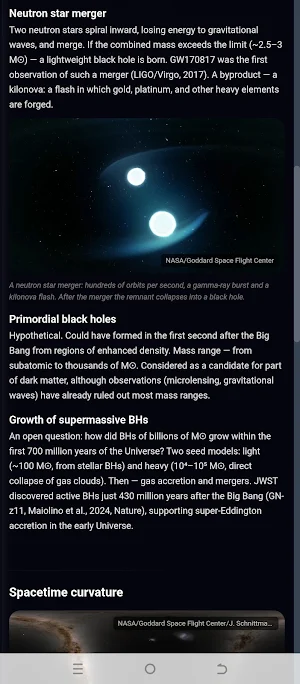


About Black Holes & Magnetars
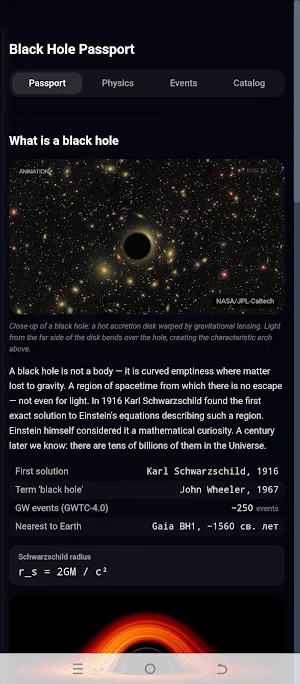
Black Holes & Magnetars is a science reference app built on real astronomical data — from the Event Horizon Telescope, LIGO/Virgo gravitational wave catalogs, Gaia astrometry missions, and the McGill Magnetar Catalog. Two of the most extreme objects in the Universe in one app — switch between black holes and magnetars with a single tap.
VISUALIZATIONS
NASA and ESA scientific animations bring extreme physics to life: watch a star get torn apart by tidal forces, hear the gravitational wave chirp of GW150914, see a camera plunge through an event horizon, observe a neutron star merger produce a kilonova, and witness magnetar starquakes and fast radio bursts. Every video is sourced from NASA/Goddard, NASA Scientific Visualization Studio, ESA/Hubble, and the EHT Collaboration.
PASSPORT
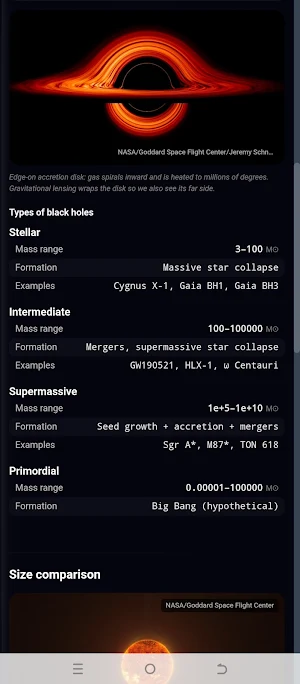
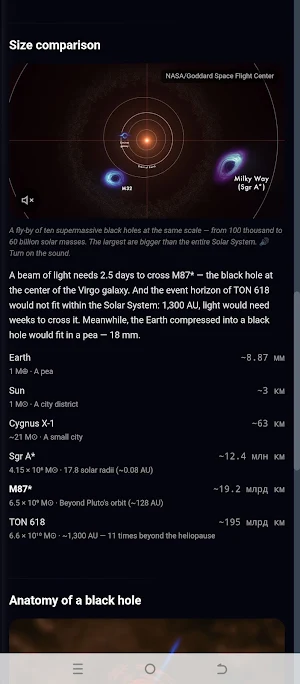
Your personal guide to both object classes. What is a black hole? How does spacetime curve around it? How large is TON 618 compared to the Solar System? What is a magnetar, and why is its magnetic field the strongest in the known Universe? The Passport tab answers these with clear visuals and precise numbers.
PHYSICS — BLACK HOLES
Seven layers of anatomy — from relativistic jets to the ring singularity. Hawking radiation, the information paradox, gravitational lensing, time dilation, and spaghettification. GPS satellites correct for relativistic physics every day — find out why.
PHYSICS — MAGNETARS
How a magnetar is born from a supernova. Nuclear pasta and the crushing structure of a neutron star. Starquakes that release more energy in a fraction of a second than the Sun does in thousands of years. Gravitational lensing so strong you can see the far side of the star.
EVENTS
Key moments in extreme astrophysics: the first image of M87* (EHT, 2019), the first image of Sgr A* (EHT, 2022), GW150914 — the first gravitational wave detection (LIGO, 2015), the first neutron star merger GW170817, the SGR 1806-20 giant flare, fast radio bursts, and kilonovae.
CATALOG
Famous black holes and magnetars with real scientific parameters — mass, distance, spin period, magnetic field, discovery method, confidence level. Cygnus X-1, Gaia BH1, Gaia BH3, Sgr A*, M87*, TON 618, 3C 273, SGR 1806-20, 1E 1547.0-5408, SGR J1745-2900, and more. Data sourced from peer-reviewed publications and the McGill Online Magnetar Catalog.
NO ADS. NO SUBSCRIPTIONS.
One-time purchase. Everything included — black holes and magnetars unlock together.
Data sources: EHT Collaboration, LIGO/Virgo/KAGRA (GWTC-4.0), Gaia Collaboration, McGill Online Magnetar Catalog (Olausen & Kaspi 2014), NASA/Goddard, ESA/Hubble.
What’s new
Version 1.5.0 · Updated October 12, 2026
Now in eight languages — pick yours right in the app. Other improvements and fixes.
Alternatives to Black Holes & Magnetars
Looking for apps like Black Holes & Magnetars? Here are 2 similar Android apps on Google Play. All of them are free to download.

| App | Rating | Price | Installs | Last updated | Compare |
|---|---|---|---|---|---|
| Black Holes & Magnetars | – | Free | 1,000+ | Oct 12, 2026 | |
| Lava Lamp Simulator: Sensory | – | Free | 100+ | Aug 23, 2026 | Compare |
| Ebru: Water Marbling Art | – | Free | 1,000+ | Sep 28, 2026 | Compare |