
Organic Synthesis Notes
StudyZoom Education In-app purchases Contains ads
Organic Synthesis Notes with Syllabus, MCQs and Quizzes for exam preparation
- Downloads
- 55+
- on Google Play
- Price
- Free
- In-app purchases
- Updated
- Jul 13
- 2026 · v1.2
Screenshots
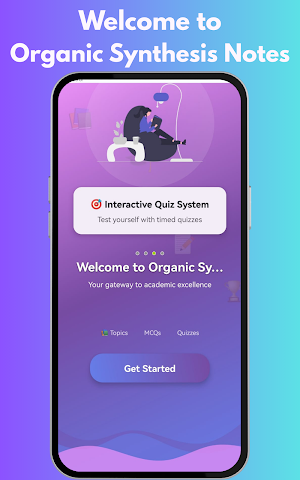
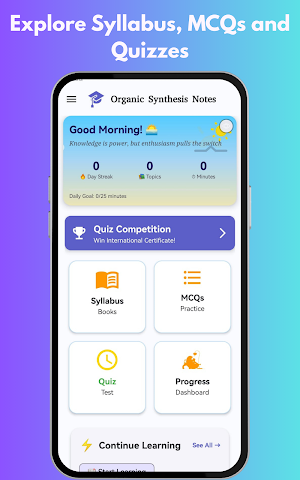
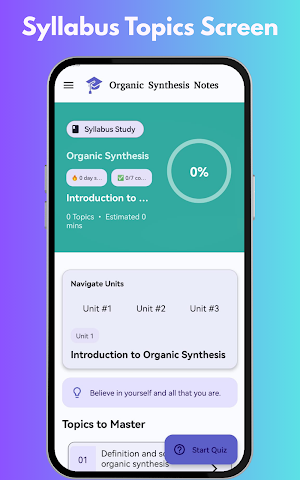
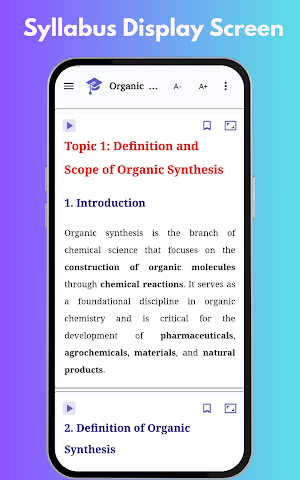


About Organic Synthesis Notes
Organic Synthesis Notes (2026–2027 Edition) is a comprehensive, research-oriented textbook designed for students, educators, & professionals in organic chemistry, pharmaceuticals, materials science, & chemical engineering. This book provides an in-depth understanding of synthetic strategies, reaction mechanisms, functional group transformations for efficient & sustainable molecule construction.
It connects theoretical knowledge with practical applications. Readers will gain insights into retrosynthetic analysis, stereochemistry, C–C bond formation, catalysis, protecting group strategies, asymmetric synthesis, & laboratory techniques essential for modern organic synthesis.
⚛️ Unit 1: Introduction to Organic Synthesis
• Definition & scope of organic synthesis
• Retrosynthetic analysis: concepts & importance
• Synthetic strategies: linear vs. convergent synthesis
• Functional group interconversions
• Protecting groups: types & applications
• Common reagents & solvents
🔢 Unit 2: Reaction Mechanisms & Stereochemistry
• Types of organic reactions: addition, elimination, substitution, rearrangement
• Reaction intermediates: carbocations, carbanions, free radicals, carbenes
• Factors affecting reaction rates & selectivity
• Stereochemistry: chirality, enantiomers, diastereomers, meso compounds
• Mechanistic pathways: SN1, SN2, E1, E2
• Transition states & reaction coordinate diagrams
📐 Unit 3: Carbon-Carbon Bond Formation Reactions
• Nucleophilic addition to carbonyl compounds
• Aldol condensation & related reactions
• Wittig & olefination reactions
• Grignard & organolithium reagents
• Suzuki, Heck, Stille cross-couplings
🔹 Unit 4: Functional Group Transformations
• Oxidation & reduction reactions
• Halogenation, nitration, sulfonation
• Alcohols, ethers, epoxides: preparation & reactions
• Carbonyl compounds & derivatives
• Amines: synthesis & functionalization
🌀 Unit 5: Synthesis of Natural Products & Pharmaceuticals
• Natural product synthesis overview
• Retrosynthetic approaches for complex molecules
• Total synthesis vs partial synthesis
• Drug design & synthesis
• Combinatorial & diversity-oriented synthesis
• Asymmetric synthesis & chiral catalysis
⚡ Unit 6: Organometallic Reagents & Catalysis
• Introduction to organometallic chemistry
• Organomagnesium, organolithium, organozinc reagents
• Transition metal-catalyzed cross-coupling reactions
• Homogeneous & heterogeneous catalysis
• Catalytic cycles & mechanisms
• Applications in stereoselective synthesis
🧩 Unit 7: Protecting Groups & Synthetic Strategies
• Need for protecting groups in multi-step synthesis
• Alcohol, amine, carbonyl, & carboxylic acid protection/deprotection
• Orthogonal protection strategies
• Step economy & atom economy
• Retrosynthetic planning revisited
• Multicomponent reactions
🔬 Unit 8: Advanced Topics in Organic Synthesis
• Photochemical reactions
• Microwave-assisted synthesis
• Biocatalysis & enzyme-mediated synthesis
• Solid-phase synthesis
• Supramolecular chemistry in synthesis
• Computational methods for design
📊 Unit 9: Laboratory Techniques & Safety
• Common lab equipment & glassware
• Reflux, distillation, extraction, chromatography
• Purification: crystallization, column chromatography, HPLC
• Spectroscopic techniques: NMR, IR, Mass Spec, UV-Vis
• Troubleshooting synthetic reactions
📏 Unit 10: Case Studies & Problem Solving
• Classic & recent total syntheses
• Synthetic challenges & solutions
• Multi-step synthesis exercises
• Spectroscopic interpretation for intermediates
• Retrosynthesis & forward synthesis problem sets
✨ This app is inspired by the authors:
Graham Clayden, Michael B. Smith, Jonathan Clayden, David A. Evans, and Philip J. Kocienski.
📲 Download Organic Synthesis Notes (2026–2027 Edition) to master modern synthetic strategies, stereochemistry, catalysis, & laboratory techniques. Ideal for students, educators, & researchers in organic chemistry.
What’s new
Version 1.2 · Updated July 13, 2026
🚀 New Update of Organic Synthesis Notes (2026–2027 Edition) ✨ What’s Inside: ✅ Detailed coverage of organic reaction mechanisms, stereochemistry, and C–C bond formation ✅ MCQs and Quizzes for exam preparation 🎯 Suitable For: 👩🎓 Students of Organic Chemistry, Pharmaceutical Sciences, and Chemical Engineering 🏆 Ideal for exams, research projects, lab work, and advanced study in synthesis Start mastering Organic Synthesis Notes (2026–2027 Edition) today!
Alternatives to Organic Synthesis Notes
Looking for apps like Organic Synthesis Notes? Here are 6 similar Android apps on Google Play. All of them are free to download.
-
Biochemistry Notes
-
Introduction to Biochemistry
-
Programming Fundamentals Notes
-
Calculus and Analytic Geometry
-
Object Oriented Programming
-
Expository Writing Notes
| App | Rating | Price | Installs | Last updated | Compare |
|---|---|---|---|---|---|
| Organic Synthesis Notes | – | Free | 50+ | Jul 13, 2026 | |
| Biochemistry Notes | – | Free | 10,000+ | Jul 4, 2026 | Compare |
| Introduction to Biochemistry | – | Free | 1,000+ | Jul 15, 2026 | Compare |
| Programming Fundamentals Notes | – | Free | 10+ | Jul 2, 2026 | Compare |
| Calculus and Analytic Geometry | – | Free | 50+ | – | Compare |
| Object Oriented Programming | – | Free | 10+ | Jun 30, 2026 | Compare |
| Expository Writing Notes | – | Free | 50+ | Jun 30, 2026 | Compare |
Similar apps on Google Play
- Biochemistry Notes
- Introduction to Biochemistry
- Programming Fundamentals Notes
- Calculus and Analytic Geometry
- Object Oriented Programming
- Expository Writing Notes
- Database System
- Multivariable Calculus
- Basic Math
- Functional Analysis
- Vector and Tensor Analysis
- Environmental Biology Notes
- Plant Biochemistry Notes
- Plant Biotechnology Notes
- Macro Structure and Analysis
- Microbial Diversity Notes
- General and Molecular Biology
- Cell Biology
- Plant Anatomy Notes
- Molecular Biology
- Bryology and Phycology Notes
- Genetics II Notes
- Genetics I Notes
- Plant Physiology Notes
- Plant Stress Physiology Notes
- Salinity and Waterlogging
- Plant Developmental Biology
- Diversity of Vascular Plants
- Plant Systematics Notes
- Taxonomy of Angiosperms Notes
- Chemistry 11 KeyBook
- Reaction Mechanisms Notes
- Surface Chemistry Notes
- Biomolecules Notes
- Natural Products Notes
- Stereochemistry Notes
- Spectroscopy Notes
- Quantum Chemistry Notes
- Inorganic Chemistry Notes
- Electrochemistry Notes
- Chemical Kinetics Notes
- Periodic Table 3D
- Industrial and Env Chemistry
- Environmental Analysis
- Science and Technology History
- History of Economic Thought
- Middle East Political History
- Social and Cultural History
- Comparative History
- History of Human Rights
- Environmental History
- History of Globalization
- International Relation History
- History of United States
- Islamic Civilization History
- Microbial Genetics
- Titration Techniques Notes
- Spectroscopic Analysis Notes
- Chromatography Notes
- Chemistry of Materials Notes
- Green Chemistry Notes
- Heritage Preservation Studies
- Historical Debates Studies
- Maths MCQs, Quiz and Interview
- Enzymology
- Environmental Chemistry
- History of South Asia
- History of Modern Europe
- History of Political Thought
- Polymer Chemistry
- Biology ; MCQs and Quiz Prep
- Biochemical Techniques
- Advanced Topics in Chemistry
- Medicinal Chemistry
- Metabolic Pathways
- Chemistry ; MCQs and Quiz Prep
- Every Day Science
- Physics ; MCQs and Quiz Prep
- Applied Microbiology
- Nucleic Acids and Proteins
- English MCQs and Quiz Prep
- General Knowledge
- World Current Affairs
- Medical Microbiology
- Computer Pro
- Plant and Animal Culture
- Recombinant DNA Technology
- Supramolecular Chemistry Notes
- Organometallic Chemistry Notes
- Bioinorganic Chemistry Notes
- Parallel and Distri. Computing
- Bioinformatics-I App
- Computer Applications in Bio
- Epidemiology App
- Professional Practices - CS
- Intro to Software Engineering
- Database Systems
- Distributed Database Systems
- Information Security
- Wireless Communication
- Web Design and Development
- Mobile and App Development
- Object Oriented Programming
- Computer Networks
- Discrete Structures
- Food and Agri Microbiology
- Environmental Biotechnology
- Industrial Microbiology Notes
- Analytical Chemistry
- Linear Algebra
- Elementary Algebra
- Plant Biodiversity and Care
- Enzymology Notes
- Metabolism Notes
- Biochemical Techniques Notes
- Cell Biology Notes
- Molecular Biology Notes
- Fundamentals of Data Mining
- Artificial Intelligence Guide
- Theory of Automata
- Computer Org and Assembly Lang
- Operating Systems
- Compiler Construction
- Data Structures and Algorithms
- Algorithm Design and Analysis
- Programming Fundamentals
- Intro to Computing Apps
- SICP - Computer Programs
- Computer Hardware and Software
- Nationalism and Imperialism
- Introduction to History
- World History
- Learn Programming Languages AI
- SQL Antipatterns
- Superintelligence
- Seven Databases in Seven Weeks
- Introduction to Algorithms
- Grokking Algorithms
- Algorithms to Live By
- Data Intensive App Design
- Computational Chemistry Notes
- Database Internals
- You Don't Know JS
- Computational Fairy Tales
- Programming Pearls
- The Pragmatic Programmer
- Fullstack React
- Principle of Microbiology
- Theoretical Mechanics