
Biomolecules Notes
StudyZoom Education In-app purchases Contains ads
Complete guide to biomolecules: structure, function, metabolism, & lab methods.
- Downloads
- 57+
- on Google Play
- Price
- Free
- In-app purchases
- Updated
- Jul 7
- 2026 · v1.1
Screenshots
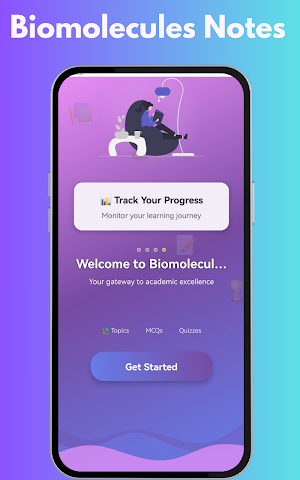
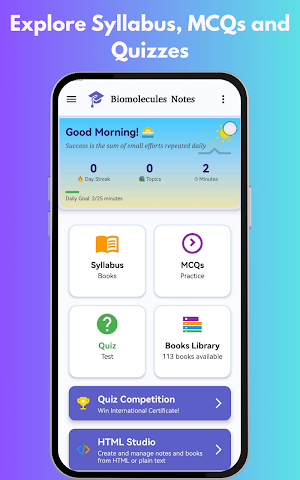
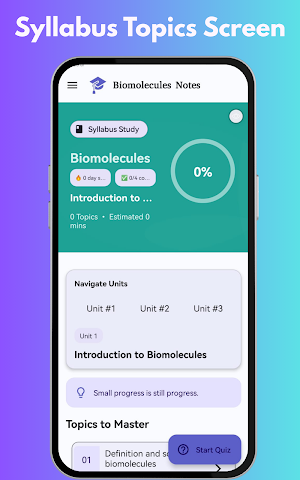
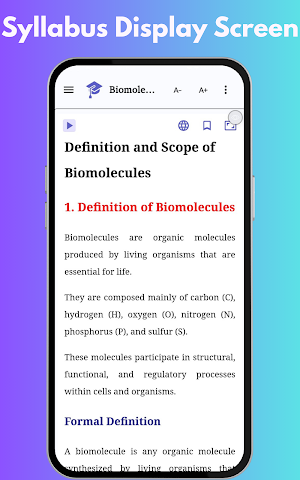


About Biomolecules Notes
Biomolecules Notes (2026–2027 Edition) is a comprehensive, research-oriented textbook designed for students, and professionals in biochemistry, molecular biology, nutrition, and biomedical sciences. This book provides an in-depth understanding of the structure, properties, functions, and metabolism of biomolecules, along with experimental and analytical techniques for their study.
It bridges theoretical concepts with practical applications. Readers will gain insights into carbohydrates, proteins, lipids, nucleic acids, enzymes, bioenergetics, metabolism, vitamins, hormones, and biomolecular engineering, with modern approaches in experimental biochemistry and clinical applications.
⚛️ Unit 1: Introduction to Biomolecules
• Definition and scope of biomolecules
• Classification: macromolecules and small molecules
• Historical context & importance in biology and biochemistry
• Role in living systems and overview of course
🔢 Unit 2: Water and Chemical Foundations
• Properties of water relevant to biomolecules
• pH, buffering, acid–base chemistry
• Chemical bonds: covalent, ionic, hydrogen, van der Waals, hydrophobic
📐 Unit 3: Carbohydrates
• Monosaccharides: nomenclature, stereochemistry, ring forms
• Disaccharides, oligosaccharides, polysaccharides
• Biological roles and structural diversity
🔹 Unit 4: Amino Acids and Peptides
• Structures, classification, essential vs non‑essential
• Optical and acid–base properties, reactions
• Biologically active peptides (e.g., insulin, glutathione)
🌀 Unit 5: Proteins and Protein Structure
• Levels of protein structure: primary to quaternary
• Fibrous vs globular proteins
• Folding, stability, denaturation, purification, characterization
⚡ Unit 6: Lipids and Membranes
• Classification of lipids: fatty acids, glycerides, phospholipids, glycolipids, sterols
• Biological functions, bilayers, micelles, liposomes
• Lipid chemical properties: saponification, oxidation
🧩 Unit 7: Nucleic Acids
• Purines, pyrimidines, nucleosides, nucleotides
• DNA and RNA structure, motifs, higher-order structures
• Biological roles and alternative DNA forms
🔬 Unit 8: Enzymes
• Classification, nomenclature, catalytic mechanisms
• Cofactors, coenzymes, enzyme kinetics, regulation
• Immobilized enzymes and industrial applications
📊 Unit 9: Bioenergetics and Energy-Rich Compounds
• Concepts: free energy, enthalpy, entropy, redox potential
• ATP, NADH, FADH₂, cyclic AMP
• Energy metabolism in cells
📏 Unit 10: Metabolism of Carbohydrates and Lipids
• Glycolysis, gluconeogenesis, pentose phosphate pathway
• Glycogen metabolism, beta-oxidation
• Pathway regulation and integration
📐 Unit 11: Amino Acid Metabolism and Protein Turnover
• Amino acid catabolism, transamination, urea cycle
• Integration with carbohydrate-lipid metabolism
• Protein degradation pathways
🔹 Unit 12: Vitamins, Hormones, and Signaling Molecules
• Fat- and water-soluble vitamins
• Hormone chemistry, signaling pathways, second messengers
• Biological roles and deficiency disorders
🌀 Unit 13: Structural-Functional Relationships and Biomolecular Engineering
• Structure–activity relationships
• Synthetic and chemoenzymatic approaches
• Applications: bioeconomy, green chemistry, spectroscopy
⚡ Unit 14: Laboratory Techniques and Experimental Methods
• Qualitative biomolecule tests
• Spectroscopic and chromatographic analysis
• Protein sequencing and nucleic acid isolation
• Case studies and project examples
🧬 Unit 15: Clinical and Nutritional Biochemistry
• Nutritional aspects and metabolic disorders
• Clinical biomarkers and enzyme assays
• Nutritional regulation of metabolism
✨ This app is inspired by the authors:
Donald Voet, Judith G. Voet, David L. Nelson, Michael M. Cox, Jeremy M. Berg, U. Satyanarayana.
📲 Download Biomolecules Notes (2026–2027 Edition) to master the chemistry, structure, function, metabolism, and experimental study of biological molecules.
What’s new
Version 1.1 · Updated July 7, 2026
🚀 New Update of Biomolecules Notes (2026–2027 Edition) ✨ What’s Inside: ✅ Comprehensive coverage of proteins, carbohydrates, lipids, nucleic acids, vitamins, and hormones ✅ MCQs and Quizzes for exam preparation 🎯 Suitable For: 👩🎓 Students of Biochemistry, Molecular Biology, Life Sciences, and Chemistry 🏆 Ideal for exams, laboratory work, research projects, and practical applications Start mastering Biomolecules Notes (2026–2027 Edition) today!
Alternatives to Biomolecules Notes
Looking for apps like Biomolecules Notes? Here are 6 similar Android apps on Google Play. All of them are free to download.
-
Biochemistry Notes
-
Introduction to Biochemistry
-
Programming Fundamentals Notes
-
Calculus and Analytic Geometry
-
Object Oriented Programming
-
Expository Writing Notes
| App | Rating | Price | Installs | Last updated | Compare |
|---|---|---|---|---|---|
| Biomolecules Notes | – | Free | 50+ | Jul 7, 2026 | |
| Biochemistry Notes | – | Free | 10,000+ | Jul 4, 2026 | Compare |
| Introduction to Biochemistry | – | Free | 1,000+ | Jul 15, 2026 | Compare |
| Programming Fundamentals Notes | – | Free | 10+ | Jul 2, 2026 | Compare |
| Calculus and Analytic Geometry | – | Free | 50+ | – | Compare |
| Object Oriented Programming | – | Free | 10+ | Jun 30, 2026 | Compare |
| Expository Writing Notes | – | Free | 50+ | Jun 30, 2026 | Compare |
Compare Biomolecules Notes with the top alternatives: ratings, updates, ASO score and keyword gaps →
Similar apps on Google Play
- Biochemistry Notes
- Introduction to Biochemistry
- Programming Fundamentals Notes
- Calculus and Analytic Geometry
- Object Oriented Programming
- Expository Writing Notes
- Database System
- Multivariable Calculus
- Basic Math
- Functional Analysis
- Vector and Tensor Analysis
- Environmental Biology Notes
- Plant Biochemistry Notes
- Plant Biotechnology Notes
- Macro Structure and Analysis
- Microbial Diversity Notes
- General and Molecular Biology
- Cell Biology
- Plant Anatomy Notes
- Molecular Biology
- Bryology and Phycology Notes
- Genetics II Notes
- Genetics I Notes
- Plant Physiology Notes
- Plant Stress Physiology Notes
- Salinity and Waterlogging
- Plant Developmental Biology
- Diversity of Vascular Plants
- Plant Systematics Notes
- Taxonomy of Angiosperms Notes
- Chemistry 11 KeyBook
- Reaction Mechanisms Notes
- Surface Chemistry Notes
- Natural Products Notes
- Stereochemistry Notes
- Spectroscopy Notes
- Quantum Chemistry Notes
- Organic Synthesis Notes
- Inorganic Chemistry Notes
- Electrochemistry Notes
- Chemical Kinetics Notes
- Periodic Table 3D
- Industrial and Env Chemistry
- Environmental Analysis
- Science and Technology History
- History of Economic Thought
- Middle East Political History
- Social and Cultural History
- Comparative History
- History of Human Rights
- Environmental History
- History of Globalization
- International Relation History
- History of United States
- Islamic Civilization History
- Microbial Genetics
- Titration Techniques Notes
- Spectroscopic Analysis Notes
- Chromatography Notes
- Chemistry of Materials Notes
- Green Chemistry Notes
- Heritage Preservation Studies
- Historical Debates Studies
- Maths MCQs, Quiz and Interview
- Enzymology
- Environmental Chemistry
- History of South Asia
- History of Modern Europe
- History of Political Thought
- Polymer Chemistry
- Biology ; MCQs and Quiz Prep
- Biochemical Techniques
- Advanced Topics in Chemistry
- Medicinal Chemistry
- Metabolic Pathways
- Chemistry ; MCQs and Quiz Prep
- Every Day Science
- Physics ; MCQs and Quiz Prep
- Applied Microbiology
- Nucleic Acids and Proteins
- English MCQs and Quiz Prep
- General Knowledge
- World Current Affairs
- Medical Microbiology
- Computer Pro
- Plant and Animal Culture
- Recombinant DNA Technology
- Supramolecular Chemistry Notes
- Organometallic Chemistry Notes
- Bioinorganic Chemistry Notes
- Parallel and Distri. Computing
- Bioinformatics-I App
- Computer Applications in Bio
- Epidemiology App
- Professional Practices - CS
- Intro to Software Engineering
- Database Systems
- Distributed Database Systems
- Information Security
- Wireless Communication
- Web Design and Development
- Mobile and App Development
- Object Oriented Programming
- Computer Networks
- Discrete Structures
- Food and Agri Microbiology
- Environmental Biotechnology
- Industrial Microbiology Notes
- Analytical Chemistry
- Linear Algebra
- Elementary Algebra
- Plant Biodiversity and Care
- Enzymology Notes
- Metabolism Notes
- Biochemical Techniques Notes
- Cell Biology Notes
- Molecular Biology Notes
- Fundamentals of Data Mining
- Artificial Intelligence Guide
- Theory of Automata
- Computer Org and Assembly Lang
- Operating Systems
- Compiler Construction
- Data Structures and Algorithms
- Algorithm Design and Analysis
- Programming Fundamentals
- Intro to Computing Apps
- SICP - Computer Programs
- Computer Hardware and Software
- Nationalism and Imperialism
- Introduction to History
- World History
- Learn Programming Languages AI
- SQL Antipatterns
- Superintelligence
- Seven Databases in Seven Weeks
- Introduction to Algorithms
- Grokking Algorithms
- Algorithms to Live By
- Data Intensive App Design
- Computational Chemistry Notes
- Database Internals
- You Don't Know JS
- Computational Fairy Tales
- Programming Pearls
- The Pragmatic Programmer
- Fullstack React
- Principle of Microbiology
- Theoretical Mechanics