
Washington Wildflowers
Books & Reference
University of Washington Herbarium presents a wildflower identification app.
- Rating
- 4.9
- 43 ratings
- Downloads
- 2.4K+
- on Google Play
- Price
- $9.99
- No in-app purchases
- Updated
- Sep 9
- 2026
Screenshots
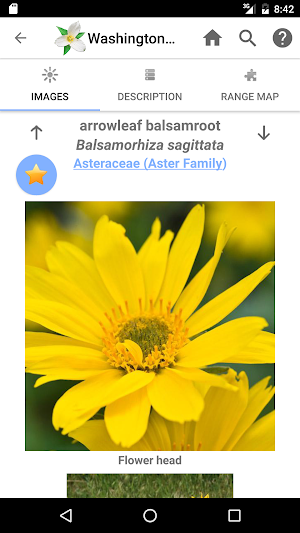


About Washington Wildflowers
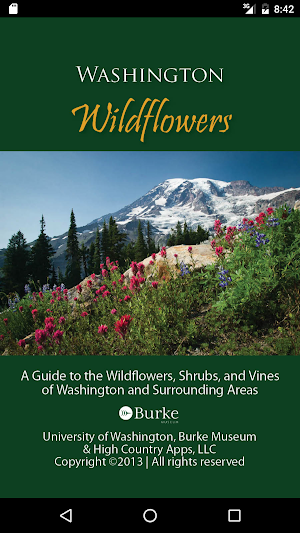
The University of Washington Herbarium at the Burke Museum and the authors of “Wildflowers of the Pacific Northwest” have partnered to produce WASHINGTON WILDFLOWERS plant identification app for mobile devices. The app provides images, species descriptions, range maps, bloom period, and technical descriptions for 1028 common wildflowers, shrubs, and vines found in Washington and adjacent areas of British Columbia, Idaho, and Oregon. The majority of species included are native, but introduced species common to the region are covered as well. The selection and use of this curated data, developed by botanists, provides users with the most accurate information available that will in turn allow them to readily identify the plants they see statewide. The app does not need an Internet connection to run, so you can use it no matter how remote your wanderings take you.
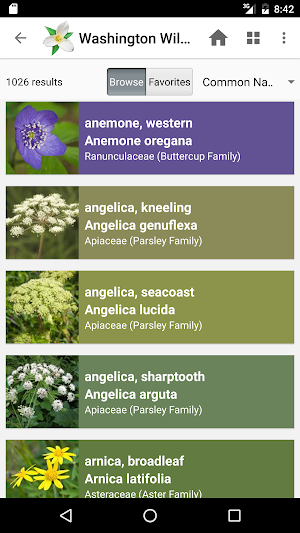
Though primarily designed for amateur enthusiasts, the breadth of content in WASHINGTON WILDFLOWERS also makes it appealing to more experienced botanists. Users can browse the species list by common or scientific name (and even by family!) to locate a plant and access the related information. However, most users will want to rely on the easy-to-use search key to accurately identify plants of interest.
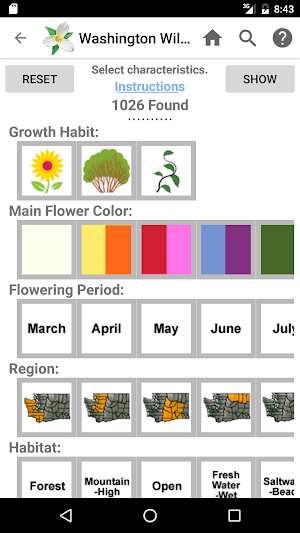
The key's interface is broken down into nine simple categories: growth habit (e.g., wildflower, shrub, vine), flower color, month of year, geographic region, habitat, leaf arrangement, leaf type, duration (annual, biennial, perennial), and origin (native or introduced). Select choices in as many or as few categories as you wish. As you do so, the number of species found is displayed at the top of the page. Once done selecting, the click of a button returns a list of thumbnail images and names for potential matches. Users scroll among the species on the list and tap a thumbnail image to access additional photos, descriptions, and range maps.
WASHINGTON WILDFLOWERS includes supporting documents with extensive information on the ecoregions of Washington, descriptions of habitats found across the state, wildflower destinations with best time to visit, insights into how the climate influences the plant communities found here, as well as detailed instructions on how to use the app. Users will also find an extensive glossary of botanical terms, along with labeled diagrams of leaves, flowers, and inflorescences. Finally, detailed descriptions can be found for each family contained in WASHINGTON WILDFLOWERS. Tapping on a family name brings up a list of images and names for all species in the app belonging to that family.
Washington and its adjacent areas are home to diverse landscapes containing a wealth of wildflowers, shrubs, and vines. WASHINGTON WILDFLOWERS will appeal to individuals of all ages who travel to such areas and are interested in knowing the names and natural history of the plants that they encounter. WASHINGTON WILDFLOWERS is also a great educational tool for learning more about plant communities, botanical terms, and how to identify plants in general.
A portion of revenues received from the app goes to help develop the floristic knowledge base that lets us create quality tools to inform the public about Washington’s plants.
What’s new
Updated September 9, 2026
Updated for Jetpack Compose and Android 17.
User reviews

Great app! I find it easier to use than the corresponding book by Turner. it would be better if it were more complete. There are several relatively common plants missing.

This app is simple to use, much better than most field guide apps I've tried. The interface does not get in your way, and they've done a great job visually representing the various features in the search by characteristics function.

Wonderful!!!

love this app

One of my all-time favorite apps. I rarely fail to identify a wildflower with it. It's been a huge help! Worth every cent.

Awesome
Alternatives to Washington Wildflowers
Looking for apps like Washington Wildflowers? Here are 6 similar Android apps on Google Play. The highest rated is Washington Post Select (4.6/5), and all 6 are free to download.
-
Washington Post Select 4.6
-
NatureID- Plant Identification 4.3
-
Flora Incognita 4.0
-
Blossom - Plant Identification 4.6
-
Plant Identifier & Care - Greg 4.1
-
Plant Story™ 4.2
| App | Rating | Price | Installs | Last updated | Compare |
|---|---|---|---|---|---|
| Washington Wildflowers | 4.9 / 5 | $9.99 | 1,000+ | Sep 9, 2026 | |
| Washington Post Select | 4.6 / 5 | Free | 1,000,000+ | Jun 29, 2020 | Compare |
| NatureID- Plant Identification | 4.3 / 5 | Free | 5,000,000+ | Feb 6, 2026 | Compare |
| Flora Incognita | 4.0 / 5 | Free | 5,000,000+ | Sep 11, 2026 | Compare |
| Blossom - Plant Identification | 4.6 / 5 | Free | 5,000,000+ | Oct 6, 2026 | Compare |
| Plant Identifier & Care - Greg | 4.1 / 5 | Free | 500,000+ | Oct 23, 2026 | Compare |
| Plant Story™ | 4.2 / 5 | Free | 100,000+ | Oct 8, 2026 | Compare |
Similar apps on Google Play
- Washington Post Select
- NatureID- Plant Identification
- Flora Incognita
- Blossom - Plant Identification
- Plant Identifier & Care - Greg
- Plant Story™
- Audubon Bird Guide
- PlantNet Plant Identification
- Planta - Care for your plants
- The Atlantic
- Planti: Plant Care
- PlantApp - Plant Identifier
- Veggie Garden Planner
- Seek by iNaturalist
- Washington Post
- iNaturalist
- PictureThis - Plant Identifier
- Plant Parent: Plant Care Guide
- Distiller - Liquor Reviews
- KARMA Search
- BBC Music Magazine