

Ear4Music: Ear Training
Aleksei Usharovskii Education iPhoneiPadiPod touch
Ear4Music: Ear Training is a free Education app for iPhone and iPad by Aleksei Usharovskii. Requires iOS 16.0. Updated November 11, 2026.
- Price
- Free
- on the App Store
- Size
- 45 MB
- Age 4+
- Updated
- Nov 11
- 2026 · v1.2
Screenshots
Save to Pinterest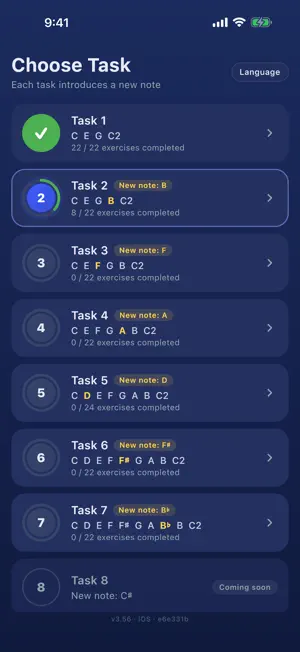


About Ear4Music: Ear Training
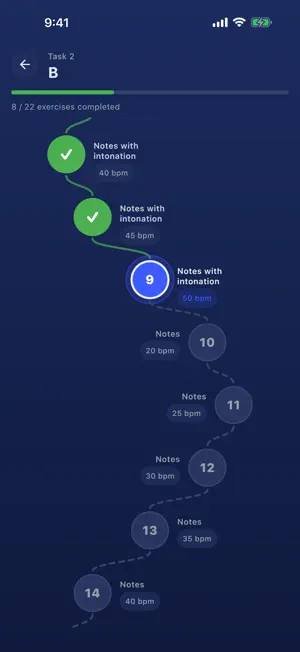
Ear4Music teaches you to recognize musical notes by ear: calmly, step by step, with a method that pairs each note with a short melody. The app is inspired by Pyotr Berezhansky's intonation method. Every note gets its own short melody that leads it home to the tonic, C. E walks down the steps (E–D–C), G runs up to the high C (G–A–B–C), and B gets there in one quick hop. Hear a note with its melody often enough and you will start to recognize it without the hint. How it works • Start with just four notes: C, E, G and the high C. • Each new task adds one note (B, F, A and finally D) until you know the whole C major octave. • Every exercise starts by tuning your ear to C major: C–E–G–C and back. • Listen, wait for "Press a key" to light up, then tap the matching key on the piano keyboard. • Wrong or too slow? The right key lights up green and the note plays again, so you remember the correct sound. • You pass an exercise with 90% correct answers. Then move on, or repeat it to make it stick. Seven tasks, 156 exercises • An animated walkthrough with sound opens every task and explains the method in a friendly, playful way. • Notes with intonation: the note plus its melody, the bridge to hearing notes on their own. • Single notes without hints: the core of ear training. • Series of 2, 3 and 4 notes in a row train musical memory and reaction speed. • The tempo rises gradually from 15 to 65 notes per minute. • After the full octave of white keys, the last two tasks add the black keys F sharp and B flat. Made for daily practice • A clear exercise path shows what you have done and what comes next. • After each session you see your correct, wrong and missed answers. • Progress is saved directly on your device. • An optional daily reminder around 11:00 if you haven't practiced yet. • Piano sound is generated inside the app, so you can train without an internet connection. • Interface in English, Czech, French, German, Russian, Spanish and Ukrainian. • Works on iPhone and iPad; on iPad in portrait and landscape, in Split View and in windows. • The catalog already lists the next topics: the other black keys, other octaves, other instruments and chords. Who it's for Beginners who want to finally hear the difference between notes. Music school students preparing for solfège and ear training classes. Singers, pianists, guitarists and anyone who wants to name a note by ear instead of guessing. Try practicing for ten minutes a day. Put on headphones, press Start and let your ears do the learning.
What’s new
Version 1.2 · Updated November 11, 2026
Ear4Music now runs natively on iPad: full screen in portrait and landscape, in Split View and in windows. The task list, the exercise path and the keyboard keep comfortable proportions on the large screen.
App privacy
The developer, Aleksei Usharovskii, reported these privacy practices to Apple.
Data Used to Track You
The following data may be used to track you across apps and websites owned by other companies:
- Identifiers: Device ID
Data Not Linked to You
The following data, which may be collected but is not linked to your identity, may be used for the following purposes:
- Identifiers: Device ID
- Usage Data: Product Interaction, Advertising Data
- Diagnostics: Crash Data, Performance Data, Other Diagnostic Data
Used for: Third-Party Advertising, Analytics
Alternatives to Ear4Music: Ear Training
Looking for apps like Ear4Music: Ear Training? Here are 6 similar apps on the App Store. The highest rated is Piano408 (5.0/5), and all 6 are free to download.
-
 Nib Rally
-
 Piano408
5.0
-
 Intervalia: Ear Training
-
 LingWay
-
 ExamCat: AI Study Tutor
4.3
-
 Voces: Ear Training & Pitch
| App | Rating | Price | Last updated | Compare |
|---|---|---|---|---|
| Ear4Music: Ear Training | – | Free | November 11, 2026 | |
| Nib Rally | – | Free | Nov 18, 2026 | Compare |
| Piano408 | 5.0 / 5 (9) | Free | Oct 13, 2026 | Compare |
| Intervalia: Ear Training | – | Free | Oct 3, 2026 | Compare |
| LingWay | – | Free | Oct 12, 2026 | Compare |
| ExamCat: AI Study Tutor | 4.3 / 5 (3) | Free | Nov 3, 2026 | Compare |
| Voces: Ear Training & Pitch | – | Free | Sep 5, 2026 | Compare |