

Pocket Experiments Science Lab
MIZOU, CO., LTD. Education iPhoneiPadiPod touch
Pocket Experiments Science Lab is a free Education app for iPhone and iPad by MIZOU, CO., LTD. Requires iOS 17.0. Updated September 29, 2026.
- Price
- Free
- on the App Store
- Size
- 12 MB
- Age 4+
- Updated
- Sep 29
- 2026 · v1.0.1
Screenshots
About Pocket Experiments Science Lab
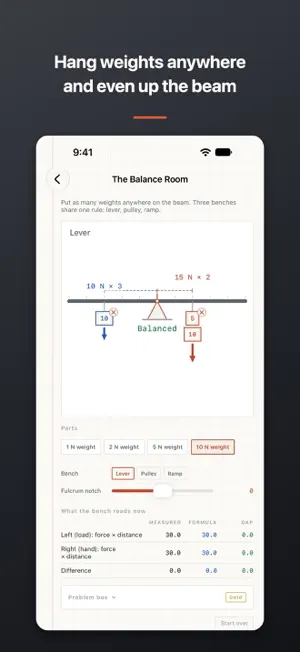
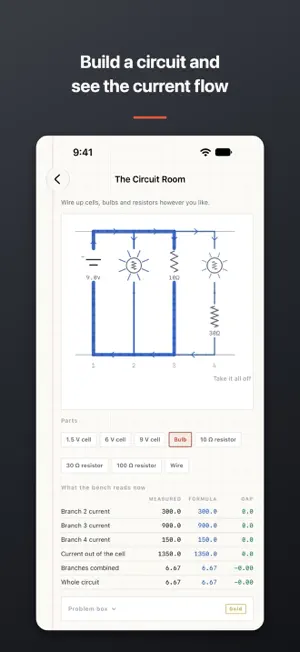
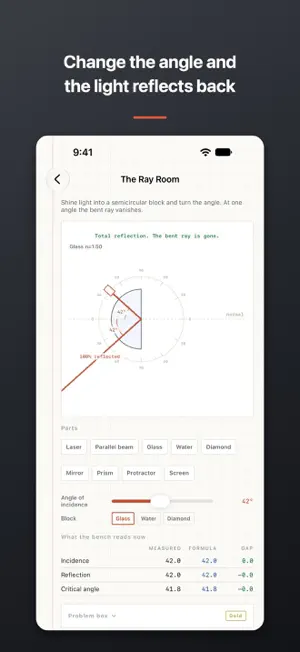
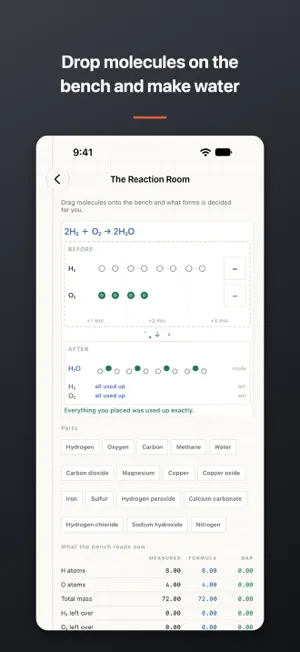
Twenty-six rooms. Not a workbook — a bench in each one. You set the parts out yourself, turn the knobs, and measure with the instruments. • Hang as many weights as you like anywhere along a balance beam, and even it up • Drag molecules onto the bench and see what they form • Set a magma's silica and the depth where it freezes, erupt it, then look at the rock through a hand lens and measure the grains • Stretch two strings, detune one, and listen to the beats • Drop three seismometers on a map; three circles meet at one point, and that point is the epicenter Every number is measured off the picture. Nothing here works a value out of a formula and then "checks" it against the same formula. The grains under the lens are really drawn, and their size is really measured. Turn a knob and the picture changes; when the picture changes, the numbers change with it. Every room has three steps: 1. Move it — turn one knob and watch what changes 2. Count it — line the measurement up against the formula and look at the gap 3. Check it — one question, and the reason either way Every room also has a question box. Clear it and the room moves up a tier: none → bronze → silver → gold. There are 78 questions in all. But the questions are not the main act. Playing with the bench is; a question is the detour you take when you think “wait — could I actually build that?” The topics are middle school and high school science: forces and motion, springs and buoyancy, pendulums, circuits, electromagnets, ray optics, lenses, sound, changes of state, solubility, titration, electrolysis, chemical reactions, preparing and collecting gases, the microscope, cell division, photosynthesis, flower structure, heredity, strata, rocks and volcanoes, earthquakes, and the sky. Three neighbors of science come along too: probability, logic gates and regular expressions. ADS AND THE ONE-TIME PURCHASE The app is free and shows ads: a banner along the bottom of the screen, and a full-screen ad when you open the app. All 26 rooms and all 78 questions are open from the first launch. There is exactly one in-app purchase and all it does is turn the ads off — it unlocks nothing and adds nothing. It is a single one-time purchase with no subscription (¥5,000 in Japan; the price for your country is shown in the app). Not based on, or affiliated with, any particular textbook.
What’s new
Version 1.0.1 · Updated September 29, 2026
Added a short animated introduction for first-time users, and an occasional reminder about removing ads (never shown after purchase). Bug fixes and improvements.
App privacy
The developer, MIZOU, CO., LTD., reported these privacy practices to Apple.
Data Used to Track You
The following data may be used to track you across apps and websites owned by other companies:
- Identifiers: Device ID
- Usage Data: Advertising Data
Data Not Linked to You
The following data, which may be collected but is not linked to your identity, may be used for the following purposes:
- Identifiers: Device ID
- Usage Data: Advertising Data
Used for: Third-Party Advertising
Alternatives to Pocket Experiments Science Lab
Looking for apps like Pocket Experiments Science Lab? Here are 6 similar apps on the App Store.



| App | Rating | Price | Last updated | Compare |
|---|---|---|---|---|
| Pocket Experiments Science Lab | – | Free | September 29, 2026 | |
| 宇宙星际航行 | – | Free | Sep 1, 2026 | Compare |
| ตะลุยโจทย์ วิทย์ ม.1 | – | Free | Aug 31, 2026 | Compare |
| 物理实验室·动手玩物理 | – | Free | Sep 2, 2026 | Compare |
| GravyLensing | – | Free | Aug 28, 2026 | Compare |
| 小狐生物实验室 | – | Free | May 28, 2026 | Compare |
| สรุปสังคม ม.4-6 EasyNote | – | Free | Aug 26, 2026 | Compare |