

Whokoban: Sokoban Puzzles
Wizhut.tech Games iPhoneiPadiPod touch
Whokoban: Sokoban Puzzles is a paid Games app for iPhone and iPad by Wizhut.tech. Requires iOS 17.0. Updated October 4, 2026.
- Price
- 2.99 USD
- on the App Store
- Size
- 5 MB
- Age 4+
- Updated
- Oct 4
- 2026 · v2.2.0
Screenshots

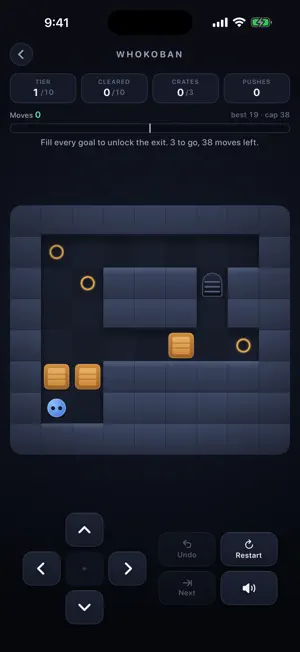
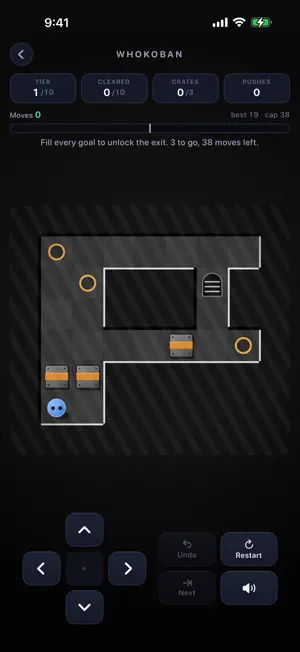
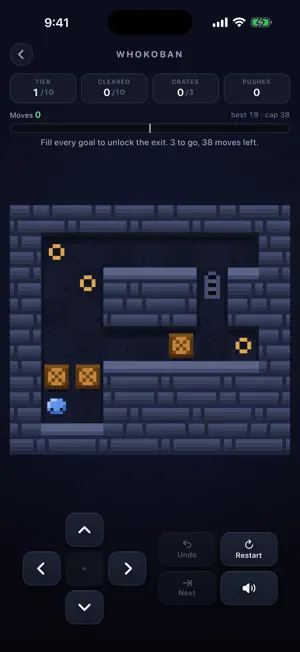
About Whokoban: Sokoban Puzzles
Every crate is parked. That is when the door opens, and that is when the level really starts. Whokoban is Sokoban with one rule changed. Filling every goal does not finish the puzzle — it unlocks the exit. You still have to walk Whoko to the door, back through the warehouse you have just rearranged, where the crates you shoved into place are now the walls in your way. Park everything perfectly and strand yourself, and you lose. MEASURED, NOT ESTIMATED Every level ships with the exact fewest possible moves it can be finished in — walking to the door included — computed by an exhaustive solver. That number is what you play against, and twice it is your move cap. THREE SETS OF LEVELS, AND THEY DO NOT PLAY ALIKE CLASSIC WHOKOBAN LEVELS — 5,000 of them. Ten tiers of 500, three crates up to twelve, every one verified solvable and measured. A level comes round a second time only after you have played the other 499 on its tier. Finish within 10% of the best possible and you rise a tier on the spot; otherwise ten clears on the tier rise anyway. THE GREAT HALLS OF WHOKO — 1,000 of them, made for iPhone Duo. The classic game in halls half again as big: 100 a tier across ten tiers, the same monsters, the same cap, every one measured. Unfold the phone and they are what a new game deals. THE LOST LEVELS OF XSOKO — 90 of them, built backwards out of their solved state and about three times denser in pushes per crate. Six tiers of fifteen, met in order of measured difficulty. No monsters and no move cap — long by design. SOMETHING ELSE IS DOWN HERE From tier 4 a monster shares the floor with you, and from tier 8 there are two. They cannot kill you — no timer, no death. Walk into one and you shove it aside, for one move; corner one with nowhere left to retreat and you squeeze past it. THREE WAYS TO PLAY Pick a mode when you start a run. Standard is everything above. Casual takes the pressure out: no move cap, no monsters, nothing to lose — undo as far back as you like, skip any level, and play for as long as you want while the levels quietly grow with you. Hardcore takes the net away: no undo, no restart, and one lost level — a crate stranded, or the cap reached — ends the whole run. TWENTY-ONE LOOKS, ONE GAME Two are free: Classic, and FlyCraft — Herbie on loan from the flying-machine game, with his drawing board, his riff and his yell. Eight are earned by climbing — Arcade, Pixel Art, Zen Garden, Cardboard, Blueprint, Cargo Bay, Xsoko, Stained Glass — one per tier, the last for finishing a run. Four belong to Hardcore alone — Ember, Noir, Circuit Board, Gilded. One belongs to iPhone Duo alone: Origami, for a clear on the inner display. And six belong to the calendar — Autumn, Halloween, Christmas, Winter, Spring and Summer — each in sight for a few weeks a year, each paid for by its season's own award, and each worn only while its season is on. A theme changes how the board is drawn, never how it plays. 88 ACHIEVEMENTS For finishing at the best possible, for the fewest possible pushes — a different skill — for clearing whole tiers, for a run from tier 1 to 10 without a single undo, for a clear in every look, for surviving Hardcore, for a hundred levels of Casual, for the Great Halls, for each of the six seasons, and for the mistake this game invents: parking every crate with no way left to reach the door. MADE TO BE PLAYED ANYWHERE No ads. No in-app purchases. No account to make. Nothing is tracked and nothing is collected — there is no network code in the game at all, and every level is rebuilt on your phone from a seed, so it all works with no signal. Ten languages, switchable inside the game with no relaunch. Swipe anywhere on the screen or use the arrow pad — one swipe is one move, never a drag. A stuck board is called the moment no way to finish remains, with the ways out on a card. The soundtrack tightens as your count closes on the cap; music and effects switch off separately.
What’s new
Version 2.2.0 · Updated October 4, 2026
Whokoban, in season. The title screen now dresses for the time of year, and six looks come and go with it: Autumn from 15 September, Halloween from 15 October, Christmas from 15 December, Winter through February, Spring from the equinox, Summer from the solstice. Each is listed a fortnight before it opens, worn while its season is on, and kept in sight a little after — back the next year. Each is paid for by an award of its own, counted only while its season is on: bring the harvest in, shove a monster aside ten times, park fifty presents, clear ten levels in the snow, five at the best possible in the garden, walk a thousand squares on the beach. Progress carries over from one year to the next. Six achievements belong to the seasons — 88 in all. They stay outside Nothing Left to Prove, so the one you can only earn in October never holds the rest hostage. The title screen says which season it is and until when, with your progress toward its look underneath; a tap opens the theme picker.
App privacy
The developer, Wizhut.tech, reported these privacy practices to Apple.
Data Not Collected
The developer does not collect any data from this app.
Alternatives to Whokoban: Sokoban Puzzles
Looking for apps like Whokoban: Sokoban Puzzles? Here are 6 similar apps on the App Store. The highest rated is Sokobear: Moving Co. (5.0/5), and all 6 are free to download.
-
 Sliding Block Adventure
-
 Sokoban: Evolution
-
 Casually Casual Warehouse Game
-
 Boney GO! - A Retro Puzzle
-
 Sokoscape - Escape the maze
-
 Sokobear: Moving Co.
5.0
Sokobear: Moving Co.
5.0
| App | Rating | Price | Last updated | Compare |
|---|---|---|---|---|
| Whokoban: Sokoban Puzzles | – | 2.99 USD | October 4, 2026 | |
| Sliding Block Adventure | – | Free | Nov 10, 2025 | Compare |
| Sokoban: Evolution | – | Free | Oct 1, 2026 | Compare |
| Casually Casual Warehouse Game | – | Free | Jun 10, 2026 | Compare |
| Boney GO! - A Retro Puzzle | – | Free | Jun 26, 2026 | Compare |
| Sokoscape - Escape the maze | – | Free | Jul 25, 2026 | Compare |
| Sokobear: Moving Co. | 5.0 / 5 (13) | Free | Oct 1, 2026 | Compare |