

Salat: Learn How to Pray
Abubucker Siddeek Mohamed Sharik Education iPhoneiPadiPod touch
Salat: Learn How to Pray is a free Education app for iPhone and iPad by Abubucker Siddeek Mohamed Sharik. Requires iOS 17.0. Updated October 1, 2026.
- Price
- Free
- on the App Store
- Size
- 15 MB
- Age 4+
- Updated
- Oct 1
- 2026 · v1.1
Screenshots


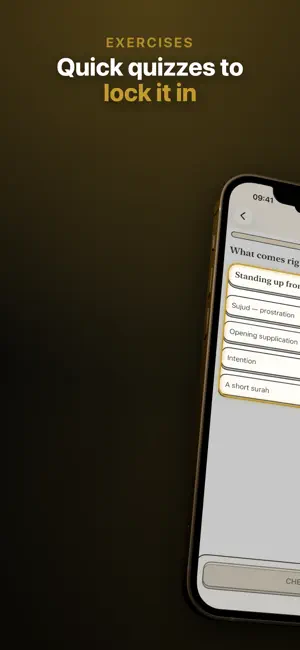
About Salat: Learn How to Pray
Learn exactly what to say in every position of the prayer, one step at a time. The Arabic, how to pronounce it in your own language, and what it means, side by side. No account, no network: just you and the words of the salah. You know the movements. Standing, bowing, forehead to the ground, sitting. What you do not know is what to say while you are down there, and nobody teaches it slowly enough to actually learn. FOURTEEN STEPS, IN ORDER Every position of the prayer, from the opening takbir to the final salam, in the order you perform them. Tap one and you get four things, never mixed together: what your body does, the Arabic text, how to pronounce it written in your own language, and what it actually means. LINE BY LINE Long passages such as Al-Fatiha and the Tashahhud are broken line by line, with the Arabic, the pronunciation and the meaning side by side on each line. That alignment is the whole lesson. You learn which words you are saying, not just the sound of them. HEAR IT, THEN HEAR YOURSELF For Al-Fatiha and the short surah, tap play and hear Mahmoud Khalil Al-Husary or Mishary Rashid Alafasy recite the line. Al-Husary's teaching recording is slow and detached, made to be repeated after. Then record yourself. Both traces are drawn on the same waveform, so you can see where you rushed and where you stopped short. The recording stays on your iPhone and is never sent anywhere. WRITTEN FOR YOUR LANGUAGE The pronunciation is not transliterated once and reused. A French reader does not read "Subhaana" the way an English reader does, so each language gets its own spelling, written for the way that language is read aloud. Fourteen languages: English, French, Arabic, Indonesian, Malay, Urdu, Bengali, Turkish, Russian, Spanish, Portuguese, German, Italian and Dutch. A WIDGET THAT KEEPS TEACHING Add the widget to your Home Screen and the positions cycle on their own, with what is said at each one. You are not studying. You are just seeing it, several times a day, until it sticks. PRIVATE AND OFFLINE No account. No sign-in. No network: the app makes no request of any kind, so it works on a plane, in a basement, anywhere. Nothing is collected, because there is nowhere to collect it to. ON THE CONTENT The prayer described here is the ground shared by the four Sunni schools of law. Where they differ (the wording of the Tashahhud, where the hands rest, the Qunut), the app tells you they differ, in a note on that step, instead of quietly picking one. It is a memorisation aid. It does not replace a teacher, and it does not claim to.
What’s new
Version 1.1 · Updated October 1, 2026
Now in 14 languages, each with its own phonetics. New Memorise tab: quizzes that only ask what you have already read, flashcards, and voice practice line by line. My progress: study days, what you hold, and what is still waiting. A daily reminder, and a widget that reads on any Home Screen.
App privacy
The developer, Abubucker Siddeek Mohamed Sharik, reported these privacy practices to Apple.
Data Not Collected
The developer does not collect any data from this app.
Alternatives to Salat: Learn How to Pray
Looking for apps like Salat: Learn How to Pray? Here are 6 similar apps on the App Store. The highest rated is Ajibus — Learn Quran Reading (5.0/5), and all 6 are free to download.
-
 NurSalah – Learn to Pray
-
 Salat&Ihsan · Guided Prayer
-
 Dini TV : apprendre en famille
-
 Salah - Learn How to Pray
4.9
-
 Arabico: Learn Quran Arabic
-
 Ajibus — Learn Quran Reading
5.0
| App | Rating | Price | Last updated | Compare |
|---|---|---|---|---|
| Salat: Learn How to Pray | – | Free | October 1, 2026 | |
| NurSalah – Learn to Pray | – | Free | Oct 16, 2026 | Compare |
| Salat&Ihsan · Guided Prayer | – | Free | Oct 16, 2026 | Compare |
| Dini TV : apprendre en famille | – | Free | Sep 14, 2026 | Compare |
| Salah - Learn How to Pray | 4.9 / 5 (27) | Free | Sep 29, 2026 | Compare |
| Arabico: Learn Quran Arabic | – | Free | Sep 20, 2026 | Compare |
| Ajibus — Learn Quran Reading | 5.0 / 5 (1) | Free | Sep 28, 2026 | Compare |