

Harmonie tonale
Aurelien Roblin Music iPhoneiPadiPod touch
Harmonie tonale is a free Music app for iPhone and iPad by Aurelien Roblin. Requires iOS 15.1. Updated October 22, 2026.
- Price
- Free
- on the App Store
- Size
- 33 MB
- Age 4+
- Updated
- Oct 22
- 2026 · v1.5.0
Screenshots



About Harmonie tonale
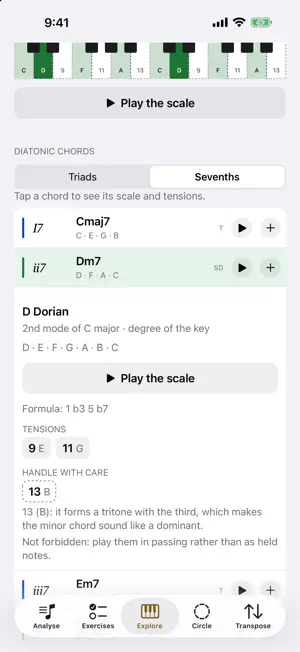
You play a progression, it sounds right, and you could not say why. Harmonie answers that question, helps you write what comes next, then drills you until the answer comes on its own. Enter a progression and the app shows what each chord does, its degree, its function, and the cadence that closes the phrase. WHY, NOT JUST WHAT Most chord apps name things. This one explains them. Why a borrowed iv darkens the arrival on I. Why a tritone substitution keeps its pull. Why V going to vi leaves the phrase open. The leading tone is named, and so is what it pulls towards. WRITE Under your progression, the app suggests the chords that can follow, from the most expected to the most colourful: authentic cadence, interrupted cadence, secondary dominant. One tap adds it. Loop the progression at the tempo you choose, and save it for later. SEVENTHS, TENSIONS AND MODES Switch the palette to seventh chords, with their formula in degrees, written the classical way (Cmaj7) or the jazz way (CΔ, D-7). On every chord, the app tells you which mode it is played in at that point, which 9ths, 11ths and 13ths sound, and which ones to handle with care. Beyond major and minor, twenty modal keys, from Dorian to Phrygian dominant, each with its characteristic note. PRACTICE Short sets that never repeat. Name a degree, name a cadence, find the key, figure an inversion, count the accidentals in a key signature, name a mode, spot the tension that clashes, pick the next chord. Three levels, and every answer is marked and explained. TRY SOMETHING ELSE On any chord, the app offers what harmony allows in its place: tritone substitution, secondary dominant, ii-V, borrowed minor subdominant, Neapolitan sixth, interrupted cadence. One tap and you hear the difference. SEE AND HEAR A keyboard and a guitar fretboard where the notes of the chord light up. Real staff notation, or guitar tab with several positions per chord. The circle of fifths, with its neighbours and its relative. Transposition, to compare two keys by ear. WRITTEN IN ENGLISH, NOT TRANSLATED The English here was written by hand, in the terms English-speaking theory actually uses. I-vi-ii-V is a rhythm changes turnaround, not a French anatole. V to I in root position is a perfect authentic cadence. V to vi is interrupted, and deceptive is given alongside it, because the two traditions disagree and you may have learned either one. Note names are a separate setting, independent of the language. On first launch, tell the app what you play and it sets itself up. NOTHING ASKED OF YOU No account, no ads, no tracking. Analyses, exercises and progress stay on your device, and everything works offline, including on a plane. Only the verification of your purchase goes through our payment provider. HARMONIE + The heart of the app is free and will stay free: analysing a progression, writing, practising, listening. Harmonie + adds the why and the memory: the explanations of borrowed chords, secondary dominants, substitutions and every suggested move, the tensions of each chord in your progression, French figured bass as a second notation system, all your saved progressions, and your exercise progress kept from one session to the next. Monthly or annual subscription, cancellable at any time in your device settings, or a single lifetime purchase. Anyone who bought Harmonie + before this version keeps everything, for good. Terms of use (EULA): https://www.apple.com/legal/internet-services/itunes/dev/stdeula/ Privacy policy: https://app-support-pages.netlify.app/harmonie/
What’s new
Version 1.5.0 · Updated October 22, 2026
Harmonie has a new look: it now feels like an iPhone app, clear and familiar. A new design. The colours, the font and the icons are those of iOS, and the tab bar is the native one, in light and dark mode. The four function colours stay, brighter, and the brand's gold marks what you can tap. One key, always in the same place. The button at the top left of every screen opens the same choice: major, minor or one of twenty modes. Transposition follows the modes. D Dorian moves to E Dorian, with the right key signatures and the degrees read in the mode. Fewer round trips. A chord added from Explore offers to show your progression, Analyse takes you straight to transposition, and the circle of fifths opens the chords of the key you picked. After a wrong answer in an exercise, you can open the chord in question: its scale, its tensions, and what clashes. Plus a few fixes: the app now opens in your iPhone's language instead of defaulting to English, the key signature quiz no longer shows the answer on the staff, and several texts read better.
App privacy
The developer, Aurelien Roblin, reported these privacy practices to Apple.
Data Not Linked to You
The following data, which may be collected but is not linked to your identity, may be used for the following purposes:
- Purchases: Purchase History
- Identifiers: User ID
Used for: App Functionality
Alternatives to Harmonie tonale
Looking for apps like Harmonie tonale? Here are 6 similar apps on the App Store. The highest rated is FretCipher (5.0/5), and all 6 are free to download.
-
 Fretboard Matrix
-
 FretCipher
5.0
-
 BComposer Scales
3.0
-
 Riffo: Guitar Scales & Solos
-
 ARN-Music 3
-
 Guitar Mode Finder
5.0
| App | Rating | Price | Last updated | Compare |
|---|---|---|---|---|
| Harmonie tonale | – | Free | October 22, 2026 | |
| Fretboard Matrix | – | Free | Oct 14, 2026 | Compare |
| FretCipher | 5.0 / 5 (4) | Free | Oct 24, 2026 | Compare |
| BComposer Scales | 3.0 / 5 (1) | Free | Oct 7, 2026 | Compare |
| Riffo: Guitar Scales & Solos | – | Free | Oct 30, 2026 | Compare |
| ARN-Music 3 | – | Free | Aug 2, 2026 | Compare |
| Guitar Mode Finder | 5.0 / 5 (2) | Free | Sep 21, 2026 | Compare |
Compare Harmonie tonale with the top alternatives: ratings, updates, ASO score and keyword gaps →