

Set Theory Fundamentals
AFTW LLC Education iPhoneiPadiPod touch
Set Theory Fundamentals is a free Education app for iPhone and iPad by AFTW LLC. Requires iOS 15.1. Updated June 3, 2026.
- Price
- Free
- on the App Store
- Size
- 38 MB
- Age 4+
- Updated
- Jun 3
- 2026 · v1.0
Screenshots
Save to Pinterest


About Set Theory Fundamentals
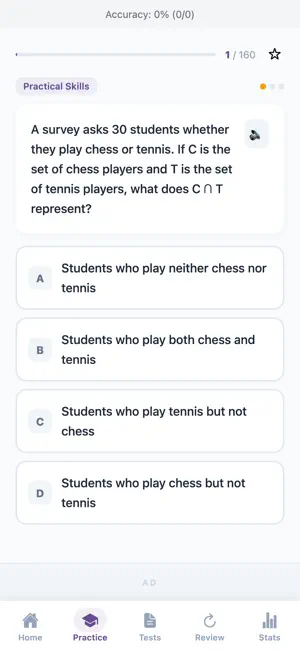
Set Theory Fundamentals is an independent study app for building confidence with core set theory ideas through focused practice. It is designed for students, self-learners, and anyone reviewing mathematical foundations for coursework, interviews, or exams. Practice across four topic areas: Fundamentals, Practical Skills, Common Pitfalls, and Advanced Concepts. Work through 160 questions covering notation, operations, relations, functions, proofs, cardinality, and common reasoning traps. Features: - FSRS spaced-repetition intervals to help you review at the right time - Weak-point heatmap to spot topics that need attention - Daily challenge for consistent practice - Mock exams for timed review - Explanation included with every question - Offline practice, no login required Practice offline, no login required. Your study flow is built for private, repeatable review. Independent study app for Set Theory Fundamentals practice. Not affiliated with, endorsed by, or sponsored by any company, certification body, exam operator, or vendor. All trademarks belong to their respective owners.
App privacy
The developer, AFTW LLC, reported these privacy practices to Apple.
Data Not Collected
The developer does not collect any data from this app.
Alternatives to Set Theory Fundamentals
Looking for apps like Set Theory Fundamentals? Here are 6 similar apps on the App Store. The highest rated is MicroParse (5.0/5), and 5 of the 6 are free to download.
-
 topological gate
-
 MicroParse
5.0
-
 Newtonic: Physics Simulator
-
 AP Chemistry Practice Online
-
 Quantum Physics: Visual Lab
4.0
-
 Physics Playground App
3.0
| App | Rating | Price | Last updated | Compare |
|---|---|---|---|---|
| Set Theory Fundamentals | – | Free | June 3, 2026 | |
| topological gate | – | Free | Oct 13, 2025 | Compare |
| MicroParse | 5.0 / 5 (2) | 1.99 USD | Feb 14, 2024 | Compare |
| Newtonic: Physics Simulator | – | Free | Nov 11, 2026 | Compare |
| AP Chemistry Practice Online | – | Free | Oct 1, 2025 | Compare |
| Quantum Physics: Visual Lab | 4.0 / 5 (1) | Free | May 28, 2026 | Compare |
| Physics Playground App | 3.0 / 5 (1) | Free | Oct 25, 2026 | Compare |