

Fractured: US
OMAR DANIEL GRAZIANO Reference iPhoneiPadiPod touch
Fractured: US is a free Reference app for iPhone and iPad by OMAR DANIEL GRAZIANO. Requires iOS 17.0. Updated September 13, 2026.
- Price
- Free
- on the App Store
- Size
- 2 MB
- Age 9+
- Updated
- Sep 13
- 2026 · v1.4
Screenshots

About Fractured: US
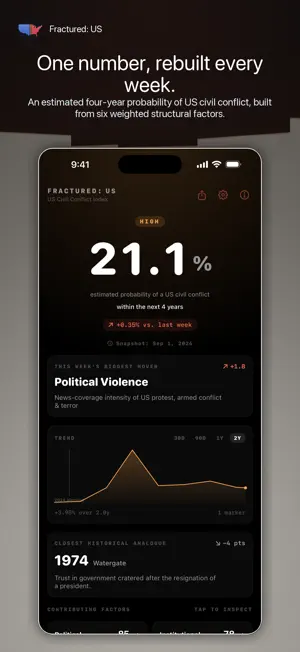
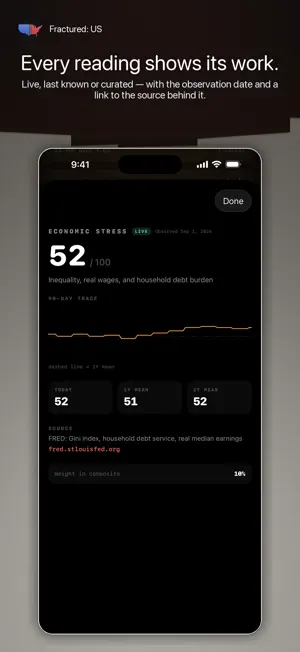
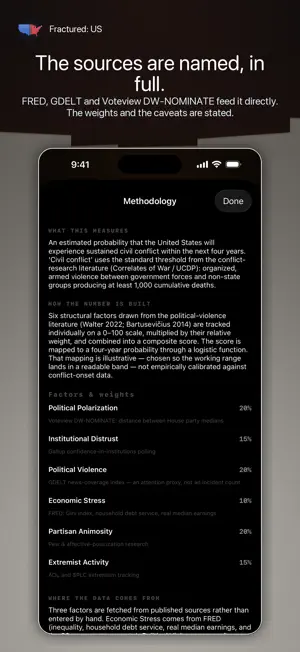
Fractured: US is a single, focused screen that surfaces one illustrative number: an estimated four-year probability of a US civil conflict, built as a weighted composite of six structural factors from the political-violence research literature. It is a discussion tool, not a forecast. The methodology is right inside the app, in plain language, with the sources cited. WHAT FRACTURED: US SHOWS • A single hero probability, color-coded by risk band: Stable, Elevated, High, Severe, Critical. • A trend chart (30-day, 90-day, 1-year, 2-year) built from the stored weekly history, with markers for notable national events, and the closest historical analogue. • Six contributing factors, each on a 0–100 scale with its weight visible: – Political Polarization (20%) — ideological distance between the major parties – Institutional Distrust (15%) — share lacking confidence in courts, Congress, media, elections – Political Violence (20%) — news-coverage intensity of US protest, armed conflict and terror – Economic Stress (10%) — inequality, real wages, and household debt burden – Partisan Animosity (20%) — affective polarization: hostility toward the opposing party – Extremist Activity (15%) — militia mobilization and organized political extremism • Tap any factor for its 90-day trace, its long-run mean, its source, and the date it was last observed. • A fifty-state view, labelled illustrative: the per-state figures are fixed offsets from the national reading, not measurement. • A week-over-week delta so you can read direction at a glance, and a warning when the index itself stops refreshing. THE METHODOLOGY, IN BRIEF Each factor is tracked on a 0–100 scale, multiplied by its weight, and combined into a composite score. The score is mapped to a four-year probability through a logistic function; the mapping is illustrative, not empirically calibrated. Three factors are fetched from published sources rather than entered by hand. Economic Stress comes from FRED (inequality, household debt service, real median earnings, the 30-year mortgage rate). Political Violence comes from GDELT's index of US news coverage of protest, armed conflict and terror — a measure of media attention, not a count of incidents. Political Polarization is Voteview's DW-NOMINATE distance between the House party medians, which moves when a new Congress convenes rather than weekly. The remaining three are curated from published Pew, Gallup, ADL and SPLC reporting and hold their last published value between reports. Every factor is labelled Live, Last known or Curated, and carries its own observation date. The methodology screen, from the info button, walks through every step, names every source (Correlates of War / UCDP threshold, Walter 2022, Bartusevičius 2014, FRED, GDELT, Voteview), and is explicit about the model's limits. WHAT FRACTURED: US IS NOT • It is not a prediction. • It is not partisan — no party, candidate, or policy is named. • It is not a news feed — there are no headlines and no remote push notifications (the optional daily reminder is a local notification only). • It collects no personal data and has no accounts or analytics — its only network activity is downloading a public weekly data file. Civil-conflict probability cannot be measured directly; the academic literature offers ranges from below 5% to above 30%. Treat the number as a focal point for thinking, not a verdict. PRIVACY Fractured: US collects no personal data and contains no analytics, ads, or third-party SDKs. Its only network request downloads a public data file (the weekly index) — no personal information is sent. There is no account, no login, and no subscription. Notifications are opt-in and local. Optional tips are the only in-app purchase, processed by Apple. FOR Civic-minded readers, political-science students, journalists, researchers, and anyone who wants a sober quantitative frame for a hard qualitative question. Educational use only.
What’s new
Version 1.4 · Updated September 13, 2026
Fractured can now ask, every so often, whether you would like to rate it on the App Store. The invitation appears a few seconds after the app opens, never more than a handful of times a year, and not at all once you have left a rating. Nothing else has changed: the index, its factors and its sources are exactly as they were in 1.3.
App privacy
The developer, OMAR DANIEL GRAZIANO, reported these privacy practices to Apple.
Data Not Collected
The developer does not collect any data from this app.
Alternatives to Fractured: US
Looking for apps like Fractured: US? Here are 6 similar apps on the App Store. The highest rated is Once: Learn to Read at Home (5.0/5), and all 6 are free to download.
-
 60th Force Support Squadron
-
 Pocket Constitution: Reference
-
 Nature Reach
-
 Once: Learn to Read at Home
5.0
Once: Learn to Read at Home
5.0
-
 The Agora: Learn Philosophy
5.0
The Agora: Learn Philosophy
5.0
-
 Languakids - Spanish for Kids
4.5
Languakids - Spanish for Kids
4.5
| App | Rating | Price | Last updated | Compare |
|---|---|---|---|---|
| Fractured: US | – | Free | September 13, 2026 | |
| 60th Force Support Squadron | – | Free | Apr 30, 2026 | Compare |
| Pocket Constitution: Reference | – | Free | Jul 14, 2026 | Compare |
| Nature Reach | – | Free | Oct 13, 2026 | Compare |
| Once: Learn to Read at Home | 5.0 / 5 (6) | Free | Oct 2, 2026 | Compare |
| The Agora: Learn Philosophy | 5.0 / 5 (9) | Free | Sep 30, 2026 | Compare |
| Languakids - Spanish for Kids | 4.5 / 5 (8) | Free | Aug 28, 2026 | Compare |
Compare Fractured: US with the top alternatives: ratings, updates, ASO score and keyword gaps →