

The Leveller
Stephen Conley Finance iPhoneiPadiPod touch
The Leveller is a paid Finance app for iPhone and iPad by Stephen Conley. Requires iOS 15.0. Updated June 7, 2026.
- Price
- 4.99 USD
- on the App Store
- Size
- 4 MB
- Age 4+
- Updated
- Jun 7
- 2026 · v1.3
Screenshots
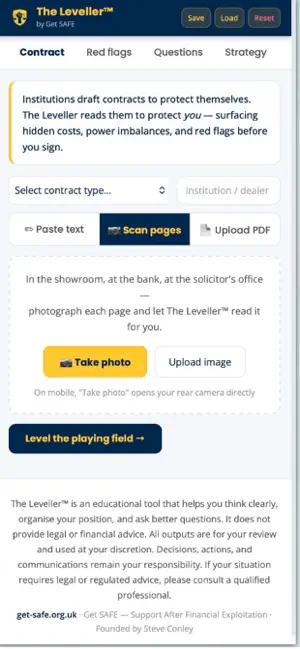


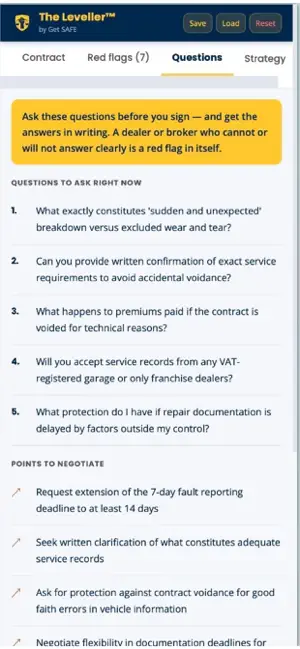
About The Leveller
Know what you're signing. Before it's too late. Most people sign contracts they haven't fully read. Not because they don't care — but because contracts are long, dense, and written by people with more legal resource than the person signing them. The Leveller™ changes that. Upload any contract — a PDF, a photo, or pasted text — and The Leveller™ analyses it in plain English, surfacing hidden costs, unfair clauses, risk-shifting language, and power imbalances. Every agreement gets a risk score out of 100 so you know exactly what you're agreeing to before you commit. WHEN YOU CAN'T TALK TO ANYONE Some of the people who need The Leveller™ most are those who have already been harmed — and are now being asked to sign something that limits what they can do next. Settlement agreements with confidentiality clauses. Redress scheme rules that cap recovery. Post-claim insurer letters that reassign rights without explanation. These documents arrive when legal advice is most needed and least affordable. The Leveller™ gives you a way to understand what you are being asked to agree to — privately, without breaching any confidentiality obligation, and without legal fees. WHAT THE LEVELLER™ ANALYSES: Motor finance, mortgages, credit cards, and secured loans Investments, pensions, and structured products Insurance, life cover, and income protection Tenancy, leasehold, and property agreements Legal services agreements and Conditional Fee Agreements (CFAs) Claims management and no win no fee contracts Insurance-backed guarantees (IBGs) and warranties Home improvement, retrofit, cavity wall, and solar panel contracts Settlement agreements and assignment of rights Complaints, redress and arbitration schemes Subrogation and insurer recovery communications Employment, zero hours, and settlement agreements Subscriptions, telecoms, and utilities WHAT YOU GET: A risk score out of 100 Plain-English summary of what you're agreeing to Hidden costs and undisclosed charges identified Red flags rated High, Medium, or Low risk Questions to ask before you sign Strategic guidance on your position A downloadable PDF report to keep or share WHAT TESTERS SAY: "The Leveller is beginning to support people not only before they sign something, but also after harm has already occurred — when they are trying to understand settlement offers, assignments, insurer recovery letters, redress schemes and arbitration processes. That is often when consumers are at their most vulnerable." — Debra Sofia Magdalene, Retrofit Right Campaign BUILT BY GET SAFE — SUPPORT AFTER FINANCIAL EXPLOITATION The Leveller™ was developed by Get SAFE, a UK organisation supporting survivors of financial harm. It is an informed consent tool — not legal advice — designed to put ordinary people on a level footing with the institutions asking them to sign. Know what you're signing.
What’s new
Version 1.3 · Updated June 7, 2026
Review prompt added. The Leveller™ now asks for your rating after your second analysis — helping more people discover the app. Also includes updated document categories and post-harm analysis improvements.
App privacy
The developer, Stephen Conley, reported these privacy practices to Apple.
Data Not Collected
The developer does not collect any data from this app.
Alternatives to The Leveller
Looking for apps like The Leveller? Here are 6 similar apps on the App Store. The highest rated is WealthAims (5.0/5), and all 6 are free to download.
-
 Heartbeat Estate Planning
-
 Bowman Estate Planning
-
 WealthAims
5.0
-
 Tandem Estate Planning
-
 Hampden Bank
-
 Saturn for Finance
| App | Rating | Price | Last updated | Compare |
|---|---|---|---|---|
| The Leveller | – | 4.99 USD | June 7, 2026 | |
| Heartbeat Estate Planning | – | Free | Sep 30, 2025 | Compare |
| Bowman Estate Planning | – | Free | Sep 30, 2025 | Compare |
| WealthAims | 5.0 / 5 (1) | Free | May 26, 2026 | Compare |
| Tandem Estate Planning | – | Free | Oct 2, 2025 | Compare |
| Hampden Bank | – | Free | Sep 23, 2026 | Compare |
| Saturn for Finance | – | Free | Oct 8, 2026 | Compare |
Compare The Leveller with the top alternatives: ratings, updates, ASO score and keyword gaps →