

Bedside: AI Nursing Practice
MBAApps Education iPhoneiPadiPod touch
Bedside: AI Nursing Practice is a free Education app for iPhone and iPad by MBAApps. Rated 5.0/5 from 2 ratings. Requires iOS 15.0. Updated October 23, 2026.
- Rating
- 5.0
- 2 ratings
- Price
- Free
- on the App Store
- Size
- 39 MB
- Age 17+
- Updated
- Oct 23
- 2026 · v5.1
Screenshots


About Bedside: AI Nursing Practice
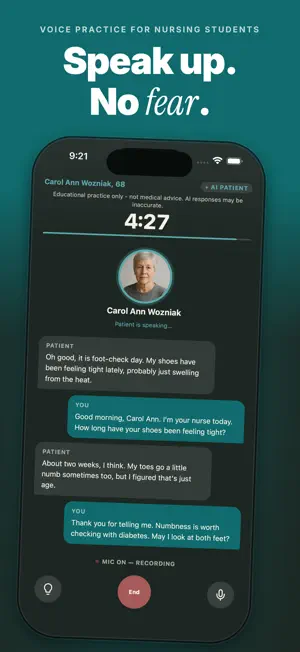
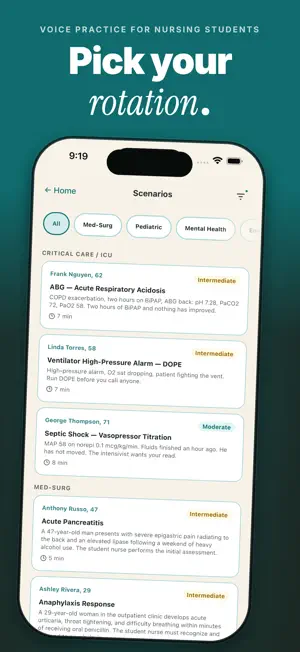
Most nursing students know the content. They freeze when they're standing at the bedside. Bedside is where you practice that part. You speak out loud. An AI patient answers. When the session ends, you get feedback on your clinical reasoning and how you communicated. There is no multiple choice and no answer key, only a conversation and an honest review of it. FOR CLINICAL ROTATIONS 90 voice-based scenarios cover med-surg, pediatrics, mental health, labor and delivery, maternity, critical care, emergency, substance use, end-of-life, families, and community health. Pick your rotation and run the conversation until it feels natural. Each scenario opens with a patient card: name, age, chief complaint. From there you ask questions, give instructions, and talk through what you think is happening and what you would do next. The patient responds the way a real one would, including when you ask badly. Difficulty runs from 1 (your first week on the floor) to 5 (critical emergencies and ethical dilemmas). Move up when you're ready. FOR NCLEX PREP The Next Gen NCLEX tests clinical judgment, not just recall. 14 NCLEX scenarios put you in situations like early sepsis and competing patient priorities, and you talk through your reasoning out loud. The AI scores it against the NCSBN Clinical Judgment Measurement Model, the framework behind the exam. If you've done thousands of practice questions and still feel underprepared, this is the gap. You need reps thinking out loud, not more rationales. HOW IT WORKS 1. Pick a scenario by rotation, specialty, or difficulty. 2. Talk to the AI patient out loud. 3. Explain your clinical decisions as you make them. 4. Get specific feedback on your judgment and communication as soon as the session ends. BUILT BY A NURSE Every scenario and rubric was written by Dr. Stacie Dee, DNP, PMHNP-BC. 11 years in emergency medicine. Faculty at Hofstra Northwell School of Nursing. The feedback you get is what a clinical instructor actually looks for. One-time purchase. No auto-renewal. Access ends automatically. Bedside is an educational tool and does not provide medical advice. Not affiliated with or endorsed by NCSBN. NCLEX is a registered trademark of NCSBN.
What’s new
Version 5.1 · Updated October 23, 2026
Calls now start faster and more reliably. We also made general performance and stability improvements across the app.
App privacy
The developer, MBAApps, reported these privacy practices to Apple.
Data Linked to You
The following data, which may be collected and linked to your identity, may be used for the following purposes:
- Purchases: Purchase History
- Identifiers: Device ID, User ID
- Contact Info: Email Address
- User Content: Audio Data, Other User Content
Used for: Analytics, App Functionality
Data Not Linked to You
The following data, which may be collected but is not linked to your identity, may be used for the following purposes:
- Usage Data: Product Interaction
- Diagnostics: Crash Data, Performance Data
Used for: Analytics, App Functionality
Alternatives to Bedside: AI Nursing Practice
Looking for apps like Bedside: AI Nursing Practice? Here are 6 similar apps on the App Store. The highest rated is NGN Studio (5.0/5), and 5 of the 6 are free to download.
-
 NCLEX Clinical Trainer
-
 Nursing Clinical Judgment Quiz
-
 Breath Lifestyle
-
 ANCC Exam Review & Study Guide
1.2
-
 DuOET: Medical English
-
 NGN Studio
5.0
| App | Rating | Price | Last updated | Compare |
|---|---|---|---|---|
| Bedside: AI Nursing Practice | 5.0 / 5 (2 ratings) | Free | October 23, 2026 | |
| NCLEX Clinical Trainer | – | Free | May 18, 2026 | Compare |
| Nursing Clinical Judgment Quiz | – | Free | May 14, 2026 | Compare |
| Breath Lifestyle | – | Free | Oct 17, 2025 | Compare |
| ANCC Exam Review & Study Guide | 1.2 / 5 (5) | 4.99 USD | Jan 16, 2024 | Compare |
| DuOET: Medical English | – | Free | Oct 16, 2026 | Compare |
| NGN Studio | 5.0 / 5 (1) | Free | Aug 18, 2026 | Compare |