

ProVelocity Swing Analyzer
ELIJAH LEON TAITEL Sports iPhoneiPadiPod touch
ProVelocity Swing Analyzer is a free Sports app for iPhone and iPad by ELIJAH LEON TAITEL. Requires iOS 15.0. Updated April 13, 2026.
- Price
- Free
- on the App Store
- Size
- 72 MB
- Age 4+
- Updated
- Apr 13
- 2026 · v1.0
Screenshots
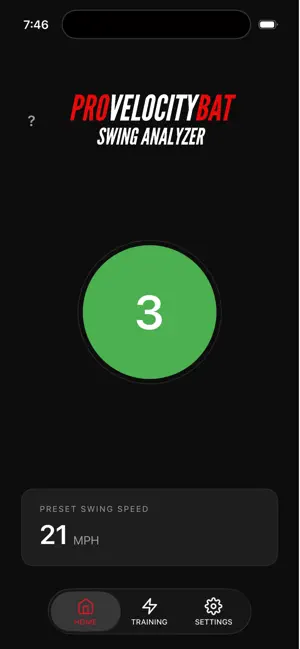
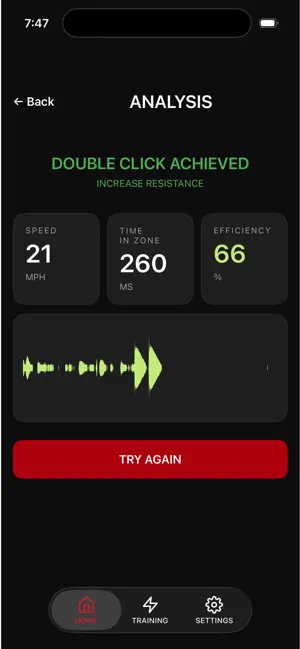

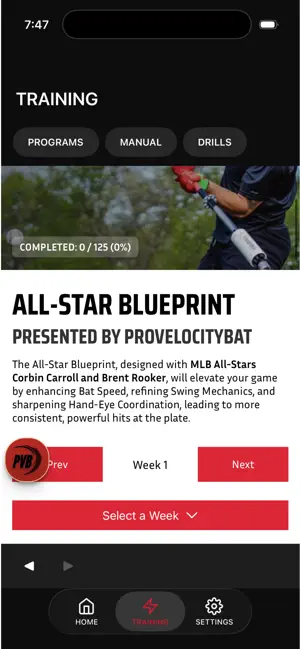
About ProVelocity Swing Analyzer
ProVelocity turns your phone into a precision swing analyzer. Using advanced acoustic detection, it listens for the distinctive double-click of your resistance bands at full bat extension to measure exactly how long your swing stays on plane — then calculates your On-Plane Efficiency (OPE) percentage. HOW IT WORKS Mount your resistance bands, place your phone 3-5 feet from your swing path with the microphone facing up, and swing. ProVelocity's audio engine filters out background noise using a bandpass filter tuned to the click frequency range, then detects whether your bat produced a single click or the coveted double click — meaning your swing entered and exited the hitting zone on plane. ON-PLANE EFFICIENCY OPE is the core metric that separates good swings from great ones. ProVelocity calculates your theoretical swing time based on physics — your bat length, batter height, resistance load, and barrel mass — then compares it to your actual measured time in the zone. The result is a clear percentage score. Hit 80% or above and you're ready to increase resistance. Below that, the app tells you to dial it back and refine your mechanics. PROGRESSIVE RESISTANCE TRAINING ProVelocity is built around a simple feedback loop: swing, measure, adjust. When your efficiency climbs above 80%, add resistance. When it drops, reduce it. Over time, you build real bat speed through progressive overload while maintaining proper swing mechanics — not just swinging harder. EQUIPMENT PROFILES Pre-configured profiles for baseball, softball, and cricket bats. Select your bat length (30" to 33"), choose from 5 lb, 7.5 lb, 8.5 lb, or 15 lb resistance bands, enter your height, and the app calculates your expected swing speed and total swing radius automatically. SWING HISTORY Every swing is logged with date, speed, time in zone, and efficiency percentage. Track your progress over weeks and months of training. See exactly when your mechanics improved and how your efficiency trends over time. WAVEFORM VISUALIZATION After each swing, view a detailed audio waveform showing the decibel levels captured during your swing. See exactly where peaks were detected and understand what your swing sounded like to the algorithm. TUNABLE SENSITIVITY Training in a noisy cage? Quiet backyard? Adjust the decibel sensitivity threshold and click window timing to match your environment. ProVelocity works wherever you train. KEY FEATURES • Real-time acoustic swing analysis • On-Plane Efficiency percentage scoring • Physics-based swing speed calculation • Progressive resistance recommendations • Baseball, softball, and cricket support • Detailed swing history database • Audio waveform visualization • Adjustable sensitivity for any environment • Works completely offline — no internet needed • No subscription, no ads, no in-app purchases Built for serious players and coaches who believe every swing counts.
App privacy
The developer, ELIJAH LEON TAITEL, reported these privacy practices to Apple.
Data Not Collected
The developer does not collect any data from this app.
Alternatives to ProVelocity Swing Analyzer
Looking for apps like ProVelocity Swing Analyzer? Here are 6 similar apps on the App Store. The highest rated is ProVelocity Bat Swing Analyzer (5.0/5), and all 6 are free to download.
-
 ProVelocity Bat Swing Analyzer
5.0
-
 Ember Hitting Analyzer
4.5
-
 CamWood
5.0
-
 TAG Sports
4.6
-
 HeyBLU: Baseball Strike Zone
4.9
-
 Pelotero
4.3
| App | Rating | Price | Last updated | Compare |
|---|---|---|---|---|
| ProVelocity Swing Analyzer | – | Free | April 13, 2026 | |
| ProVelocity Bat Swing Analyzer | 5.0 / 5 (5) | Free | Jul 4, 2024 | Compare |
| Ember Hitting Analyzer | 4.5 / 5 (23) | Free | Oct 17, 2026 | Compare |
| CamWood | 5.0 / 5 (1) | Free | Oct 11, 2026 | Compare |
| TAG Sports | 4.6 / 5 (8) | Free | Aug 25, 2026 | Compare |
| HeyBLU: Baseball Strike Zone | 4.9 / 5 (19) | Free | Oct 8, 2026 | Compare |
| Pelotero | 4.3 / 5 (13) | Free | Oct 19, 2026 | Compare |