

Six Lines: I-Ching & Almanac
Digital Rain Technologies, Limited Reference iPhoneiPadiPod touch
Six Lines: I-Ching & Almanac is a free Reference app for iPhone and iPad by Digital Rain Technologies, Limited. Rated 5.0/5 from 3 ratings.
- Rating
- 5.0
- 3 ratings
- Price
- Free
- on the App Store
- Size
- 67 MB
- Age 4+
- Updated
- Oct 24
- 2026 · v1.9.3
Screenshots

About Six Lines: I-Ching & Almanac
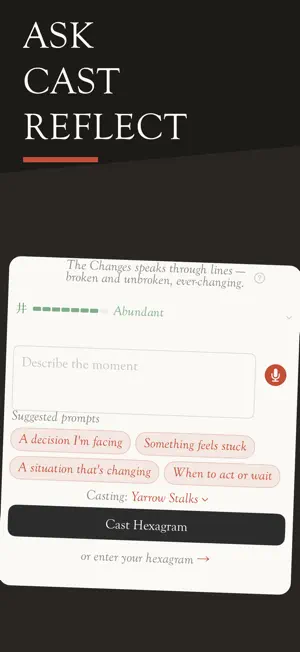
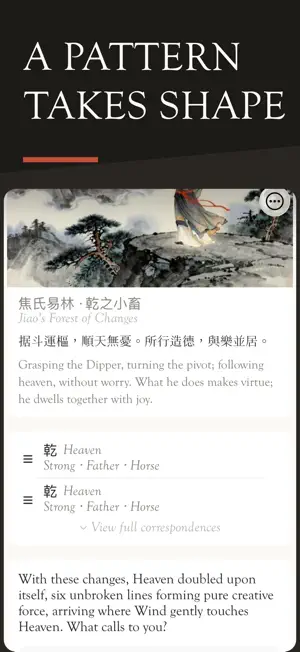
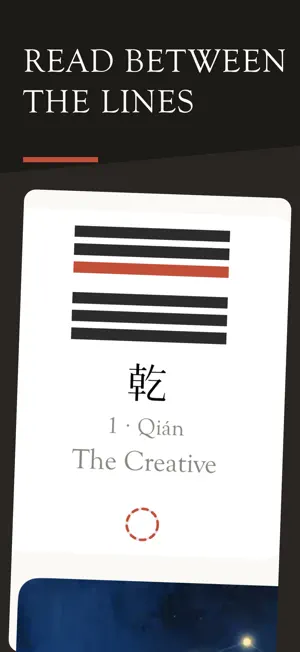
Conclusions are cheap now. Everything arrives pre-ranked and pre-argued: a score, a verdict, a confident paragraph. Six Lines is an I-Ching for people who would rather sharpen their judgment than borrow another answer. The I-Ching is an ancient instrument for this work. It gives you a situation in compressed form: positions, tensions, changes, warnings, openings. It rarely resolves into a single clean answer. You work out what matters, what conflicts, and what the situation asks of you. Learning to read it is slow. That slowness is part of the training. Six Lines is built for it. Everything needed to work a reading is here and cross-referenced. The machine reasons across the structure and stops short of drawing your conclusion. A READING YOU CAN AUDIT State a question and cast, with three coins or 49 yarrow stalks. What comes back is not a verdict. First the structure, then the interpretation: what state you're in, which factors weigh most and why, what constrains action, and what would make you revise the reading. Constraints and predictions say in advance what would prove them wrong. Major claims trace back to the lines and signals they rest on. You can open the reasoning chain and check it. That is the discipline: don't ask only why you should believe something. Ask what would make you stop. THE QUESTION BEFORE THE VERDICT The structure is Liu Yao (六爻), formalised by Jing Fang. Six Lines computes it deterministically: branches, Six Relatives, element strengths, voids and clashes. The chart carries no verdict. Which Useful Spirit matters depends on what you asked, so Six Lines reads the question first, then applies classical rules. A strong Wealth line helps if you asked about money and hurts if you asked about your father. THE CLASSIC ITSELF All 64 hexagrams in three layers: the original Chinese, a character-by-character gloss from the Bradford Hatcher matrix translations, and our own commentary on the judgment, the image and every line. It looks for what the text withholds: a favourable reading can carry a warning, and a hard one can hold the way through. Each is also paired with a public-domain masterpiece, which gets an essay of its own. The complete Yilin (Forest of Changes): a verse and a painting for all 4,096 transformations. JOURNAL Save the question and the reading. Come back weeks later and record what you decided, what you expected, and what happened. Over enough entries you are no longer only studying the I-Ching. You are calibrating your own judgment. ALMANAC AND CALENDAR Most almanac apps rate your day out of five stars, and two will disagree. The 1739 imperial Xieji Bianfang Shu objects: a blanket score collapses influences the real system weighs one activity at a time. So you get what's auspicious and what to avoid per activity, with the conflicts to watch. Lucky directions, the Jianchu cycle, Bazi pillars, the lunar calendar and 24 solar terms, and a date finder. Never an overall score. THE RECORDS (optional) Sixty-four historical cases in judgment, timing and consequence, spanning Zhou to Jin, centred on the Warring States. Each carries the idiom it left behind and the hexagram transition it turns on. Three are free, plus a rotating Record of the Day. The rest is one purchase, opened in twelve sealed batches at your pace. Nothing expires. TWO WAYS TO READ Goudy Old Style on warm ivory for reading at length, or a phosphor-green terminal skin for working a question. English, Simplified and Traditional Chinese. No ads, no tracking, no notifications about how your day will go. Everything above is free except The Records. No account, no subscription. AI readings draw from a shared monthly pool. When it runs dry they rest until the month turns. You'll know Six Lines worked when you close it, notice the story you were about to tell yourself, and don't cast at all.
What’s new
Version 1.9.3 · Updated October 24, 2026
A plainer first visit, and Yilin verses checked against the manuscript. • Today says what its numbers mean: "Hexagram 47, changing into 28", which line you are studying, and what the tea house is. It ends with a way to bring your own question • Ask puts your question first. The keyboard waits until you tap the field • Settings opens on your own preferences. The tea house stays off until you choose it • 216 Yilin verses corrected against the manuscript, with their English and 153 explanations revised • 721 new paintings for Yilin verses in light mode • Today's date follows your language's word order • Fixes throughout
App privacy
The developer, Digital Rain Technologies, Limited, reported these privacy practices to Apple.
Data Not Linked to You
The following data, which may be collected but is not linked to your identity, may be used for the following purposes:
- User Content: Other User Content
- Identifiers: Device ID
- Usage Data: Product Interaction
Used for: App Functionality
Alternatives to Six Lines: I-Ching & Almanac
Looking for apps like Six Lines: I-Ching & Almanac? Here are 6 similar apps on the App Store. The highest rated is I Ching: Yi Jing Life Guide (5.0/5), and all 6 are free to download.
-
 I Ching: Yi Jing Life Guide
5.0
-
 I Ching Classroom
5.0
-
 I Ching - Book of Changes
-
 Juseyo: Korean Travel Phrases
-
 Frequency - Audio Lessons
5.0
-
 Yuun: Chinese Almanac
| App | Rating | Price | Last updated | Compare |
|---|---|---|---|---|
| Six Lines: I-Ching & Almanac | 5.0 / 5 (3 ratings) | Free | October 24, 2026 | |
| I Ching: Yi Jing Life Guide | 5.0 / 5 (1) | Free | Apr 6, 2026 | Compare |
| I Ching Classroom | 5.0 / 5 (1) | Free | Nov 20, 2025 | Compare |
| I Ching - Book of Changes | – | Free | Sep 29, 2026 | Compare |
| Juseyo: Korean Travel Phrases | – | Free | Oct 15, 2026 | Compare |
| Frequency - Audio Lessons | 5.0 / 5 (2) | Free | Apr 16, 2026 | Compare |
| Yuun: Chinese Almanac | – | Free | Aug 23, 2026 | Compare |