

ABG Calculator - Pulmoro
Hamza Crichlow Medical iPhoneiPadiPod touch
ABG Calculator - Pulmoro is a free Medical app for iPhone and iPad by Hamza Crichlow. Rated 5.0/5 from 8 ratings. Requires iOS 18.2. Updated July 19, 2026.
- Rating
- 5.0
- 8 ratings
- Price
- Free
- on the App Store
- Size
- 6 MB
- Age 17+
- Updated
- Jul 19
- 2026 · v1.1.1
Screenshots



About ABG Calculator - Pulmoro
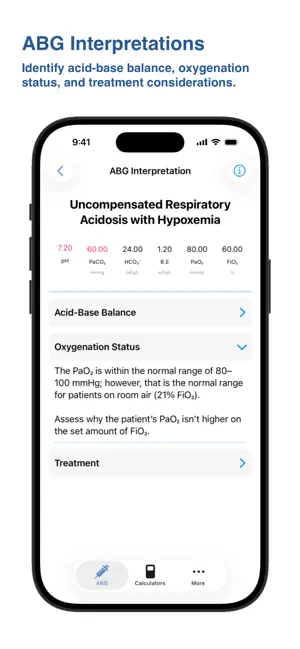
Pulmoro is a clinical decision support app built for healthcare professionals managing patients with respiratory conditions, especially those requiring mechanical ventilation. It brings evidence based calculations, guided interpretations, and educational context into a single, intuitive platform designed for real time bedside care. Pulmoro was also selected as a 2025 Swift Student Challenge Winner, recognized by Apple for its creativity, technical skill, and meaningful impact in healthcare education. At the center of Pulmoro is arterial blood gas (ABG) interpretations with integrated oxygenation analysis. Clinicians receive immediate insight into acid-base status, compensation, and oxygenation, paired with concise explanations that connect physiology to practice. These interpretations are structured to deepen understanding, not just present simplified answers. Alongside ABG analysis, Pulmoro includes a comprehensive suite of respiratory and ventilator focused calculators. Users can quickly determine tidal volume, compliance, cardiac output, anion gap, the A-a gradient, and other essential values used daily in intensive care and emergency settings. Each calculator displays the underlying formula and reference ranges, allowing clinicians to see exactly how results are derived and reinforcing the physiology behind every number. Case studies woven throughout the app help users apply these calculations to realistic scenarios, bridging the gap between theory and bedside practice. Pulmoro functions as both a reference and a learning companion for clinicians strengthening their clinical reasoning skills. Pulmoro was created by a Respiratory Therapist with experience in intensive care, emergency medicine, and ECMO support. The app grew out of firsthand exposure to the complexities of respiratory care during the COVID-19 pandemic and beyond, inspiring a tool that simplifies critical decisions without sacrificing depth or accuracy. Accessibility and usability guided every design choice. Pulmoro adapts seamlessly to light and dark modes, emphasizes readable typography and contrast, and supports dynamic text sizing for varied clinical environments. It also functions fully offline, ensuring reliability in settings where connectivity may be limited. Pulmoro is not a replacement for clinical judgment, but a tool built to enhance it. By unifying ABG interpretation, oxygenation assessment, and essential ventilator calculations, it provides clinicians with a clear, reliable, and educational resource at the bedside. Whether used by respiratory therapists, physicians, nurses, or students, Pulmoro turns complex respiratory concepts into meaningful, actionable insights, helping clinicians deliver safer, more confident care.
Ratings & reviews
5.0
8 ratings
What’s new
Version 1.1.1 · Updated July 19, 2026
This update includes: - Bug fixes and performance improvements
App privacy
The developer, Hamza Crichlow, reported these privacy practices to Apple.
Data Not Collected
The developer does not collect any data from this app.
Alternatives to ABG Calculator - Pulmoro
Looking for apps like ABG Calculator - Pulmoro? Here are 6 similar apps on the App Store. The highest rated is RTB2 – Respiratory Reference (5.0/5), and all 6 are free to download.
-
 RTB2 – Respiratory Reference
5.0
-
 Mechanical Ventilation Expert
1.8
-
 Respiratory Notes
4.0
-
 VentRef
5.0
-
 Ventilator Guide
-
 BreathLyft
| App | Rating | Price | Last updated | Compare |
|---|---|---|---|---|
| ABG Calculator - Pulmoro | 5.0 / 5 (8 ratings) | Free | July 19, 2026 | |
| RTB2 – Respiratory Reference | 5.0 / 5 (2) | Free | Apr 23, 2026 | Compare |
| Mechanical Ventilation Expert | 1.8 / 5 (8) | Free | Jul 22, 2026 | Compare |
| Respiratory Notes | 4.0 / 5 (4) | Free | Aug 14, 2026 | Compare |
| VentRef | 5.0 / 5 (44) | Free | Oct 6, 2026 | Compare |
| Ventilator Guide | – | Free | Nov 15, 2023 | Compare |
| BreathLyft | – | Free | Apr 27, 2026 | Compare |