

Talklet: AI Language Tutor
Talklet AI Limited Education iPhoneiPadiPod touch
Talklet: AI Language Tutor is a free Education app for iPhone and iPad by Talklet AI Limited. Rated 4.7/5 from 7,337 ratings. Requires iOS 15.0.
- Rating
- 4.7
- 7.3K ratings
- Price
- Free
- on the App Store
- Size
- 85 MB
- Age 4+
- Updated
- Oct 30
- 2026 · v2.4.0
Screenshots


About Talklet: AI Language Tutor
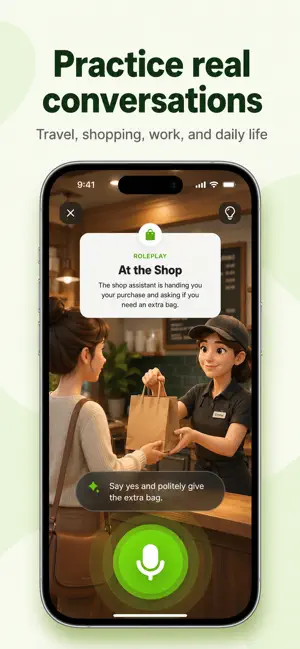
Talklet helps you learn a language by speaking it. Talk out loud with an AI tutor, get feedback after you speak, and try again when the words don't come easily. Maybe you've studied the words but still hesitate when someone is waiting for an answer. Here, you can take your time and work on what you want to say. Choose your language Learn English, Spanish, French, Japanese, German, Korean, Italian, Mandarin Chinese, or Portuguese. Start with a plan for your level Take a short speaking check and tell Talklet what you want to do with the language. Your learning plan and lessons are based on your level and goals. Start with simpler exchanges if you're new, or work on longer answers if you're returning to a language you already know. Practice everyday conversations • Introduce yourself and make small talk • Order food, shop, or ask for directions • Make a phone call or explain what you need at an appointment • Get ready for travel or a conversation with a neighbor • Talk with family members or your child's teacher Practice for work • Rehearse a job interview or your first day • Ask a coworker for help • Discuss a schedule or explain a problem with a supervisor • Answer a customer's question • Speak up in a meeting Speak, review, try again Your tutor responds to your answers and keeps the conversation going. After each turn, review feedback and a more natural way to express your idea. Say the suggested phrase yourself, then continue. If it doesn't feel right yet, return to the lesson and give it another try. Learn words in context Build useful vocabulary and practice pronunciation through conversations. The words stay connected to situations where you might use them, from a quick exchange at a café to a longer discussion at work. Practice on your own schedule Find a few minutes before work or spend more time on a lesson when you can. There's no need to get every sentence right the first time. Start with one conversation you wish felt easier.
Ratings & reviews
4.7
7.3K ratings
What’s new
Version 2.4.0 · Updated October 30, 2026
Bug fixes.
App privacy
The developer, Talklet AI Limited, reported these privacy practices to Apple.
Data Used to Track You
The following data may be used to track you across apps and websites owned by other companies:
- Identifiers: Device ID
Data Linked to You
The following data, which may be collected and linked to your identity, may be used for the following purposes:
- User Content: Audio Data, Other User Content
Used for: Product Personalization, App Functionality
Data Not Linked to You
The following data, which may be collected but is not linked to your identity, may be used for the following purposes:
- Identifiers: Device ID, User ID
- Usage Data: Product Interaction
- Diagnostics: Crash Data, Performance Data, Other Diagnostic Data
- Contact Info: Email Address
Used for: Third-Party Advertising, Analytics, Product Personalization, App Functionality
Alternatives to Talklet: AI Language Tutor
Looking for apps like Talklet: AI Language Tutor? Here are 6 similar apps on the App Store. The highest rated is Tempo: Slow English (4.8/5), and all 6 are free to download.
-
 Talko: Learn English with AI
4.7
-
 Tempo: Slow English
4.8
-
 Pinu – Language Learning
4.1
-
 tellem: Speak & Learn English
4.7
-
 Speak English & Spanish : Lisn
4.7
-
 English Bites
4.6
| App | Rating | Price | Last updated | Compare |
|---|---|---|---|---|
| Talklet: AI Language Tutor | 4.7 / 5 (7,337 ratings) | Free | October 30, 2026 | |
| Talko: Learn English with AI | 4.7 / 5 (5,057) | Free | Nov 2, 2026 | Compare |
| Tempo: Slow English | 4.8 / 5 (1,768) | Free | Oct 25, 2026 | Compare |
| Pinu – Language Learning | 4.1 / 5 (56) | Free | Oct 30, 2026 | Compare |
| tellem: Speak & Learn English | 4.7 / 5 (524) | Free | Oct 27, 2026 | Compare |
| Speak English & Spanish : Lisn | 4.7 / 5 (1,233) | Free | Oct 23, 2026 | Compare |
| English Bites | 4.6 / 5 (170) | Free | Jun 17, 2026 | Compare |