

Chemical Elements Quiz & Study
Abdulkarim Nasir Education iPhoneiPadiPod touch
Chemical Elements Quiz & Study is a free Education app for iPhone and iPad by Abdulkarim Nasir. Requires iOS 13.0. Updated January 2, 2025.
- Price
- Free
- on the App Store
- Size
- 17 MB
- Age 4+
- Updated
- Jan 2
- 2025 · v1.4
Screenshots


About Chemical Elements Quiz & Study
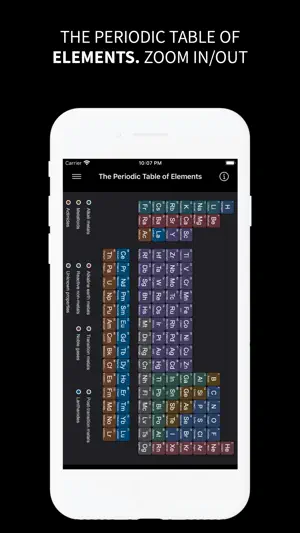
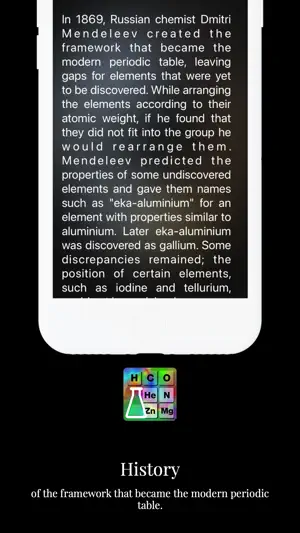
Put your knowledge of the periodic table to the test with this entertaining chemical elements quiz app! Unlike other apps where you're presented with options where you can make mere guesses, this app demands that you type the name of the chemical element of the periodic table! Study the elements then take the quiz. How to play: 1. Start by typing the element's name. Once you're done, dismiss the keyboard by clicking return or by tapping any part of the screen. Next, click the "Show Answer" button to reveal the name of the chemical element to verify your answer. If your input matches the chemical element's name, you win, otherwise no! 2. Click the "Next Element" button to go to the next element. 3. Turn on "Randomize" switch to get the chemical elements randomly. In 1789, French chemist Antoine Lavoisier tried grouping the elements as metals and nonmetals. Forty years later, German physicist Johann Wolfang Döbereiner observed similarities in physical and chemical properties of certain elements. He arranged them in groups of three in increasing order of atomic weight and called them triads, observing that some properties of the middle element, such as atomic weight and density, approximated the average value of these properties in the other two in each triad. A breakthrough came with the publication of a revised list of elements and their atomic masses at the first international conference of chemistry in Karlsruhe, Germany, in 1860. They concluded that hydrogen would be assigned the atomic weight of 1 and the atomic weight of other elements would be decided by comparison with hydrogen. For example, carbon, being 12 times heavier than hydrogen, would have an atomic weight of 12. British chemist John Newlands was the first to arrange the elements into a periodic table with increasing order of atomic masses. He found that every eight elements had similar properties and called this the law of octaves. He arranged the elements in eight groups but left no gaps for undiscovered elements. In 1869, Russian chemist Dmitri Mendeleev created the framework that became the modern periodic table, leaving gaps for elements that were yet to be discovered. While arranging the elements according to their atomic weight, if he found that they did not fit into the group he would rearrange them. Mendeleev predicted the properties of some undiscovered elements and gave them names such as "eka-aluminium" for an element with properties similar to aluminium. Later eka-aluminium was discovered as gallium. Some discrepancies remained; the position of certain elements, such as iodine and tellurium, could not be explained. German chemist Lothar Meyer produced a version of the periodic table similar to Mendeleev’s in 1870. He left gaps for undiscovered elements but never predicted their properties. The Royal Society of London awarded the Davy Medal in 1882 to both Mendeleev and Meyer. The later discovery of elements predicted by Mendeleev, including gallium (1875), scandium (1879) and germanium (1886), verified his predictions and his periodic table won universal recognition. In 1955 the 101st element was named mendelevium in his honor. The concept of sub-atomic particles did not exist in the 19th century. In 1913, English physicist Henry Moseley used X-rays to measure the wavelengths of elements and correlated these measurements to their atomic numbers. He then rearranged the elements in the periodic table on the basis of atomic numbers. This helped explain disparities in earlier versions that had used atomic masses. In the periodic table, the horizontal rows are called periods, with metals in the extreme left and nonmetals on the right. The vertical columns, called groups, consist of elements with similar chemical properties. Scientists use the table to study chemicals and design experiments. It is used to develop chemicals used in the pharmaceutical and cosmetics industries and batteries used in technological devices.
What’s new
Version 1.4 · Updated January 2, 2025
Fewer ads...
App privacy
The developer, Abdulkarim Nasir, reported these privacy practices to Apple.
Data Not Linked to You
The following data, which may be collected but is not linked to your identity, may be used for the following purposes:
- Identifiers: Device ID
- Usage Data: Advertising Data
Used for: Third-Party Advertising, Analytics
Alternatives to Chemical Elements Quiz & Study
Looking for apps like Chemical Elements Quiz & Study? Here are 6 similar apps on the App Store. The highest rated is Elements Periodic Table Quiz (5.0/5), and 5 of the 6 are free to download.
-
 Elements Periodic Table Quiz
5.0
Elements Periodic Table Quiz
5.0
-
 Learn Periodic Table Pro
-
 Elements - Flashcards and Quiz
5.0
Elements - Flashcards and Quiz
5.0
-
 Chemical Elements Practice
4.8
Chemical Elements Practice
4.8
-
 Elemental Periodic Table Quiz
5.0
Elemental Periodic Table Quiz
5.0
-
 Quran Quiz, Quote & Wallpaper
| App | Rating | Price | Last updated | Compare |
|---|---|---|---|---|
| Chemical Elements Quiz & Study | – | Free | January 2, 2025 | |
| Elements Periodic Table Quiz | 5.0 / 5 (1) | Free | Dec 21, 2023 | Compare |
| Learn Periodic Table Pro | – | 1.99 USD | Sep 28, 2024 | Compare |
| Elements - Flashcards and Quiz | 5.0 / 5 (1) | Free | May 14, 2025 | Compare |
| Chemical Elements Practice | 4.8 / 5 (38) | Free | May 28, 2026 | Compare |
| Elemental Periodic Table Quiz | 5.0 / 5 (1) | Free | Jan 2, 2024 | Compare |
| Quran Quiz, Quote & Wallpaper | – | Free | Sep 15, 2026 | Compare |