

Lattice Multiplication
Esa Helttula Education iPhoneiPadiPod touch
Lattice Multiplication is a paid Education app for iPhone and iPad by Esa Helttula. Rated 5.0/5 from 1 ratings. Requires iOS 17.6. Updated September 9, 2026.
- Rating
- 5.0
- 1 ratings
- Price
- 3.99 USD
- on the App Store
- Size
- 1 MB
- Age 4+
- Updated
- Sep 9
- 2026 · v7.0
Screenshots

About Lattice Multiplication
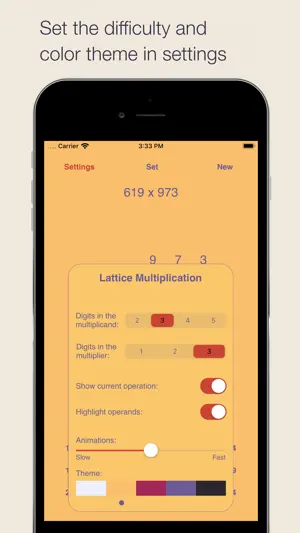
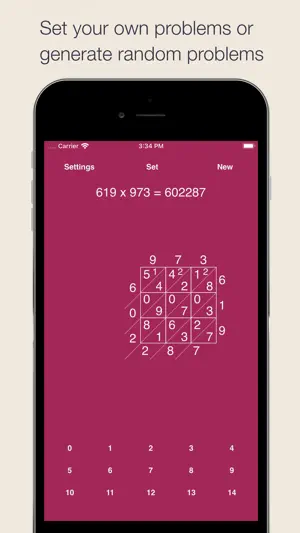
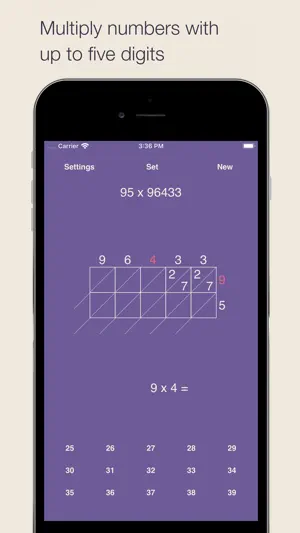
Lattice Multiplication helps students learn and practice the lattice multiplication method step by step. The app shows each part of the lattice multiplication process visually. Students first complete the multiplication steps and then add along the diagonals. Animated numbers move into the correct places, helping students understand how the method works. Lattice multiplication is a compact visual method for multiplying larger numbers. It is algorithmically equivalent to long multiplication and is also excellent times tables practice. Students can solve randomly generated problems or enter their own multiplication problems. Wired.com: “This was one form of multiplication that I’d never done before, but the app taught me very clearly. It makes multiplying large numbers easier, and allows you to see it all visually.” Teacher endorsement: “The math apps by Esa Helttula allow students to practice and reinforce the specific computation strategies taught in class, with as much or as little scaffolding as necessary. They also provide individualized feedback to each student, with an immediacy that is not always possible through pencil and paper practice.” — Rita Zeni, Ecole Sandy Hill Elementary, Abbotsford, BC, Canada Features: - Step-by-step lattice multiplication practice - Multiplicand can have up to 5 digits - Multiplier can have up to 3 digits - Randomly generated or manually entered problems - Current operation for each step can be hidden - Operands for the current operation can be highlighted - Three visual themes: black, gray, and gold - Adjustable animation speed - Different interfaces for iPhone and iPad The Lattice Multiplication Method Lattice multiplication is algorithmically equivalent to long multiplication. A lattice (a grid) guides the calculation. All the multiplications are done first and then the additions. The method was introduced to Europe in 1202 in Fibonacci's Liber Abaci. In this groundbreaking book Fibonacci presented many algorithms for working with Arabic numerals. Ancient Indians and Chinese originally invented some of the algorithms. Fibonacci presented both the current standard long multiplication and also an originally Indian method called lattice multiplication, which is faster and more compact for working with larger numbers. Other iDevBooks Math Apps: Other iDevBooks math apps include Column Addition, Long Multiplication, Long Division, Column Subtraction, Visual Multiplication Table, Fraction Math, Partial Differences Subtraction, Partial Quotients Division, Partial Sums Addition, Decimal Rounding, and more. Feedback: New ideas to make this app better are welcome. Please visit idevbooks.com to give feedback. Privacy: This app has no ads, no in-app purchases, and does not transmit user data during operation. The app also does not contain links to other apps or to the web.
What’s new
Version 7.0 · Updated September 9, 2026
Updated for iOS 26 compatibility.
App privacy
The developer, Esa Helttula, reported these privacy practices to Apple.
Data Not Collected
The developer does not collect any data from this app.
Alternatives to Lattice Multiplication
Looking for apps like Lattice Multiplication? Here are 6 similar apps on the App Store. The highest rated is Addition School ! ! (5.0/5), and 3 of the 6 are free to download.
-
 Napier's Bones Simulation
-
 Addition School ! !
5.0
Addition School ! !
5.0
-
 AeroVariation
4.5
AeroVariation
4.5
-
 Learn French: Verb Forms
4.0
Learn French: Verb Forms
4.0
-
 LearnAccounting
-
 States of Austria Quiz
3.0
States of Austria Quiz
3.0
| App | Rating | Price | Last updated | Compare |
|---|---|---|---|---|
| Lattice Multiplication | 5.0 / 5 (1 rating) | 3.99 USD | September 9, 2026 | |
| Napier's Bones Simulation | – | 1.99 USD | May 20, 2024 | Compare |
| Addition School ! ! | 5.0 / 5 (4) | 4.99 USD | May 6, 2026 | Compare |
| AeroVariation | 4.5 / 5 (4) | 1.29 USD | Aug 8, 2026 | Compare |
| Learn French: Verb Forms | 4.0 / 5 (4) | Free | Oct 31, 2025 | Compare |
| LearnAccounting | – | Free | Aug 28, 2026 | Compare |
| States of Austria Quiz | 3.0 / 5 (2) | Free | Nov 11, 2025 | Compare |