

Sealant Calculator
Tools Contains ads
Estimate tubes of caulk, bead volume and backer rod size. Offline.
- Downloads
- 2+
- on Google Play
- Price
- Free
- No in-app purchases
- Updated
- Oct 2
- 2026 · v1.3
Screenshots


About Sealant Calculator
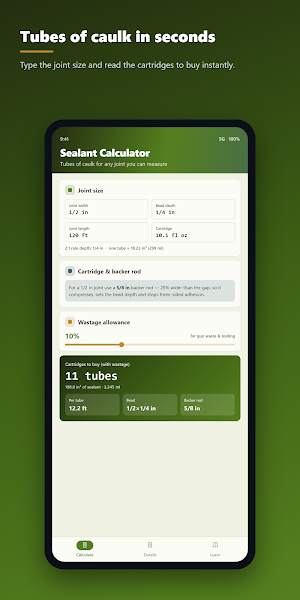
Sealant Calculator helps you work out, in seconds, how many tubes of caulk a joint will take and what size backer rod goes behind it. Enter the joint width, depth and length and read the cartridges to buy straight away. It works completely offline and nothing you enter ever leaves your phone.
HOW IT WORKS
The app uses the standard sealant estimating method:
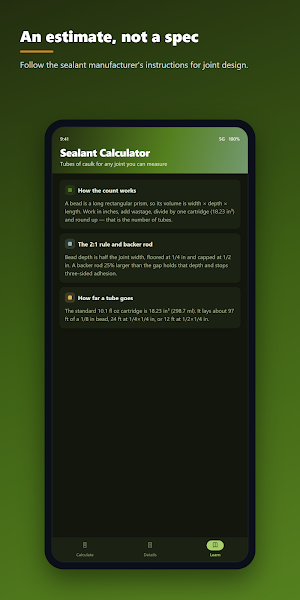
1. A bead of sealant is a long rectangular prism, so its volume is joint width times joint depth times joint length. Work in inches — the joint length in feet is multiplied by 12 — and the answer comes out in cubic inches.
2. A wastage allowance you choose (typically 5 to 10 percent) is added on top, for gun waste, tooling, the plug left in each nozzle and a little overfill.
3. The result is divided by the volume of one cartridge and rounded up to whole tubes.
4. Joint geometry follows the 2:1 rule used in joint-design practice: the sealant depth is half the joint width, never shallower than 1/4 inch and never deeper than 1/2 inch. A closed-cell backer rod sized 25 percent larger than the gap holds that depth, compresses into place and keeps the sealant bonded to two faces instead of three.
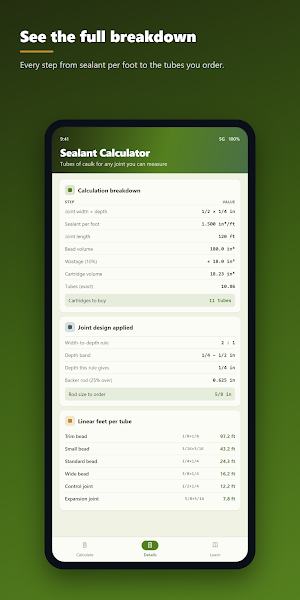
A worked example: a 1/2 inch wide by 1/4 inch deep joint running 120 feet holds 180 cubic inches of sealant. With a 10 percent wastage allowance that is 198 cubic inches, or 3,245 ml. The standard cartridge is 10.1 US fluid ounces — 18.23 cubic inches, or 298.7 ml, which is why it is sold as the 300 ml tube. That works out at 10.86 tubes, so you buy 11, and each tube lays about 12.2 linear feet at that bead size. The backer rod for a 1/2 inch joint is 5/8 inch.
WHAT YOU CAN DO
- Enter joint width, depth and length and read the cartridges to buy instantly
- Tap one button to snap the bead depth to the 2:1 rule for your joint width
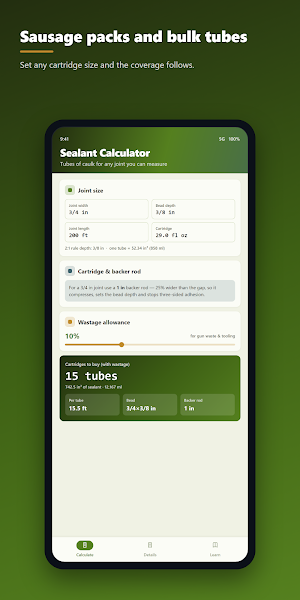
- Set any cartridge size — 10.1 fl oz tubes, or 20 and 29 fl oz sausage packs
- Choose a wastage allowance from 0 to 30 percent with a slider
- See the backer rod diameter to order and the linear feet one tube covers
- Open Details for a full step-by-step breakdown, the joint-design rules applied, and a coverage table of linear feet per tube for eight common bead sizes
- Learn the simple maths behind the numbers in plain language
BUILT FOR CLARITY
A fresh, workshop-green design puts the big number first, with the supporting figures right beside it. Light and dark themes, a tiny download, no clutter and no account required.
AN ESTIMATE, NOT A JOINT SPECIFICATION
This is a simplified educational tool for sealant quantity. Real jobs vary with the joint profile, tooling, substrate porosity, gun waste, temperature and the sealant you choose. Joint design for movement, weatherproofing or fire rating must follow the sealant manufacturer's written instructions and the project specification. Always confirm the final quantities with your supplier before ordering. This app is for general information and education only and is not professional construction advice.
PRIVACY
The app collects no personal data and works fully offline. Ads are served by Google AdMob, which may use an advertising identifier as described in Google's policies.
Download Sealant Calculator and get a quick, sensible picture of the caulk your next joint will take.
What’s new
Version 1.3 · Updated October 2, 2026
improve app performance
Alternatives to Sealant Calculator
Looking for apps like Sealant Calculator? Here are 6 similar Android apps on Google Play. All of them are free to download.
-
Paver Calculator
-
Rip Rap Calculator
-
Thinset Calculator
-
Insulation Calculator
-
Siding Calculator
-
Roof Truss Calculator
| App | Rating | Price | Installs | Last updated | Compare |
|---|---|---|---|---|---|
| Sealant Calculator | – | Free | 1+ | Oct 2, 2026 | |
| Paver Calculator | – | Free | 10+ | Oct 25, 2026 | Compare |
| Rip Rap Calculator | – | Free | 1+ | Sep 30, 2026 | Compare |
| Thinset Calculator | – | Free | 5+ | Oct 3, 2026 | Compare |
| Insulation Calculator | – | Free | 50+ | Oct 18, 2026 | Compare |
| Siding Calculator | – | Free | 50+ | Oct 2, 2026 | Compare |
| Roof Truss Calculator | – | Free | 100+ | Oct 1, 2026 | Compare |
Compare Sealant Calculator with the top alternatives: ratings, updates, ASO score and keyword gaps →