
Optical Mineral Identifier
KayYesR Tools
Petrography tool: rank mineral matches from thin section optical properties.
- Downloads
- 19+
- on Google Play
- Price
- $0.49
- No in-app purchases
- Updated
- May 25
- 2026 · v1.7
Screenshots
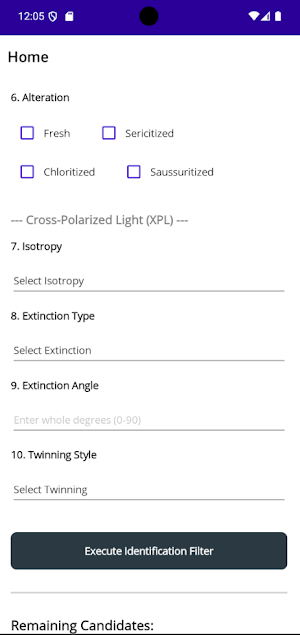
About Optical Mineral Identifier
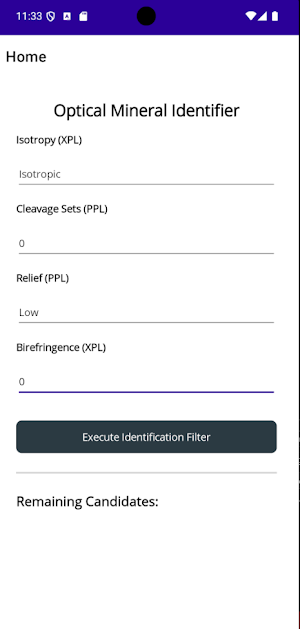
Optical Mineral Identifier is an offline petrography tool for thin section work. It takes observable optical properties from a polarizing microscope and ranks the most likely mineral matches using a weighted scoring algorithm.
It is not a replacement for a trained eye. It narrows the field; the user makes the final call.
WHAT IT DOES
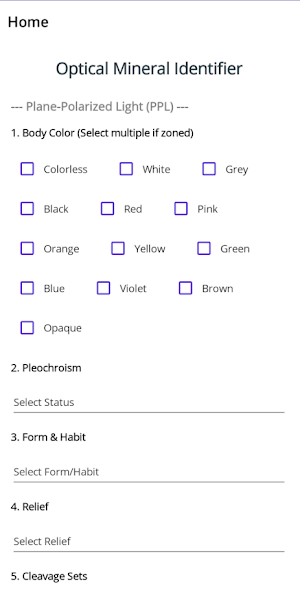
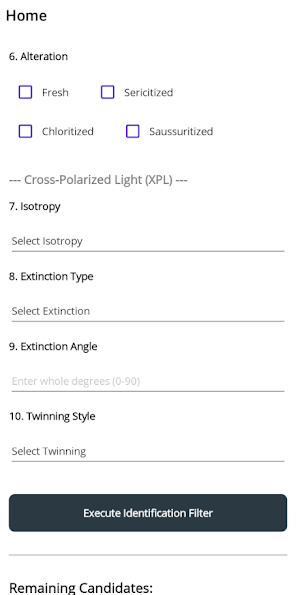
You enter what you see under the microscope — birefringence, extinction angle and type, relief, pleochroism, cleavage, twinning, habit, body colour, and alteration. The algorithm scores each mineral in its database against your input, weighting properties by their diagnostic value (birefringence and extinction angle carry the most weight; body colour and alteration the least). It returns the top ten candidates ranked by confidence, with a 35% confidence floor below which it reports no match rather than guessing.
DATABASE
163 rock-forming and accessory phases, including:
— Silicates: quartz, full alkali feldspar and plagioclase series, micas, pyroxene and amphibole suites, olivine endmembers, garnet endmembers, the three Al₂SiO₅ polymorphs, epidote group, layer silicates
— Carbonates: calcite, dolomite, aragonite, siderite, rhodochrosite, magnesite, and others
— Oxides, halides, sulfates, hydroxides, borates, phosphates, tungstates, clays
— Common opaque phases (treated as isotropic in transmitted light)
Birefringence values cross-checked against Nesse's Optical Mineralogy, Deer Howie & Zussman, and Klein & Dutrow.
PRECISION MICHEL-LÉVY CHART
Built-in chart covering the 0–6000 nm retardation range, so high-birefringence carbonates and other phases are not compressed off the right edge of a standard chart.
OTHER FEATURES
— 100% offline, no account required, no tracking, no ads
— Dark mode for low-light lab environments
— SQLite database stored locally
— Built on .NET MAUI
ACCURACY AND LIMITATIONS
Internal testing indicates roughly 85-90% top-rank accuracy for clear-cut cases when all relevant properties are entered. Accuracy drops for ambiguous cases — plagioclase compositional varieties, amphibole subtypes, and similar fine distinctions where optical properties alone are insufficient.
The tool is a reference and screening aid, not an arbiter. Standard petrographic judgment remains necessary.
INTENDED USERS
Geology students learning thin section work, petrography researchers, and practising geologists who want a fast first-pass narrowing of candidates before consulting reference texts.
FEEDBACK
Misranks, missing phases, and bug reports are welcome at [email protected].
What’s new
Version 1.7 · Updated May 25, 2026
- 16 KB page size compatibility for Android 15+ - Internal stability improvements - Compatibility update for newer Android devices - Stability improvements
Alternatives to Optical Mineral Identifier
Looking for apps like Optical Mineral Identifier? Here are 5 similar Android apps on Google Play. The highest rated is Birdbuddy: ID & Collect Birds (4.6/5), and all 5 are free to download.
-
Picture Mushroom - Mushroom ID 4.2
-
Numerology - Angel Numbers 4.5
-
Blossom - Plant Identifier 4.4
-
PlantSnap: Plant Identifier 3.8
-
Birdbuddy: ID & Collect Birds 4.6
| App | Rating | Price | Installs | Last updated | Compare |
|---|---|---|---|---|---|
| Optical Mineral Identifier | – | $0.49 | 10+ | May 25, 2026 | |
| Picture Mushroom - Mushroom ID | 4.2 / 5 | Free | 1,000,000+ | Sep 18, 2026 | Compare |
| Numerology - Angel Numbers | 4.5 / 5 | Free | 50,000+ | Dec 29, 2025 | Compare |
| Blossom - Plant Identifier | 4.4 / 5 | Free | 5,000,000+ | Oct 6, 2026 | Compare |
| PlantSnap: Plant Identifier | 3.8 / 5 | Free | 10,000,000+ | Oct 2, 2026 | Compare |
| Birdbuddy: ID & Collect Birds | 4.6 / 5 | Free | 100,000+ | Oct 24, 2026 | Compare |