CelestialQuest: Space Explorer
Explore real space: three drives, 152 destinations, 120,000 real stars.
About CelestialQuest: Space Explorer
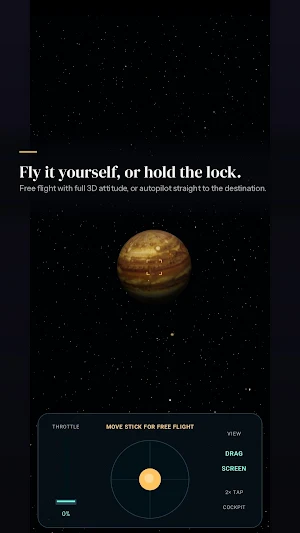
Explore space, with real physics under every maneuver.
CelestialQuest is a spacecraft simulator built on actual astronomy. The
stars are where they really are. The planets are where they really are,
right now, on today's date. Fly from low Earth orbit to the satellite
galaxies.
THREE DRIVES
- ION — precise maneuvering and orbital work, 0 to 100 km/s.
- REL — sub-light travel, 0 to 0.9999c, with everything relativity
implies: your clock falls behind Earth's, the sky aberrates, and
starlight shifts blue ahead of you and red behind.
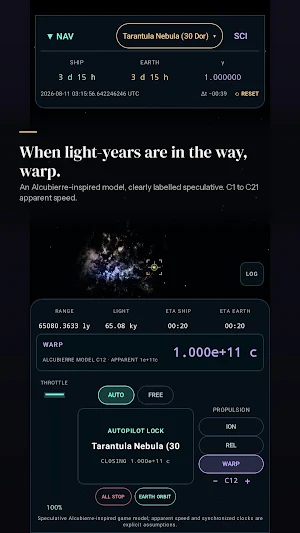
- WARP — an Alcubierre-inspired model, clearly labelled speculative,
C1 to C21 apparent speed for crossing interstellar distances.
REAL PHYSICS, HONESTLY LABELLED
- Special relativity: Lorentz factor, time dilation, proper time. Near
the light barrier your clock runs roughly 70x slower than Earth's.
- Real Keplerian orbits. A 400 km Earth orbit takes 92 minutes, because
that is how long it actually takes.
- Planetary positions from NASA/JPL J2000 orbital elements.
- The science panel tells you exactly which parts are established
physics, which are approximations, and which are speculative.
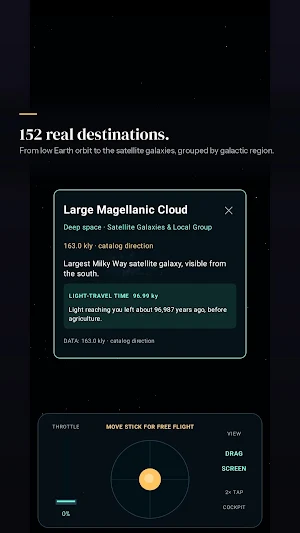
152 REAL DESTINATIONS
The Sun, every planet, dwarf planets, major moons, asteroids and comets.
105 nearby stars at their true measured distances. 47 deep-sky objects —
the Orion Nebula, the Pillars of Creation, Sagittarius A*, Andromeda —
grouped by galactic region out to the satellite galaxies.
A SKY MADE OF REAL DATA
119,625 catalogued stars at true positions, colored by measured spectral
index and sized by apparent magnitude. Fly far enough and the
constellations shift, because parallax is real. Behind them, the Milky
Way's disk, bulge and arms.
Approach a deep-sky object and it resolves into an actual photograph
from Hubble, JWST, Chandra or ESO.
LIGHT IS SLOW
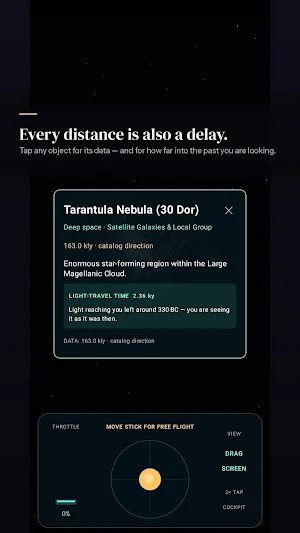
Every distance is also a delay. Reach the Crab Nebula and the light
arriving at your cockpit left in 1054 AD — the year Chinese astronomers
recorded the supernova that made it. The app tells you, everywhere, how
far into the past you are looking.
TIME IS THE MECHANIC
Clocks always run at real time — there is no artificial speed-up dial.
What changes is how much distance each drive covers while they run.
- Under ION, a journey takes as long as the physics says. Mars at 75 km/s
is roughly a twelve-day trip. Close the app and come back: the
mission continues while you are away, and your position, heading and
clocks are exactly where you left them.
- Under REL, relativity itself becomes the fast travel. Run to Proxima
Centauri at 0.9999c and 4.25 years pass on Earth — but only about
three weeks pass aboard your ship. The distance did not shrink; your
experience of it did. That gap is real and shown live on two clocks.
- Under WARP, distance stops mattering. At C10 the same crossing takes a
fraction of a second. This is the speculative drive, labelled as such —
but it is how you see the galaxy in an afternoon.
The mission log records what you have done, in real units: how far behind
Earth your clock has fallen, how far you have travelled, which worlds you
reached first.
STILL GROWING
CelestialQuest is actively developed. New destinations, higher resolution
textures, and new telescope imagery are added over time — and every
update is free to anyone who owns the app.
WHAT THIS APP DOES NOT DO
No ads. No in-app purchases. No subscriptions. No analytics, no tracking,
no third-party SDKs. It requests no permissions and has no internet access
at all — everything is bundled inside the app. It works on a plane, in a
basement, forever.
Buy it once. Own it for life. Every future update included.
IMAGE CREDITS
Astronomical imagery courtesy of NASA, ESA, CSA, STScI, the Chandra X-ray
Center, ESO and NOIRLab/NSF/AURA. Star positions from the HYG database
(Hipparcos, Yale, Gliese) and ESA Gaia. Per-image credits are in the app.
Not affiliated with or endorsed by NASA, ESA or any other agency.
CelestialQuest: Space Explorer details
CelestialQuest: Space Explorer is a paid Simulation app for Android with 1+ installs on Google Play. It was released on August 12, 2026 and last updated on August 12, 2026. It's developed by Ennes Labs LLC. It requires Android 8.0 or later.
- Category
- Simulation
- Installs
- 1+
- Price
- $2.99
- In-app purchases
- No
- Ads
- No ads
- Current version
- V0.6
- Requires Android
- 8.0
- Content rating
- Everyone
- Released
- August 12, 2026
- Last updated
- August 12, 2026
- Developer
- Ennes Labs LLC
What’s new in CelestialQuest: Space Explorer
First release. Fly a spacecraft through the real universe — 152 real destinations, 119,625 catalogued stars at their true positions, and real telescope imagery on approach. Three drives: ION for orbital work, REL for genuine relativistic flight with real time dilation, and a speculative Alcubierre-inspired WARP. No ads. No in-app purchases. No tracking. Works entirely offline.
Version V0.6 · Updated August 12, 2026
Alternatives to CelestialQuest: Space Explorer
Looking for apps like CelestialQuest: Space Explorer? Here are 4 similar Android apps on Google Play.

Ember Deck: Roguelike Builder
A premium roguelike deckbuilder. Six wardens, six bosses. No ads. No IAP. Ever.

Lotto Picker: Number Generator
Random lottery number generator. Secure, private, offline. No ads, no tracking.

AmoebaQuest
Grow. Survive. Evolve. A microscopic survival journey through 10 hostile worlds.

PageMage: Text Extractor
Clean article & PDF reader. Strip ads from any page. Private, no tracking.
| App | Rating | Price | Installs | Last updated |
|---|---|---|---|---|
| CelestialQuest: Space Explorer | – | $2.99 | 1+ | Aug 12, 2026 |
| Ember Deck: Roguelike Builder | – | 7.99 USD | 0+ | Sep 8, 2026 |
| Lotto Picker: Number Generator | – | 1.99 USD | 1+ | Jul 22, 2026 |
| AmoebaQuest | – | 0.99 USD | 1+ | Jul 22, 2026 |
| PageMage: Text Extractor | – | 3.99 USD | 10+ | Sep 23, 2026 |
