
Landscape Alternatives
Bugwood Education
Suggested alternatives to invasive plants in the Midwest United States.
- Rating
- 4.3
- 10 ratings
- Downloads
- 1.2K+
- on Google Play
- Price
- Free
- No in-app purchases
- Updated
- Jul 25
- 2024 · v2.0.10
Screenshots
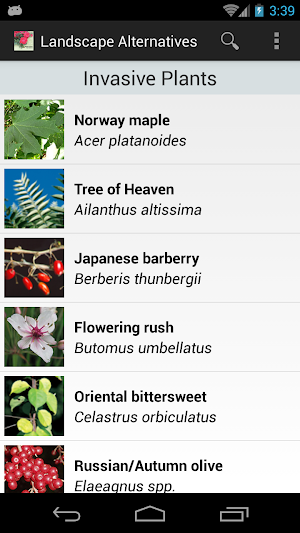
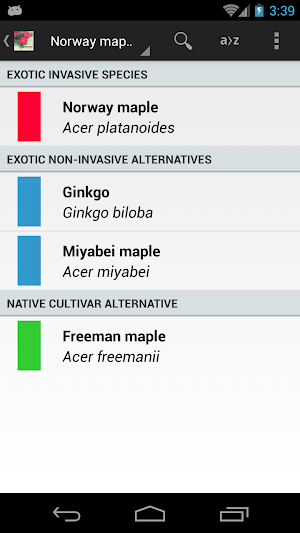
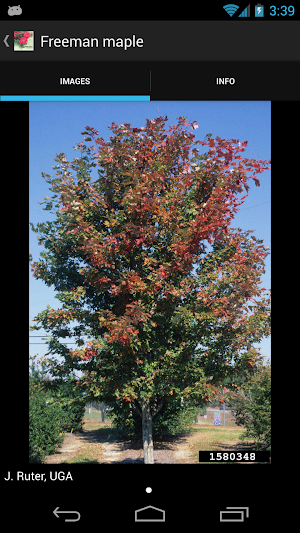
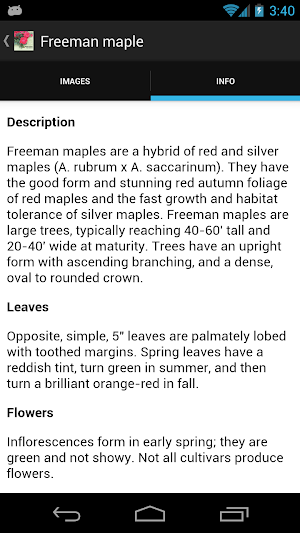
About Landscape Alternatives
Everybody loves a beautiful garden. Gardeners love plants that are adaptable, tough, and fast-growing. It’s even better if that plant produces showy fruits that attract birds or is an annual that self seeds, so it doesn’t need to be replanted every year. Unfortunately, many of these plant traits desirable to gardeners can also increase the likelihood that a plant jumps the garden fence and invades natural areas.
Invasive plants threaten our environment and economy. They pose an enormous threat to our native plants, animals, and ecosystems, and they cost the United States approximately $35 billion per year (www.invasivespecies.gov).
Although invasive plants are almost always not native to a region, it is important to note that most non-native species are not invasive. We use the following definitions.
Native (indigenous): A species that was present in North American prior to European settlement or has arrived since through natural means of dispersal.
Non-native (exotic, alien, introduced): A species that was brought to North America by humans, either deliberately or accidentally.
Invasive: A non-native whose introduction does or is likely to cause economic or environmental harm or harm to human health (from Federal Executive Order 13112).
People have introduced invasive species both accidentally and deliberately. This app focuses on plant species that are used ornamentally and have become invasive in at least part of the Midwest. Cultivars or hybrids produced from these species may or may not be invasive. In the few published cultivar evaluation studies, some cultivars prove to be more invasive than the parent species, others less or not invasive. We lack research about cultivar invasiveness for many of these species. When we have good evidence about a problematic or relatively benign cultivar, we list those specifically.
Suggested alternatives include both native species and non-native species that currently show no signs of becoming invasive.
What’s new
Version 2.0.10 · Updated July 25, 2024
Bug fix.
User reviews

Alternatives to Landscape Alternatives
Looking for apps like Landscape Alternatives? Here are 6 similar Android apps on Google Play. The highest rated is EDDMapS (4.6/5), and all 6 are free to download.





| App | Rating | Price | Installs | Last updated | Compare |
|---|---|---|---|---|---|
| Landscape Alternatives | 4.3 / 5 | Free | 1,000+ | Jul 25, 2024 | |
| EDDMapS | 4.6 / 5 | Free | 10,000+ | Jul 6, 2026 | Compare |
| IveGot1 | 4.0 / 5 | Free | 10,000+ | – | Compare |
| GLEDN | 3.6 / 5 | Free | 5,000+ | Jul 24, 2024 | Compare |
| EDDMapS Pro | 3.8 / 5 | Free | 1,000+ | May 19, 2026 | Compare |
| Washington Invasives | 3.4 / 5 | Free | 5,000+ | Aug 31, 2026 | Compare |
| Wild Spotter | – | Free | 1,000+ | – | Compare |
Similar apps on Google Play
- EDDMapS
- IveGot1
- GLEDN
- EDDMapS Pro
- Washington Invasives
- Wild Spotter
- Outsmart Invasive Species
- Healthy Trees, Healthy Cities
- IPCConnect
- MyIPM Hawaii
- MyIPM for Row Crops
- ISMTrack
- Georgia Bats in Bridges
- Rangeland Health Monitoring
- IveGot1 Español
- Feral Pig Damage
- Iowa Plants Pull it or Keep it
- Good Bugs +
- Alaska Invasives ID
- Stop NY Invasives
- EDDMapS IPM
- GA Cotton Insect Advisor
- SE Agricultural Stink Bug ID
- EDDMapS BioControl
- NJ Invasives
- Vegetable Doctor
- Great Lakes Vegetables
- Squeal on Pigs
- Forest Insect Pests
- Texas Invasives
- MAEDN
- SEEDN
- EDDMapS West