
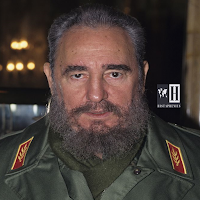
Fidel Castro - Biography
Books & Reference In-app purchases Contains ads
Fidel Castro
- Downloads
- 1+
- on Google Play
- Price
- Free
- In-app purchases
- Updated
- May 13
- 2024 · v1.0
Screenshots
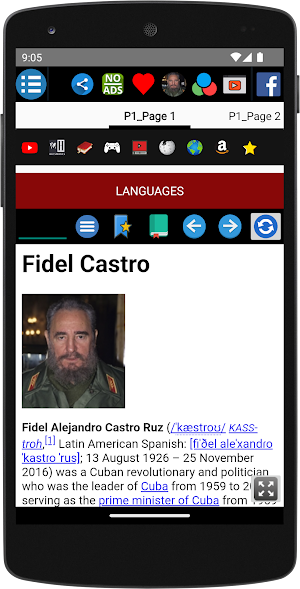
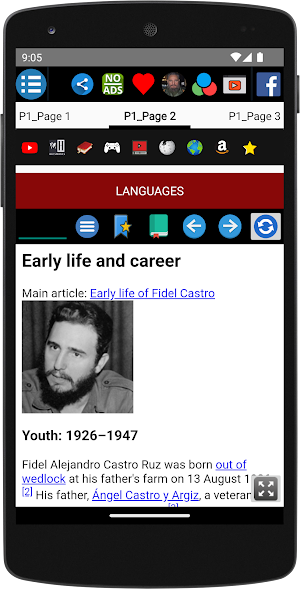


About Fidel Castro - Biography
Fidel Alejandro Castro Ruz ( 13 August 1926 – 25 November 2016) was a Cuban revolutionary and politician who was the leader of Cuba from 1959 to 2008, serving as the prime minister of Cuba from 1959 to 1976 and president from 1976 to 2008. Ideologically a Marxist–Leninist and Cuban nationalist, he also served as the first secretary of the Communist Party of Cuba from 1965 until 2011. Under his administration, Cuba became a one-party communist state; industry and business were nationalized, and socialist reforms were implemented throughout society.
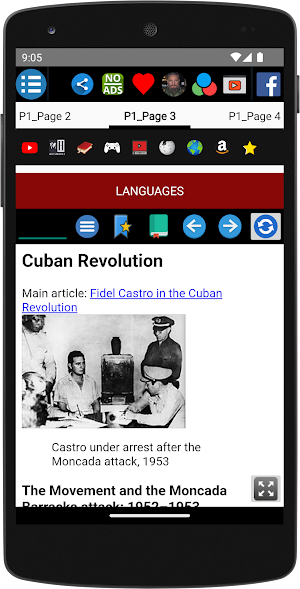
Born in Birán, the son of a wealthy Spanish farmer, Castro adopted leftist and anti-imperialist ideas while studying law at the University of Havana. After participating in rebellions against right-wing governments in the Dominican Republic and Colombia, he planned the overthrow of Cuban president Fulgencio Batista, launching a failed attack on the Moncada Barracks in 1953. After a year's imprisonment, Castro travelled to Mexico where he formed a revolutionary group, the 26th of July Movement, with his brother Raúl Castro and Ernesto "Che" Guevara. Returning to Cuba, Castro took a key role in the Cuban Revolution by leading the Movement in a guerrilla war against Batista's forces from the Sierra Maestra. After Batista's overthrow in 1959, Castro assumed military and political power as Cuba's prime minister. The United States came to oppose Castro's government and unsuccessfully attempted to remove him by assassination, economic embargo, and counter-revolution, including the Bay of Pigs Invasion of 1961. Countering these threats, Castro aligned with the Soviet Union and allowed the Soviets to place nuclear weapons in Cuba, resulting in the Cuban Missile Crisis—a defining incident of the Cold War—in 1962.
Adopting a Marxist–Leninist model of development, Castro converted Cuba into a one-party, socialist state under Communist Party rule, the first in the Western Hemisphere. Policies introducing central economic planning and expanding healthcare and education were accompanied by state control of the press and the suppression of internal dissent. Abroad, Castro supported anti-imperialist revolutionary groups, backing the establishment of Marxist governments in Chile, Nicaragua, and Grenada, as well as sending troops to aid allies in the Yom Kippur, Ogaden, and Angolan Civil War. These actions, coupled with Castro's leadership of the Non-Aligned Movement from 1979 to 1983 and Cuban medical internationalism, increased Cuba's profile on the world stage. Following the dissolution of the Soviet Union in 1991, Castro led Cuba through the economic downturn of the "Special Period", embracing environmentalist and anti-globalization ideas. In the 2000s, Castro forged alliances in the Latin American "pink tide"—namely with Hugo Chávez's Venezuela—and formed the Bolivarian Alliance for the Americas. In 2006, Castro transferred his responsibilities to Vice President Raúl Castro, who was elected to the presidency by the National Assembly in 2008.
The longest-serving non-royal head of state in the 20th and 21st centuries, Castro polarized world opinion. His supporters view him as a champion of socialism and anti-imperialism whose revolutionary government advanced economic and social justice while securing Cuba's independence from American hegemony. His critics view him as a dictator whose administration oversaw human rights abuses, the exodus of many Cubans, and the impoverishment of the country's economy.
Alternatives to Fidel Castro - Biography
Looking for apps like Fidel Castro - Biography? Here are 6 similar Android apps on Google Play. The highest rated is Adolf Hitler - Biography (4.6/5), and all 6 are free to download.
-
History of Afghanistan
-
Retro Classic Games 500 in 1
-
Satanism - History
-
الوتس الأزرق | Guide
-
Israel - Palestine War History
-
Adolf Hitler - Biography 4.6
| App | Rating | Price | Installs | Last updated | Compare |
|---|---|---|---|---|---|
| Fidel Castro - Biography | – | Free | 1+ | May 13, 2024 | |
| History of Afghanistan | – | Free | 100+ | Oct 28, 2023 | Compare |
| Retro Classic Games 500 in 1 | – | Free | 100+ | Oct 28, 2023 | Compare |
| Satanism - History | – | Free | 500+ | Oct 28, 2023 | Compare |
| الوتس الأزرق | Guide | – | Free | 50+ | Dec 31, 2023 | Compare |
| Israel - Palestine War History | – | Free | 100+ | Nov 25, 2023 | Compare |
| Adolf Hitler - Biography | 4.6 / 5 | Free | 500+ | Oct 28, 2023 | Compare |
Similar apps on Google Play
- History of Afghanistan
- Retro Classic Games 500 in 1
- Satanism - History
- الوتس الأزرق | Guide
- Israel - Palestine War History
- Adolf Hitler - Biography
- Freemasonry History
- Illuminati History
- Black People History
- History of Guinea-Bissau
- Jewish history
- History of Haiti - Istwa Ayiti
- شات التاج الذهبي
- Roman Empire - History
- History of the USA
- World History
- History of Africa
- History of Ancient Israel
- Internal combustion engine
- Catholic Church - History
- History of Burkina Faso
- Taariikhda Soomaali Galbeed
- Map of Africa
- History of Ancient Egypt
- World War I - History
- Russia - Ukraine War - History
- History of DR Congo
- Oromo History - Seenaa Oromoo
- Slavery - History
- History of Ethiopia/የኢትዮጵያ ታሪክ
- پښتانه پېښليک/Pashtuns History
- History of Angola
- Amhara History / አማራ - ታሪክ
- World War II - History
- Ancient Mesopotamia - History
- History of Israel
- History of Earth
- History of Ancient Greece
- Baloch - History / بلوچ تاریخ
- History of the Congo
- History of Sudan
- Map of DR Congo
- Afghanistan Map/افغانستان نقشه
- Wicca - History
- Magic - History
- Military strategy - History
- Black magic - History
- Nikola Tesla - Biography
- Romeo and Juliet
- Gun - History
- History of Cameroon
- Firearm - History
- Art - History
- History of the Gambia
- Philosophy - History
- Military tactics - History
- Fidel Castro - Biography
- Avicenna Ibn Sina - Biography
- Albert Einstein - Biography
- Maabka Soomaaliya /Somalia Map
- Map of Ethiopia/የኢትዮጵያ ካርታ
- Map of Nigeria
- Babylon - History
- AK-47 - History
- Alexander the Great -Biography
- Sindhis - History/سنڌي - تاريخ
- Balochistan History / بلوچستان
- Abraham Lincoln - Biography
- Aztec - History
- Amhara Region -History/አማራ ክልል
- Anarchism - History
- Amharic History / አማርኛ - ታሪክ
- Oromia History-Seenaa Oromiyaa
- Swastika - History
- Aristotle - Biography
- Socrates - Biography
- Plato - Biography
- Technology - History
- Map of Mali
- Christianity - History
- Odisha History- ଓଡ଼ିଶାର ଇତିହାସ
- French Revolution - History
- Fascism History
- اللوتس عمر اللوردي الاصلي
- Bible - History
- Ancient Rome History
- Ancient History
- Devil - History
- Democracy - History
- Communism - History
- Capitalism - History
- Lionel Messi - Biography
- History of religion
- D-Day History
- Gulf War - History
- Arab–Israel War - History
- History of Zimbabwe
- History of Zambia
- History of Yemen
- The Art of War by Sun Tzu
- Diabetes - History
- HIV/AIDS
- As a Man Thinketh -James Allen
- History of Vietnam
- History of Venezuela
- History of Vatican City
- History of Vanuatu
- History of Uzbekistan
- History of US Virgin Islands
- History of Uruguay
- History of the United Kingdom
- History of Gaza
- History of the UAE
- History of Uganda
- History of Tuvalu
- Turks Caicos Islands - History
- History of Turkmenistan
- History of Turkey
- History of Tunisia
- History of Trinidad and Tobago
- History of Tonga
- History of Togo
- History of Thailand
- History of Tanzania
- History of Tajikistan
- History of Taiwan
- History of Syria
- History of Switzerland
- History of Sweden
- History of Suriname
- History of Sri Lanka
- History of Spain
- History of South Sudan
- History of South Korea
- History of Solomon Islands
- History of Slovenia
- History of Slovakia
- History of Sierra Leone
- History of Seychelles
- History of Serbia
- History of Senegal
- History of Saudi Arabia
- History of San Marino
- History of Saint Lucia
- Saint Kitts and Nevis History
- Rwanda History -Amateka Rwanda
- History of Russia
- History of Romania
- History of Qatar
- History of Puerto Rico