
Biology O Level Notes
Education Contains ads
O Level biology Notes app for ordinary level scholars covering from form 1 to s4
- Downloads
- 10K+
- on Google Play
- Price
- Free
- No in-app purchases
- Updated
- May 12
- 2026 · v7.0-ds
Screenshots

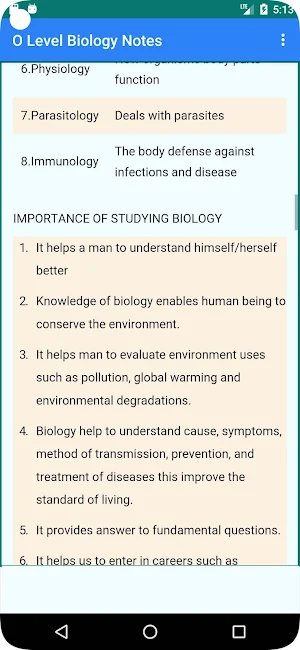

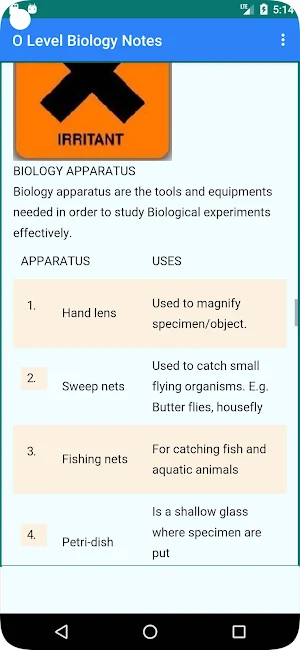


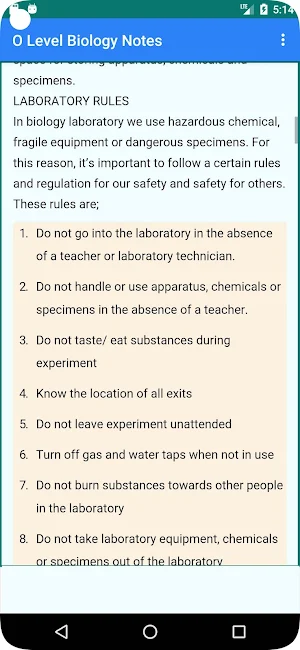

About Biology O Level Notes
Topics included:
Introduction to Biology:
Introduction to Biology provides an overview of the basic principles and concepts of biology. Students are introduced to the scientific method, the nature of science, and the study of living organisms.
Classification of Living Things:
Classification of Living Things deals with the principles and methods used to categorize and organize living organisms into different groups based on their evolutionary relationships and shared characteristics. Students learn about taxonomy, binomial nomenclature, hierarchical classification systems, and the diversity of life on Earth.
Cell Structure and Organization:
This topic focuses on the fundamental unit of life, the cell. Students explore the structure and organization of cells, including cell organelles (nucleus, mitochondria, chloroplasts), cell membrane, cytoplasm, and cell division processes such as mitosis and meiosis.
Safety in Our Environment (Laboratory):
Safety in the laboratory and environment is crucial in biological experiments. Students learn about laboratory safety protocols, including handling chemicals, disposing of waste, using equipment, and preventing accidents or exposure to hazardous substances.
HIV, AIDS, and STDs:
This topic covers the human immunodeficiency virus (HIV), acquired immunodeficiency syndrome (AIDS), and sexually transmitted diseases (STDs). Students learn about the transmission, prevention, and impact of these diseases on individuals and public health.
Organic Evolution:
Organic Evolution explores the process of change in living organisms over time through natural selection and other mechanisms. Students study the evidence of evolution, such as fossils, comparative anatomy, embryology, and molecular biology.
Genetics and Variation -1:
This topic introduces the principles of genetics, including Mendelian genetics, inheritance patterns, and genetic variation within populations.
Growth and Development:
Growth and Development cover the processes by which living organisms grow, mature, and change throughout their life cycles.
Regulation (Homeostasis):
Regulation (Homeostasis) focuses on the mechanisms that maintain a stable internal environment in organisms. Students learn about the nervous and endocrine systems and how they coordinate physiological responses.
Nutrition -1:
This topic delves into the study of how living organisms obtain and utilize nutrients for growth, energy, and metabolic processes.
Gaseous Exchange and Respiration:
Gaseous Exchange and Respiration explore how living organisms obtain oxygen and release carbon dioxide through respiratory processes.
Transport of Materials in Living Things -1:
This topic covers the transport of substances (e.g., water, nutrients, gases) within living organisms, including the circulatory system in animals and the vascular system in plants.
Balance of Nature:
Balance of Nature refers to the delicate ecological equilibrium between living organisms and their environment.
Reproduction -2:
Reproduction -2 continues the study of the processes by which organisms produce offspring, including sexual reproduction and its variations.
Coordination -2:
Coordination -2 further explores the regulation and integration of physiological processes in organisms.
Movement:
Movement involves the study of how living organisms and their components move and interact.
Introduction to Biology:
Introduction to Biology provides an overview of the basic principles and concepts of biology. Students are introduced to the scientific method, the nature of science, and the study of living organisms.
Classification of Living Things:
Classification of Living Things deals with the principles and methods used to categorize and organize living organisms into different groups based on their evolutionary relationships and shared characteristics. Students learn about taxonomy, binomial nomenclature, hierarchical classification systems, and the diversity of life on Earth.
Cell Structure and Organization:
This topic focuses on the fundamental unit of life, the cell. Students explore the structure and organization of cells, including cell organelles (nucleus, mitochondria, chloroplasts), cell membrane, cytoplasm, and cell division processes such as mitosis and meiosis.
Safety in Our Environment (Laboratory):
Safety in the laboratory and environment is crucial in biological experiments. Students learn about laboratory safety protocols, including handling chemicals, disposing of waste, using equipment, and preventing accidents or exposure to hazardous substances.
HIV, AIDS, and STDs:
This topic covers the human immunodeficiency virus (HIV), acquired immunodeficiency syndrome (AIDS), and sexually transmitted diseases (STDs). Students learn about the transmission, prevention, and impact of these diseases on individuals and public health.
Organic Evolution:
Organic Evolution explores the process of change in living organisms over time through natural selection and other mechanisms. Students study the evidence of evolution, such as fossils, comparative anatomy, embryology, and molecular biology.
Genetics and Variation -1:
This topic introduces the principles of genetics, including Mendelian genetics, inheritance patterns, and genetic variation within populations.
Growth and Development:
Growth and Development cover the processes by which living organisms grow, mature, and change throughout their life cycles.
Regulation (Homeostasis):
Regulation (Homeostasis) focuses on the mechanisms that maintain a stable internal environment in organisms. Students learn about the nervous and endocrine systems and how they coordinate physiological responses.
Nutrition -1:
This topic delves into the study of how living organisms obtain and utilize nutrients for growth, energy, and metabolic processes.
Gaseous Exchange and Respiration:
Gaseous Exchange and Respiration explore how living organisms obtain oxygen and release carbon dioxide through respiratory processes.
Transport of Materials in Living Things -1:
This topic covers the transport of substances (e.g., water, nutrients, gases) within living organisms, including the circulatory system in animals and the vascular system in plants.
Balance of Nature:
Balance of Nature refers to the delicate ecological equilibrium between living organisms and their environment.
Reproduction -2:
Reproduction -2 continues the study of the processes by which organisms produce offspring, including sexual reproduction and its variations.
Coordination -2:
Coordination -2 further explores the regulation and integration of physiological processes in organisms.
Movement:
Movement involves the study of how living organisms and their components move and interact.
Alternatives to Biology O Level Notes
Looking for apps like Biology O Level Notes? Here are 6 similar Android apps on Google Play. All of them are free to download.
-
Form 2 notes, All subjects
-
Form Three notes, all Subjects
-
Form Five notes, All subjects
-
Form 1 notes : all subjects
-
Advanced Level Geography Notes
-
Mathematics O Level Notes
| App | Rating | Price | Installs | Last updated |
|---|---|---|---|---|
| Biology O Level Notes | – | Free | 10,000+ | May 12, 2026 |
| Form 2 notes, All subjects | – | Free | 10+ | – |
| Form Three notes, all Subjects | – | Free | 50+ | – |
| Form Five notes, All subjects | – | Free | 10+ | – |
| Form 1 notes : all subjects | – | Free | 50,000+ | May 11, 2026 |
| Advanced Level Geography Notes | – | Free | 100+ | – |
| Mathematics O Level Notes | – | Free | 100+ | – |
Similar apps on Google Play
- Form 2 notes, All subjects
- Form Three notes, all Subjects
- Form Five notes, All subjects
- Form 1 notes : all subjects
- Advanced Level Geography Notes
- Mathematics O Level Notes
- O Level Physics Notes
- Advanced Level Mathematics
- O Level Geography Notes
- Chemistry O Level Notes
- Secondary School Notes
- Advanced Level Chemistry
- Biology O Level Notes
- Advanced Level Biology
- Advanced Physics (A Level)
- History form 4 Notes
- Mathematics form 1 to 4 notes
- Physics Form 2 Notes
- Physics Form 1-4 Notes
- Physics Notes form 3
- History Form 3 Notes
- History Form 2 Notes
- History form 1-4 notes
- CRE form one to four Notes
- Geography form 2 notes
- Geography Form 1 notes
- Chemistry form 4 notes
- Biology Form 1-4 notes
- Biology form 2 notes
- Biology Form 3 notes
- Agriculture Form 1 to 4 notes
- Form Six Notes : all subjects
- Form 4 Notes (All subjects)
- Update apps all list