About Qibla Locator AR 3D
Find the Qibla with clear, private guidance designed for everyday use.
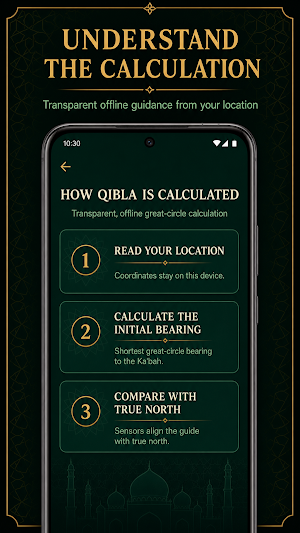
Qibla Locator AR 3D combines a precise flat compass with an optional camera guide. Your direction is calculated on-device from your current coordinates to the Ka'bah using an initial great-circle bearing. No account or cloud service is required.
FLAT QIBLA COMPASS
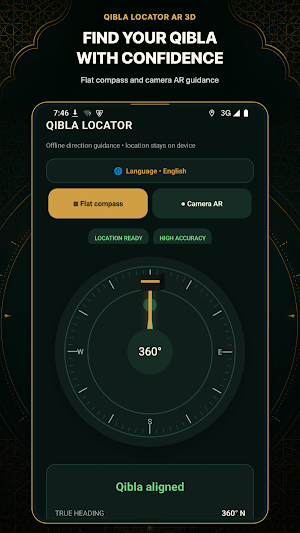
• See your true heading and Qibla bearing together.
• Follow a clear gold direction marker toward the Ka'bah.
• View the approximate great-circle distance from your location.
• Read location and sensor quality at a glance.
• Switch between ten complete interface languages inside the app.
TILT-AWARE CAMERA GUIDANCE
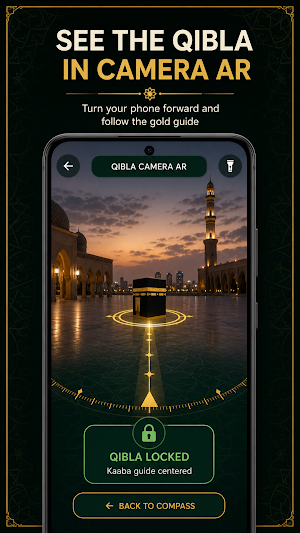
• Use the rear-camera preview as a visual orientation aid.
• Follow a simple turn arrow until the Qibla direction is centered.
• See a compact 3D Ka'bah illustration only when the camera faces forward and the Qibla is within view.
• The model stays centered and occupies no more than about 20% of the camera width, leaving the surrounding scene visible.
• If the phone points too far up or down, the 3D model disappears and an upright-camera hint appears.
• Camera frames are displayed live and are never saved by the app.
ACCURACY AND PRIVACY
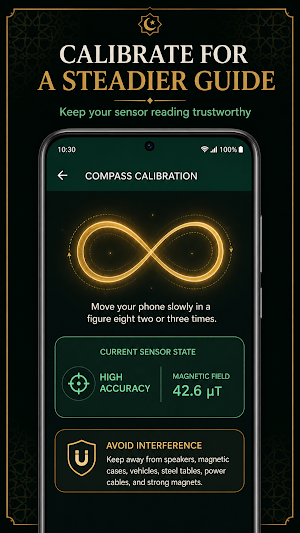
Qibla Locator AR 3D can use the rotation-vector, accelerometer, and magnetic-field sensors available on your device. Local magnetic declination is applied when a location is available so guidance can use true north. A built-in calibration guide helps you reduce common compass interference.
Location coordinates remain on your device and are used only for the Qibla calculation. The camera is optional and is not used to capture photos or videos.
SUPPORTED LANGUAGES
English, Indonesian, Arabic, Urdu, Bengali, Persian, Turkish, Hindi, Hausa, and French. Arabic, Urdu, and Persian use right-to-left layout automatically.
Device sensors can be affected by magnetic cases, speakers, vehicles, steel surfaces, power cables, and nearby electronics. Accuracy also depends on sensor quality and location availability. Keep the phone away from interference, calibrate when needed, and compare with a trusted local reference if conditions are uncertain.
