Kolí – Psalms
Find Tehillim for what you are living through, and why each chapter appears.
About Kolí – Psalms
When you do not know what to say, Kolí helps you find a place to begin.
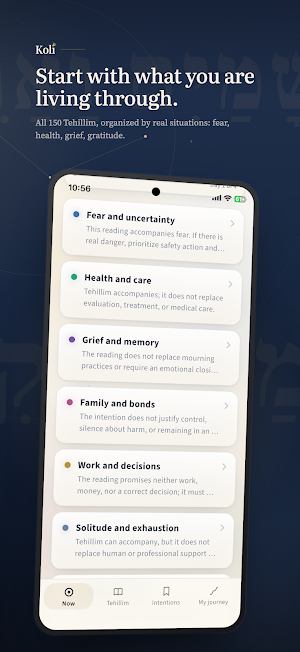
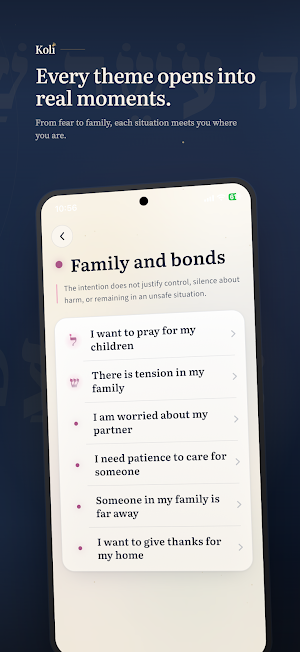
Kolí is an intelligent Tehillim app that organizes all 150 chapters around real situations: fear, waiting, health, grief, family, work, decisions, gratitude, travel, exhaustion, and more.
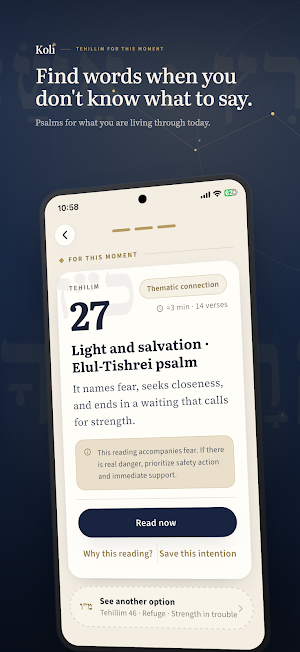
It does not choose at random or generate new interpretations. Every recommendation explains why it appears, how it relates to the moment, and whether it is a thematic connection, a Kolí editorial selection, a documented use, or part of a traditional cycle.
WITH KOLÍ YOU CAN
• Read all 150 chapters of Tehillim.
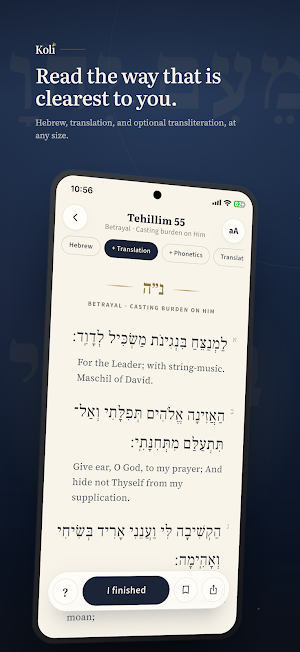
• View Hebrew with English or Spanish translation.
• Search any chapter by its number.
• Receive one primary recommendation and up to two alternatives.
• Read for yourself or for someone else.
• Save private intentions.
• Follow 3-, 7-, 14-, or 30-day programs.
• Complete all 150 on your own, or split them within a private group.
• Read one chapter together, live.
• Continue from your last verse.
• Use large text, dark mode, and high contrast.
• Read offline.
TEHILLIM, NOT PROMISES
Kolí does not predict outcomes or present Psalms as a formula. Readings may accompany you, but they do not replace medical care, professional support, safety measures, rabbinic guidance, or practical action when needed.
PRIVACY
You can read without creating an account. Names, notes, and intentions remain private on your device. Sacred texts remain available free of charge.
ALWAYS FREE
All 150 chapters of Tehillim, with their Hebrew and their translation, and search by number. Grief and memory, and health and care, are always open: we do not charge for grief or for illness. Reading a chapter together, live, is free as well.
KOLÍ PLUS
Plus adds search by theme, the remaining situations, intentions, programs, splitting the 150 within a group, your path, and the journal. It never locks the 150 chapters of Tehillim.
No audio. No social network. No punitive streaks. Just Tehillim, context, and a clear place to begin.
