Iridology Analysis Toolkit Pro
Research tool for capturing, analyzing the pupil, collarette and iris patterns
About Iridology Analysis Toolkit Pro
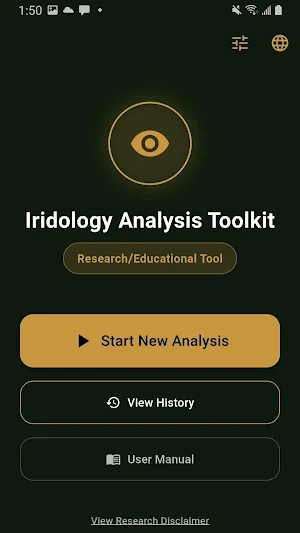
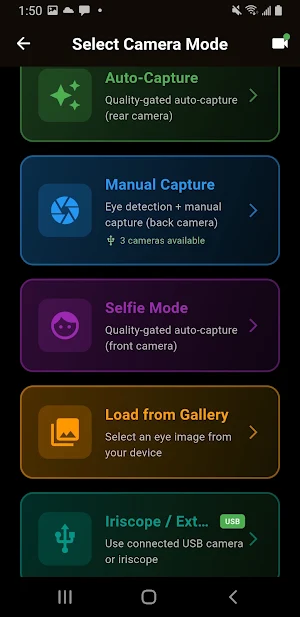
Iridology Analysis Toolkit is a research and educational tool for capturing, analyzing, and documenting iris patterns using classical mapping techniques and AI-assisted zone detection.
Core Algorithm Components:
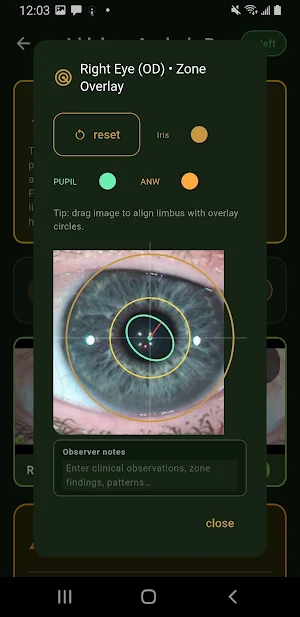
Iris Detection
Uses grayscale image processing to locate the iris boundary
Employs a circle-scoring algorithm that searches for the strongest edge gradient
Two-pass detection: coarse search followed by fine refinement
Returns center coordinates, radius, and confidence score
Pupil Detection
Searches within the inner portion of the detected iris
Uses adaptive thresholding based on the darkest 30% of pixels
Fits an ellipse to the dark region using covariance matrix eigenvalue decomposition
Extracts boundary points by ray-casting from center outward
Returns center, major/minor axes, orientation angle, and boundary points
Pupil Boundary Analysis
Analyzes 72 boundary points (every 5 degrees) around the pupil edge
Calculates deviation from the average radius at each clock position
Groups deviations by clock hour (12 zones)
Identifies flattenings (inward deviations) and protrusions (outward deviations)
ANW (Autonomic Nerve Wreath) Detection
Searches for gradient changes between pupil edge and mid-iris
Identifies the collarette boundary
Calculates ANW ratio relative to iris diameter
Algorithm updates include:
SHIFTS (Drawing Out)
Which zone the collarette bulges toward
CONSTRICTIONS (Drawing In) Frontal zone constricted S: Middle-temporal shift. ← Drawing OUT (protrusion), S: Frontal and basal zones are constricted. ← Drawing IN (narrowing)
Basal zone constricted
Combined “Frontal and basal” pattern
Both in Same Eye
Correctly reports both when present
ANW Form Type – Regular, Drawn In, Drawn Out
ANW Asymmetry – Per-sector variance detection
Zone Constrictions – “Frontal zone constricted” style reporting
Pattern Correlation – Compare pupil and ANW findings by sector
Zone-Specific Organ Associations
Each of the 8 pupil zones has specific organ associations for:
Flattenings – Indicating hypofunction/weakness
Protrusions – Indicating hyperfunction/irritation
Main Application Features
Analysis Screen
Real-time eye validation before analysis
Progress indicator during processing
Displays all measurements with color-coded status
Shows organ associations for detected anomalies
Full descriptions for Pupil Form and Decentration Patterns
Reports Generated
On-Screen Results – Interactive cards with expandable details
TXT Report – Plain text with results section
JSON Report – Structured data for integration/archival
PDF Report – Professional formatted document with images
Additional Features
Now available in 15 languages
Age-based pupil size assessment
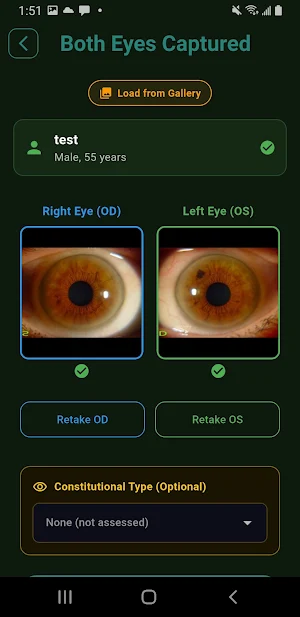
Bilateral comparison between eyes
Scan history with local database storage
Similar Apps

Trisharan
Trisharan Bangla Buddhist Book App

iroiro Japan
Learn Japanese with daily news, kanji breakdowns, stroke order & flashcards.
登録日本語教員Pass|日本語教員試験対策
Learn the 8 areas of the basic and applied (reading comprehension) exams with 720 questions. Review with 160 practice questions and detailed explanations.

Easy Peasy Classes
Right place learn with fun. All your exams preparation is our responsibility.

WWGS Maintenance
It is an app by Gurukul Growth Education Foundation, Maharashtra.

Mechanical Dictionary Offline
Mechanical Dictionary Offline 5700 terms in 5 languages, simple & offline
